
What Is a Cycloid?
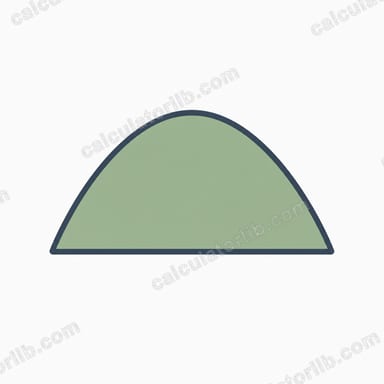
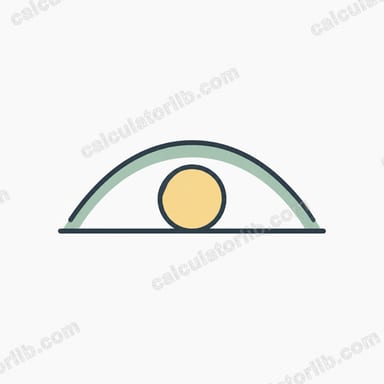
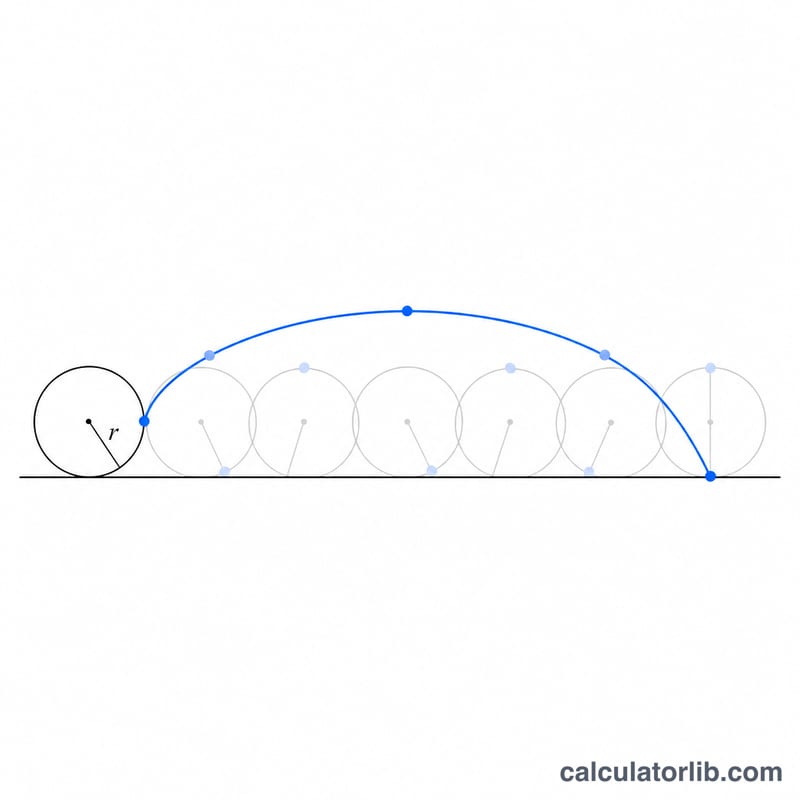
A cycloid is the curve traced by a fixed point on the rim of a circle of radius r as the circle rolls without slipping along a straight line. It produces a series of identical arches, each one full rotation of the wheel. The cycloid has elegant, exact closed-form results: the arc length of one arch is exactly eight times the radius, and the area beneath one arch is exactly three times the area of the rolling circle.
How to Use This Calculator
Enter the rolling circle radius r. The calculator returns the arc length of one arch, the area under one arch, the base width (one full revolution), and the arch height. Optionally enter a parameter value t (in radians) to find the exact coordinates of the tracing point at that moment via the parametric equations.
The Formulas Explained
The parametric equations are \(x = r(t - \sin t)\) and \(y = r(1 - \cos t)\). Integrating the speed over \(t\) from \(0\) to \(2\pi\) gives the arc length \(L = 8r\). The base width of one arch is the circumference \(2\pi r\), and the maximum height is the diameter \(2r\). The area under one arch, found by integration, is \(A = 3\pi r^{2}\).
$$x = r\,(t - \sin t), \quad y = r\,(1 - \cos t)$$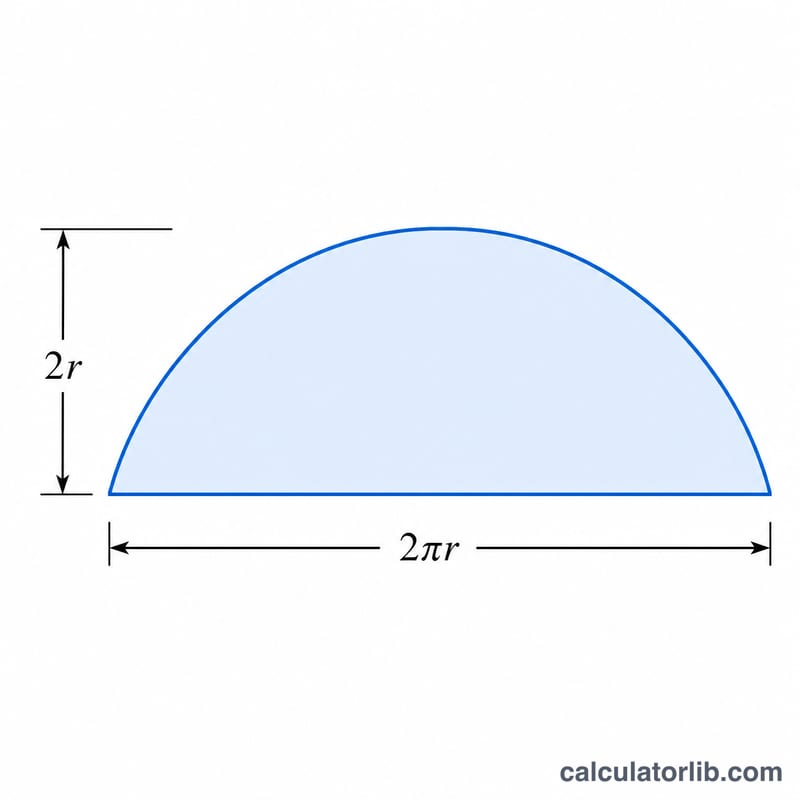
Worked Example
For \(r = 2\): arc length \(L = 8 \times 2 = 16\). Area \(A = 3\pi \times 2^{2} = 12\pi \approx 37.699\). Base width \(= 2\pi \times 2 \approx 12.566\) and arch height \(= 4\). At \(t = \pi\), the point is at the top: \(x = 2(\pi - \sin \pi) = 2\pi \approx 6.283\), \(y = 2(1 - \cos \pi) = 4\).
FAQ
Why is the arc length exactly 8r? Because the integral of the speed \(\sqrt{2r^{2}(1-\cos t)}\) over one period simplifies neatly to \(8r\) — a famously clean result.
Is the area really three times the circle's area? Yes — \(A = 3\pi r^{2}\) is exactly three times \(\pi r^{2}\), a result first proven by Galileo's contemporaries.
What units does it use? The calculator is unit-agnostic; outputs are in the same length unit as \(r\) (areas in that unit squared).