
What is a parabolic segment?
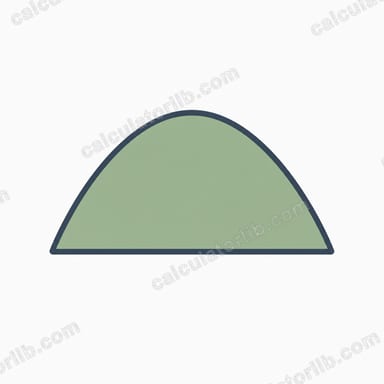
A parabolic segment, also called a parabolic arch, is the flat region bounded by a parabola and a straight chord that cuts across it. Picture a parabola opening downward with its vertex at the top; the chord is the line connecting the two points where the parabola meets it. The shape is symmetric about the axis running through the vertex. It appears constantly in engineering and design — arch bridges, suspension-cable profiles, reflector dishes, and architectural arches all follow parabolic curves.
How to use this calculator
Enter just two measurements in any consistent length unit (millimetres, centimetres, metres, inches or feet — just keep them the same):
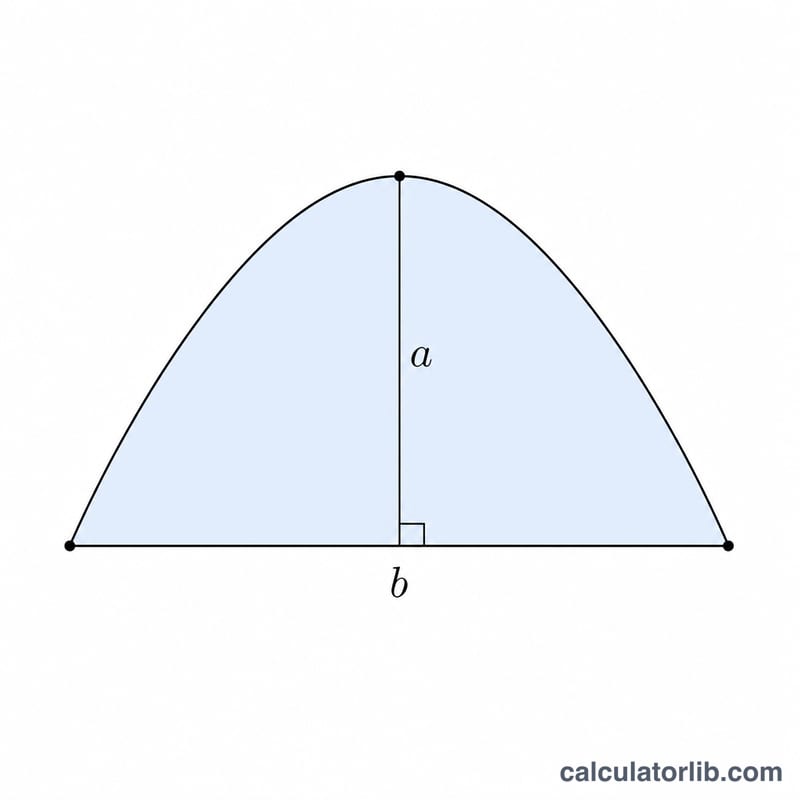
Height a — the perpendicular distance from the chord to the vertex (apex) of the parabola.
Chord length b — the straight-line distance between the two endpoints on the chord.
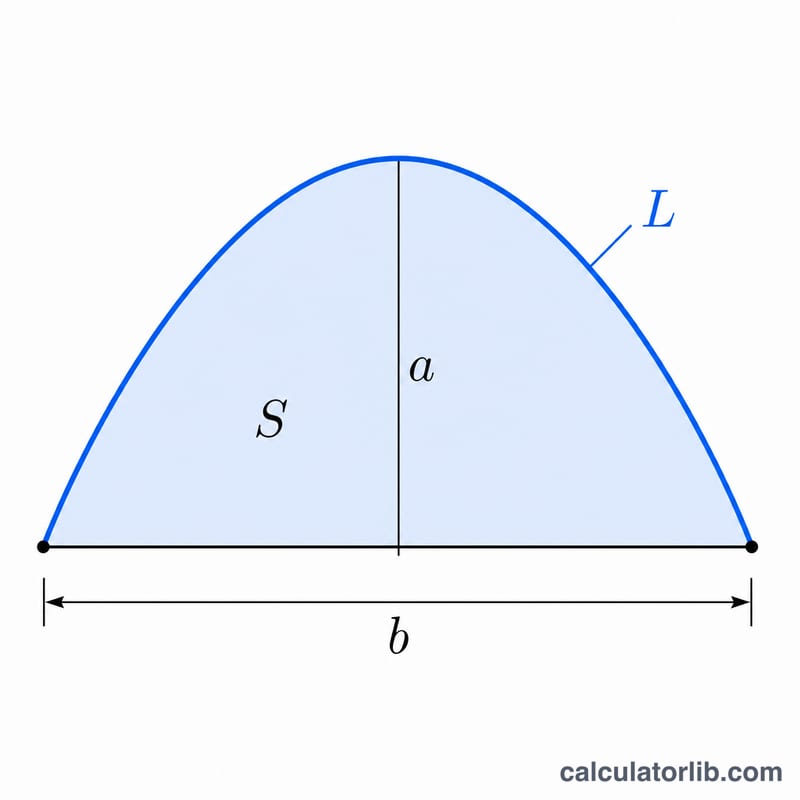
The calculator returns the enclosed area S (in your length unit squared), the arc length L of the curved boundary only, and the full perimeter L + b (curve plus chord).
The formulas explained
The area follows from Archimedes' classic result that a parabolic segment fills exactly two-thirds of its bounding rectangle: $$S = \frac{2}{3}\cdot a\cdot b$$ The arc length is obtained by integrating the parabola's curve. Define the helper value \(s = \sqrt{b^{2} + 16a^{2}}\); then $$L = \frac{1}{2}\cdot s + \frac{b^{2}}{8a}\cdot\ln\!\left(\frac{4a + s}{b}\right)$$ where \(\ln\) is the natural logarithm. The \(4a\) term reflects that the parabola's slope at each endpoint is \(\frac{4a}{b}\).
Worked example
Take \(a = 2\) and \(b = 1\). Area: $$S = \frac{2}{3}\cdot 2\cdot 1 = 1.33333$$ For the arc length, \(s = \sqrt{1 + 16\cdot 4} = \sqrt{65} = 8.06226\). Then \(\frac{1}{2}\cdot s = 4.03113\), \(\frac{b^{2}}{8a} = \frac{1}{16} = 0.0625\), and \(\frac{4a + s}{b} = 16.06226\) with \(\ln = 2.77636\), giving a second term of \(0.17352\). So $$L = 4.03113 + 0.17352 = 4.20465$$
FAQ
Does L include the straight chord? No — L is the length of the curved parabola only. The full perimeter of the segment is L + b, which is also shown.
What if the height is zero? The segment degenerates into a flat line: the area is 0 and the arc length collapses to the chord length b.
What units should I use? Any single length unit. Area comes out in that unit squared and lengths in that unit, so the formulas apply directly to the entered numbers.