
What this calculator does
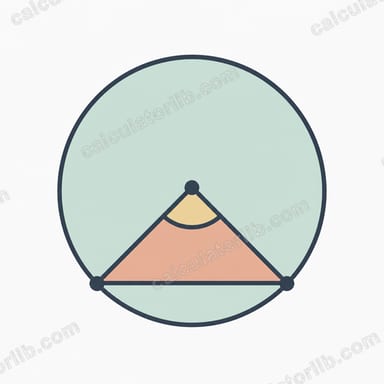
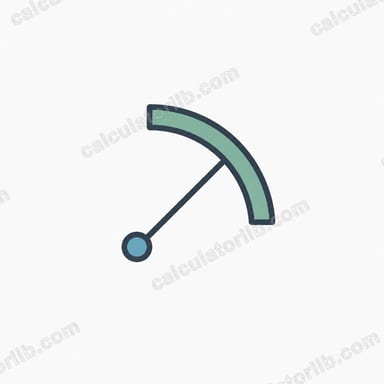
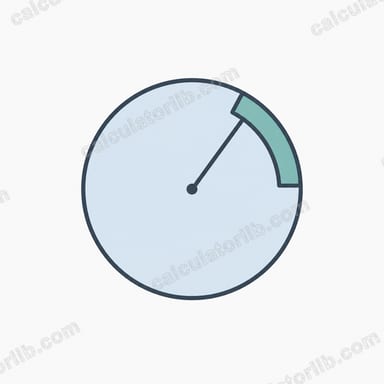
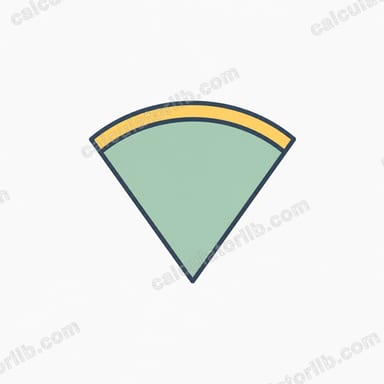
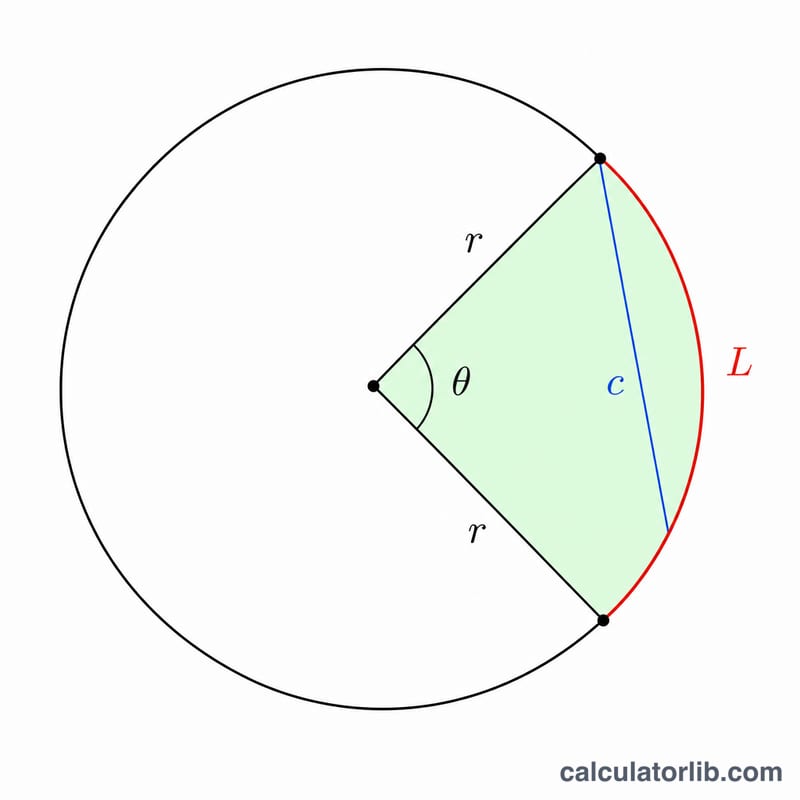
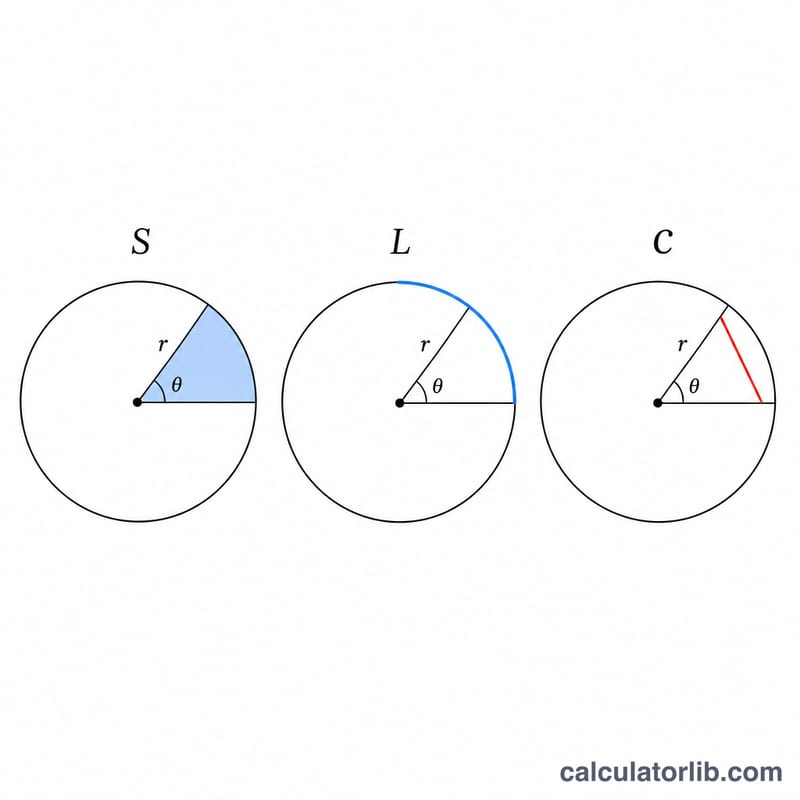
This tool computes three key measurements of a circular sector — the pie-slice region bounded by two radii and the arc between them. Given the radius r and the central angle θ, it returns the sector area S, the arc length L (the curved edge), and the chord length c (the straight line joining the two arc endpoints). It is pure geometry and works the same everywhere, with any consistent length unit.
How to use it
Enter the radius and the central angle, then choose whether the angle is in degrees or radians. The radius is unit-agnostic: if you enter centimetres, the area comes back in square centimetres and the lengths in centimetres. For a normal sector keep the angle between 0 and 360 degrees (0 to 2π radians).
The formulas explained
All three formulas use the angle in radians, so degrees are first converted with \(\theta_{\text{rad}} = \theta \times \frac{\pi}{180}\). Then the area is $$S = \frac{r^{2}\theta}{2},$$ the arc length is $$L = r\theta,$$ and the chord is $$c = 2r\cdot\sin\!\frac{\theta}{2}.$$ The area and arc grow linearly with the angle, while the chord follows the sine of the half-angle.
Worked example
Take \(r = 1\) and \(\theta = 120\) degrees. Converting, \(\theta_{\text{rad}} = \frac{2\pi}{3} \approx 2.094395\). Then $$S = \frac{1^{2} \times 2.094395}{2} = 1.047198,$$ $$L = 1 \times 2.094395 = 2.094395,$$ and $$c = 2 \times 1 \times \sin(1.047198) = 2 \times 0.866025 = 1.732051$$ (which is \(\sqrt{3}\)).
FAQ
What unit does the area use? Whatever length unit you used for the radius, squared. The tool does no unit conversion.
What happens at a full circle (360°)? The area becomes \(\pi r^{2}\), the arc becomes the full circumference \(2\pi r\), and the chord becomes 0 because the endpoints meet.
Can I enter radians directly? Yes — switch the angle unit to Radians and the value is used as-is without the degree conversion.