
What Is the Chord Length Calculator?
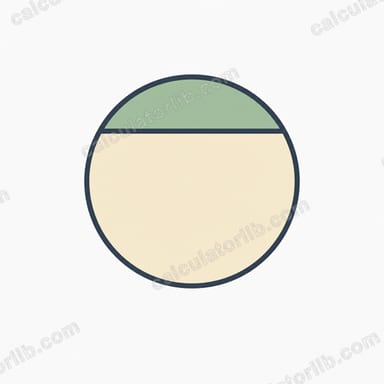
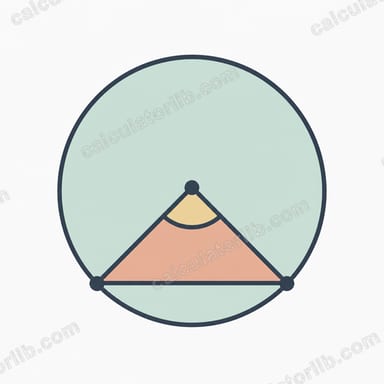
A chord is a straight line segment whose endpoints both lie on a circle. This calculator finds the length of any chord when you know the circle's radius and the central angle that the chord subtends at the center. It is useful in geometry, engineering, architecture, surveying, and any field involving circular arcs.
How to Use It
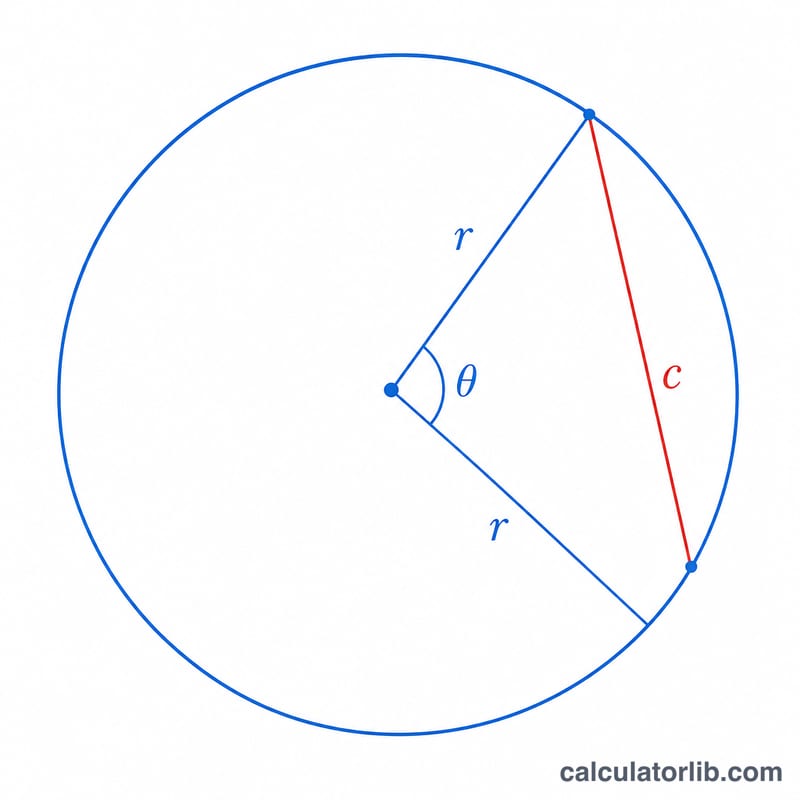
Enter the radius (r) of the circle and the central angle (θ) in degrees — the angle measured at the center of the circle between the two radii drawn to the chord's endpoints. The calculator returns the chord length in the same units as the radius.
The Formula Explained
The chord length is given by:
$$c = 2 \cdot \text{Radius} \cdot \sin\!\left(\frac{\text{Angle} \times \pi / 180}{2}\right)$$
Here \(r\) is the radius and \(\theta\) is the central angle. The angle is halved and converted to radians before taking the sine. Geometrically, the radius, half the chord, and the bisector of the angle form a right triangle, where half the chord equals \(r\cdot\sin(\theta/2)\) — doubling gives the full chord.
Worked Example
Suppose a circle has a radius of 10 and a chord subtends a central angle of 60°. Then \(\theta/2 = 30°\), and \(\sin(30°) = 0.5\). So $$c = 2 \times 10 \times 0.5 = 10$$ units. A 60° chord on a circle of radius 10 is exactly 10 units long.
FAQ
What units does the result use? The chord length is in the same units as the radius you entered (cm, m, inches, etc.).
What if the angle is 180°? A 180° central angle produces a chord that passes through the center — the diameter — so \(c = 2r\).
Can the angle be greater than 180°? Yes, but for angles above 180° the chord length begins to decrease again, reaching 0 at 360°. The same two endpoints are described by both a minor and major arc.