
What is the partial products method?
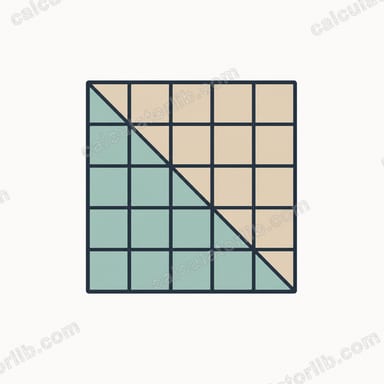
The partial products method is a strategy for multiplying multi-digit numbers by breaking each factor into its place-value parts, multiplying each part separately, and then adding all the results. It is widely taught in elementary math because it makes the underlying place value visible — students see exactly where each digit of the answer comes from instead of memorizing a procedure.
How to use this calculator
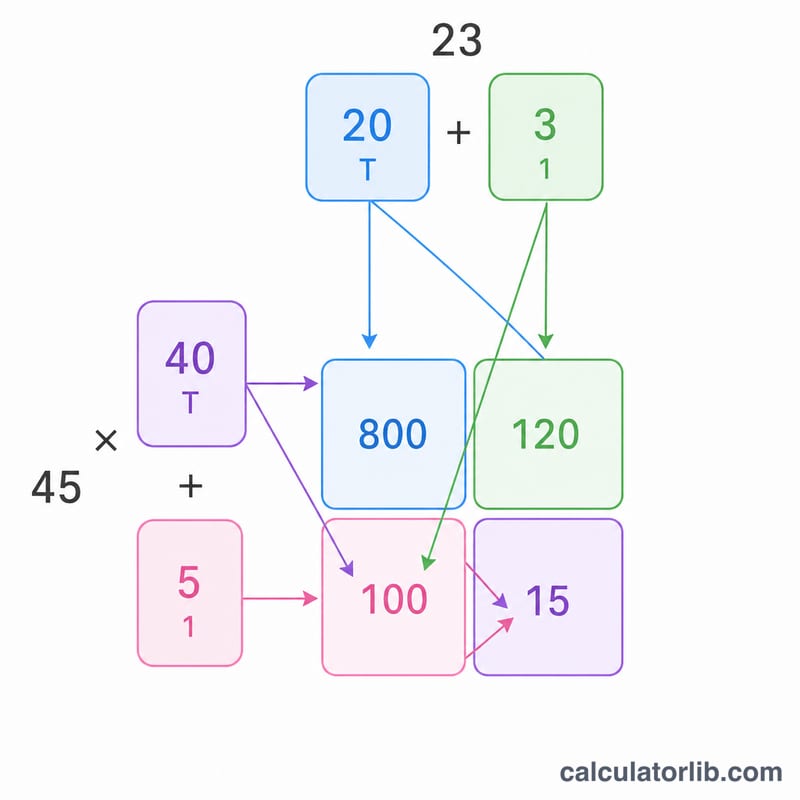
Enter your two whole numbers in the fields and submit. The calculator decomposes each number into place values (for example 45 becomes 40 + 5), multiplies every part of the first number by every part of the second, lists all the partial products, and then sums them to give the final product.
The formula explained
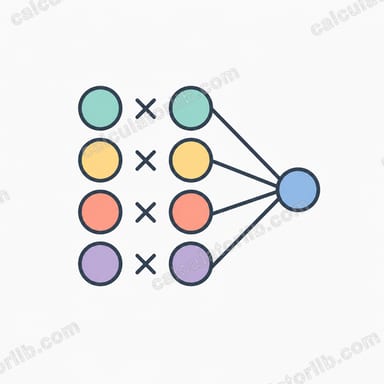
If \(a = a_1 + a_2 + \ldots\) (its place-value pieces) and \(b = b_1 + b_2 + \ldots\), then by the distributive property $$a \times b = \sum_{i}\sum_{j} a_i \times b_j.$$ Each term \(a_i \times b_j\) is a "partial product." Adding them all back together always reconstructs the full product.
Worked example
Multiply \(23 \times 45\). Decompose: \(23 = 20 + 3\) and \(45 = 40 + 5\). The four partial products are: $$20 \times 40 = 800, \quad 20 \times 5 = 100, \quad 3 \times 40 = 120, \quad 3 \times 5 = 15.$$ Add them: $$800 + 100 + 120 + 15 = 1{,}035.$$ So \(23 \times 45 = 1{,}035\).
FAQ
How many partial products will there be? Roughly the number of nonzero digits in the first number times the number of nonzero digits in the second number.
Does it work with larger numbers? Yes — the method scales to any number of digits; there are simply more partial products to add.
Is this the same as the standard algorithm? It produces the same answer. The standard column algorithm is just a compressed version of partial products that combines steps.