
What Is a Sum of Products?
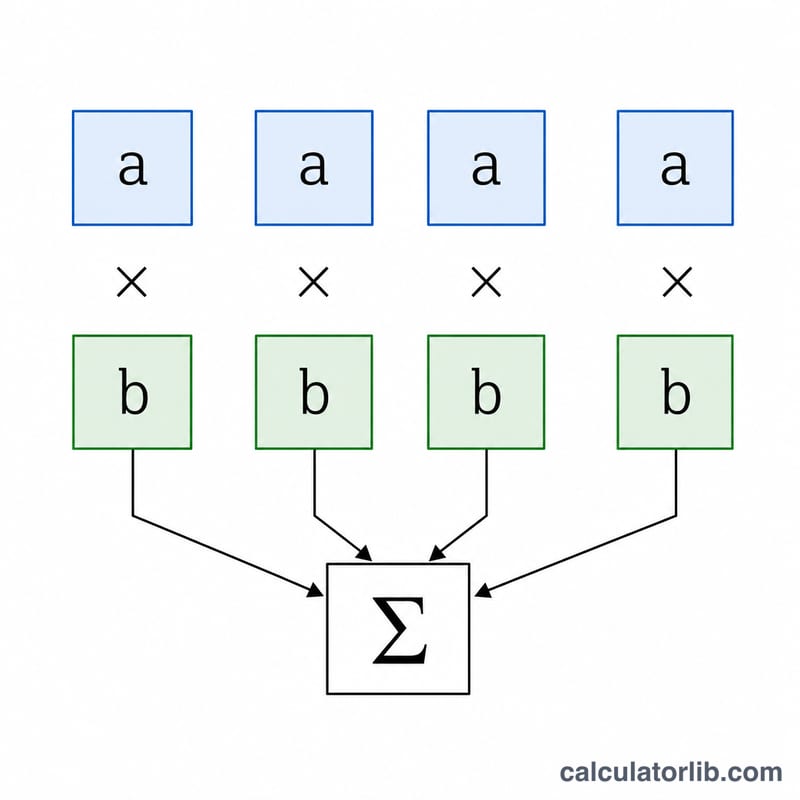
The sum of products is the total you get when you multiply each element of one list by the matching element of a second list and then add all those products together. Written compactly, it is \(S = \sum (a_i \times b_i)\). This operation is identical to the dot product of two vectors and appears everywhere from statistics and physics to finance and machine learning.
How to Use This Calculator
Enter your first list of numbers in List A and the matching list in List B, separating values with commas. The calculator pairs them position by position — the first of A with the first of B, the second with the second, and so on — multiplies each pair, and sums the results. If one list is longer, the extra trailing values are ignored so only complete pairs count.
The Formula Explained
For lists \(a = (a_1, a_2, \ldots, a_n)\) and \(b = (b_1, b_2, \ldots, b_n)\), the sum of products is:
$$S = a_1 \cdot b_1 + a_2 \cdot b_2 + \ldots + a_n \cdot b_n$$Each term contributes its product, and the running total is the final answer. There are no division steps, so the result is defined for any numeric input.
Worked Example
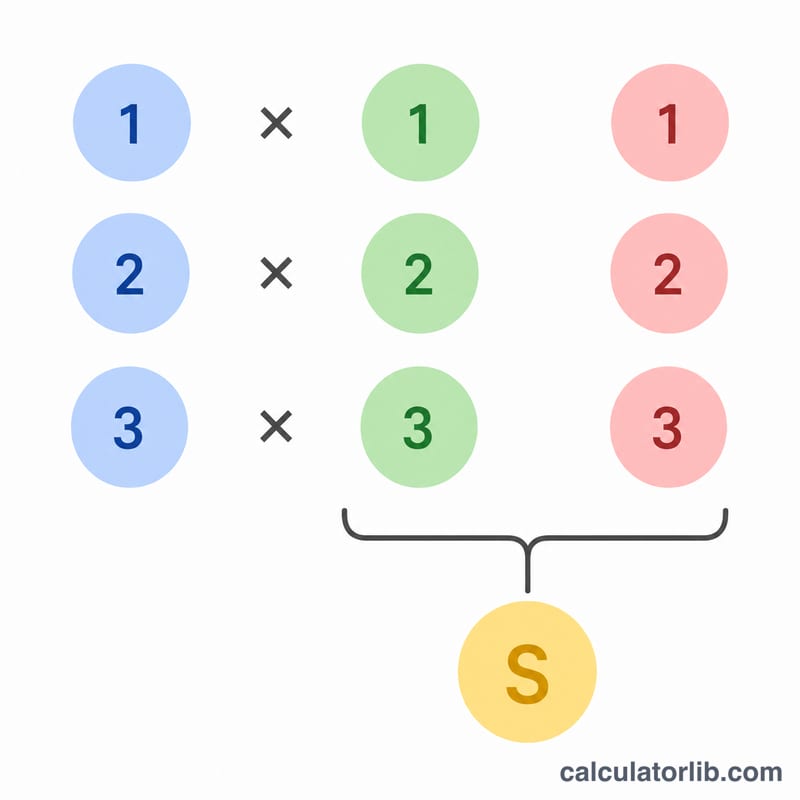
Suppose List A = 1, 2, 3 and List B = 4, 5, 6. Compute each product: \(1 \times 4 = 4\), \(2 \times 5 = 10\), \(3 \times 6 = 18\). Add them:
$$4 + 10 + 18 = 32$$So the sum of products is 32, using 3 pairs.
FAQ
Is this the same as a dot product? Yes — for two vectors of equal length, the sum of products is exactly the dot product.
What if my lists are different lengths? Only matching pairs are used; extra values at the end of the longer list are ignored.
Can I use decimals or negative numbers? Absolutely. The calculator handles decimals and negatives, so products and the final sum may be negative or fractional.