
What Is a Triangular Number?
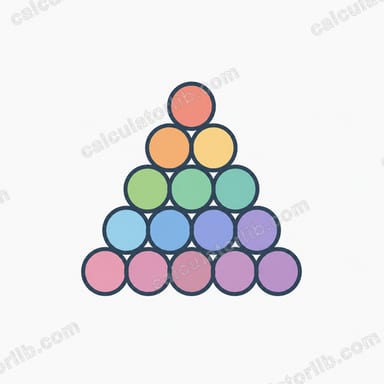
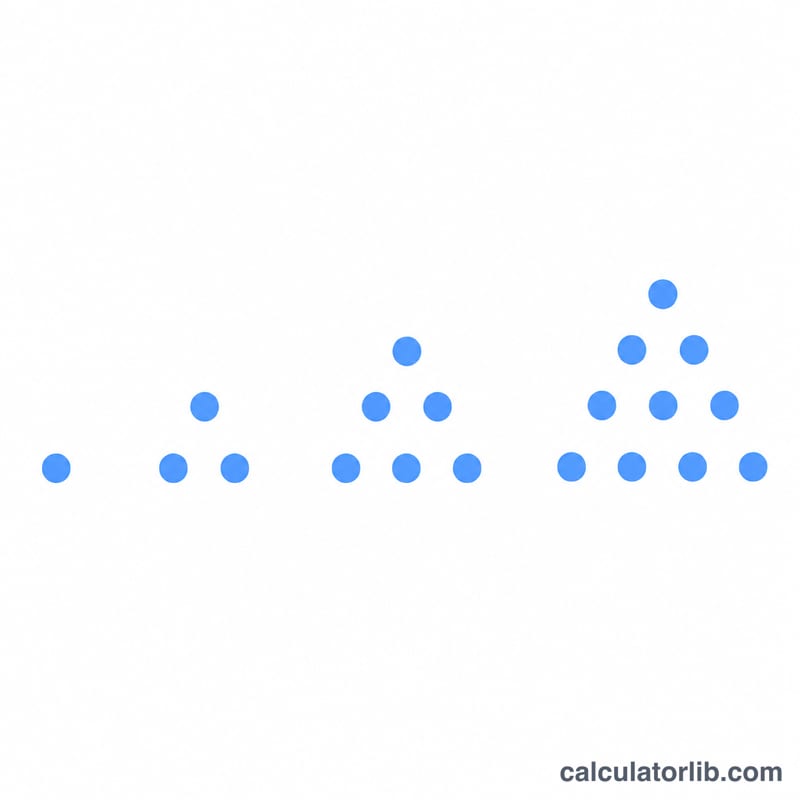
A triangular number counts the objects that can be arranged in an equilateral triangle. The nth triangular number, written \(T(n)\), is the sum of all positive integers from 1 up to \(n\). The sequence begins 1, 3, 6, 10, 15, 21, 28 — each term adds the next whole number. This calculator returns \(T(n)\) for any non-negative whole number you enter.
How to Use the Calculator
Type the term number \(n\) (for example 10) into the input box and submit. The calculator instantly returns the triangular number, which is also the total you would get by adding every integer from 1 to \(n\). Enter 0 and you get 0, since there is nothing to sum.
The Formula Explained
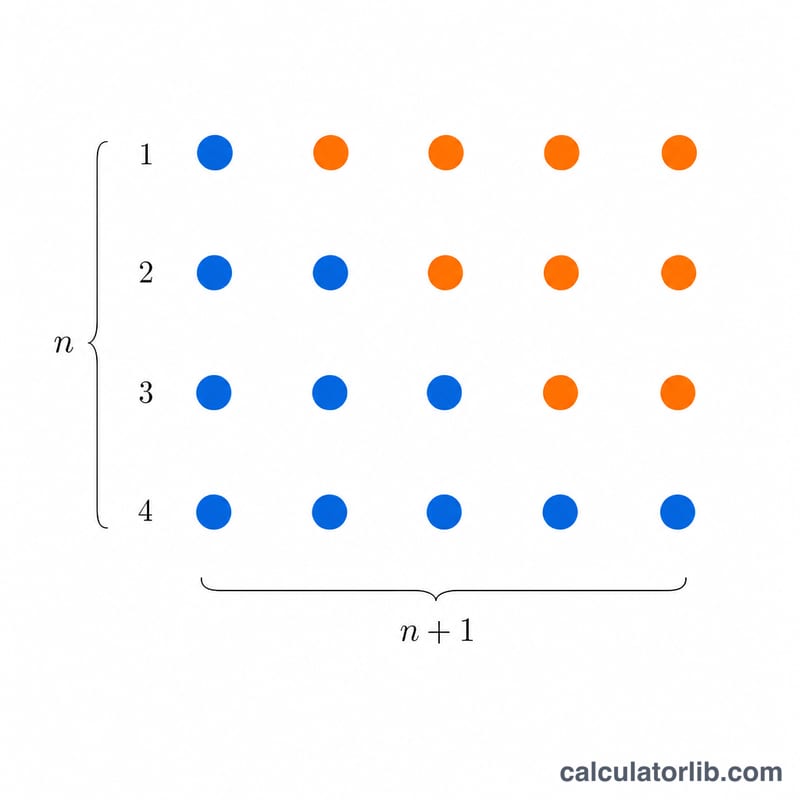
The closed-form formula is $$T(n) = \frac{n(n+1)}{2}.$$ Instead of adding numbers one by one, you multiply \(n\) by the next integer \((n+1)\) and halve the result. This works because pairing the first and last terms, the second and second-to-last, and so on, always gives the same sum of \((n+1)\), and there are \(n/2\) such pairs. The story that Carl Friedrich Gauss discovered this as a schoolboy by summing 1 to 100 to get 5050 is famous — and you can verify it: $$\frac{100 \times 101}{2} = 5050.$$
Worked Example
Suppose \(n = 10\). Then $$T(10) = \frac{10 \times (10 + 1)}{2} = \frac{10 \times 11}{2} = \frac{110}{2} = 55.$$ So the sum \(1 + 2 + 3 + \cdots + 10\) equals 55, and 55 dots can be stacked into a neat triangle with 10 dots on the bottom row.
FAQ
What is the 100th triangular number? \(T(100) = \frac{100 \times 101}{2} = 5050\).
Can n be a decimal? Triangular numbers are defined for non-negative whole numbers, so the calculator uses the integer part of your input.
Is T(n) always a whole number? Yes. Either \(n\) or \(n+1\) is even, so \(n(n+1)\) is always divisible by 2.