
What is the False Position method?
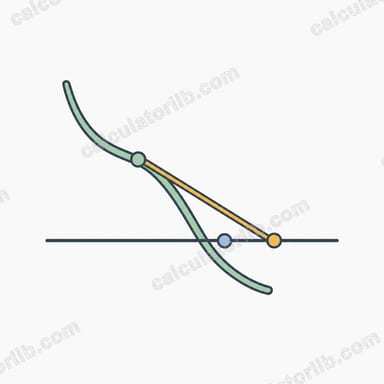
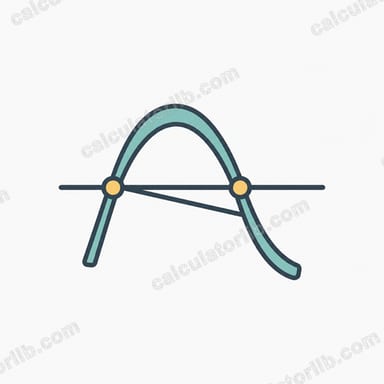
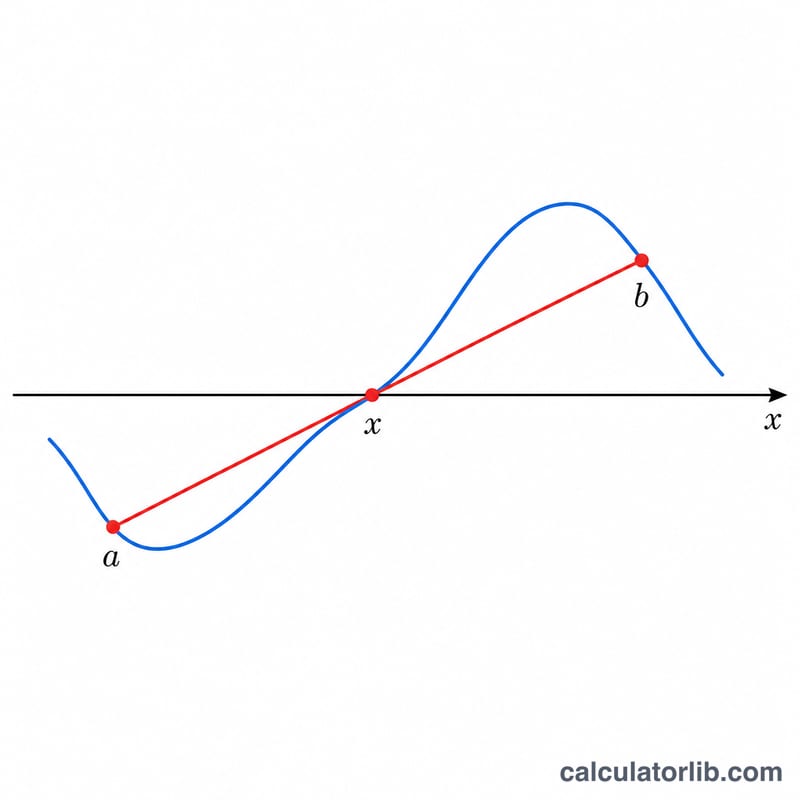
The False Position method (Latin regula falsi, also called the "scissor method") is a bracketing root-finding technique for solving f(x) = 0. Like bisection, it needs a starting interval [a, b] on which the function changes sign, so that f(a)·f(b) ≤ 0 guarantees a root lies between a and b. Instead of always halving the interval, it draws a straight line between the two endpoints and takes the line's x-intercept as the next estimate, which usually converges faster than bisection.
How to use this calculator
Enter your function as f(x) using standard notation: + - * / ^, parentheses, and functions such as sin, cos, tan, exp, log, ln, sqrt, abs, cbrt. Set the lower endpoint a and upper endpoint b so that f(a) and f(b) have opposite signs. Pick the maximum number of iterations and the number of significant digits to display. The result shows the approximate root x, how many iterations were performed, and the residual f(x), which should be very close to zero.
The formula explained
At each step the next estimate is the x-intercept of the secant line through the bracket endpoints:
$$x_n = \frac{a_n \cdot f(b_n) - b_n \cdot f(a_n)}{f(b_n) - f(a_n)}$$.
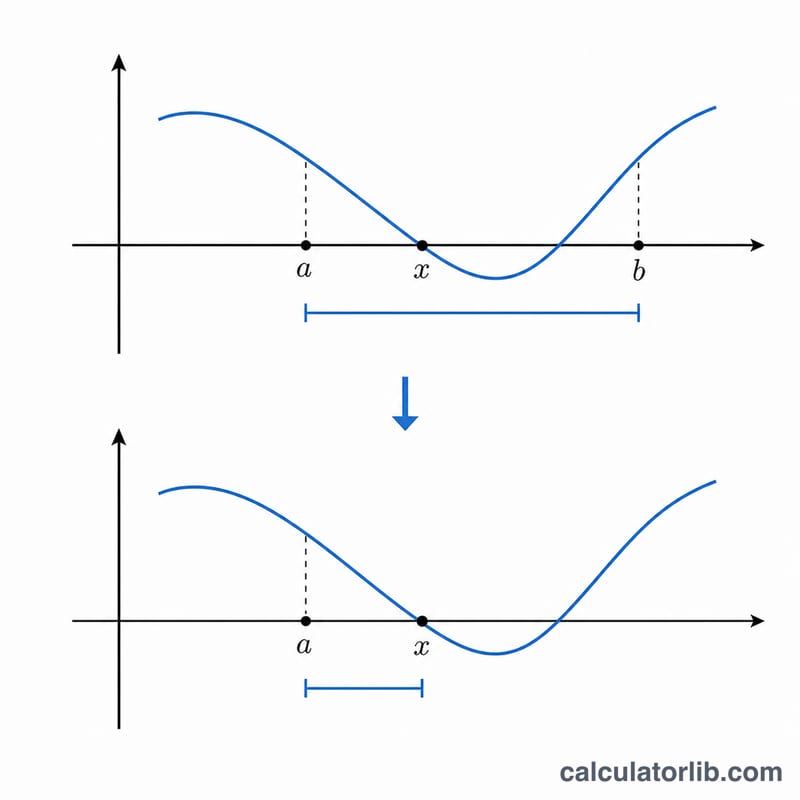
If \(f(x_n)\) has the same sign as \(f(a_n)\), then a is replaced by \(x_n\); otherwise b is replaced. This keeps the sign change — and therefore the bracketed root — intact. Iteration stops when \(|f(x_n)|\) falls below the tolerance (about 1e-12) or the iteration limit is reached.
Worked example
For \(f(x) = x - \cos(x)\) on [-10, 10]: \(f(-10) \approx -10.839\) (negative) and \(f(10) \approx 10.839\) (positive), so the interval brackets a root. The method converges to \(x \approx 0.7390851332\), where \(f(x) \approx 0\). This value is the well-known fixed point of cosine.
FAQ
Why must f(a)·f(b) be ≤ 0? A sign change ensures a continuous function crosses zero inside the interval. Without it, the method may not have a root to find and the tool reports a warning.
Why can convergence be slow? For functions with strong curvature, one endpoint can stay fixed, leading to slow linear convergence. That is normal regula-falsi behaviour and is why the iteration count is capped.
What if the denominator is zero? If f(b) equals f(a), the secant line is horizontal and has no unique intercept; the calculator reports an error rather than dividing by zero.