
What this calculator does
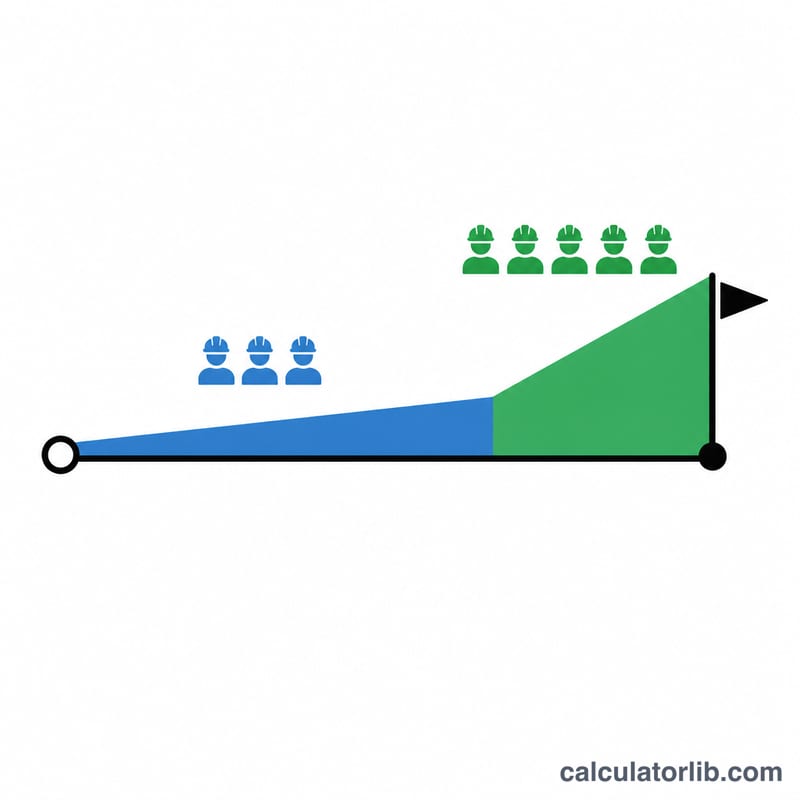
This tool solves the classic "work-rate" arithmetic word problem (known in Japanese school math as "shigotozan"): given that a known number of workers completed a known amount of work in a known number of days, how many workers do you need to finish a target amount of work within a target deadline? It assumes every worker has the same constant output and that total work equals workers times rate times days. The math is pure arithmetic and applies identically everywhere.
How to use it
Enter your baseline reference scenario: the number of workers, how many days they worked, and how much work they finished (use 1 to mean "one whole job"). Then enter the target: the amount of work to complete and the deadline in days. The calculator returns the per-worker daily rate, the exact fractional number of workers needed, and the practical answer rounded up to a whole person.
The formula explained
First we recover one worker's daily output from the baseline: \(r = \text{baselineWork} / (\text{baselineWorkers} \times \text{baselineDays})\). Then the workers needed to finish the target work in the target days is \(\text{targetWork} / (r \times \text{targetDays})\), which simplifies to $$\text{Workers} = \left\lceil \frac{\text{Workers}_0 \cdot \text{Days}_0 \cdot \text{Target Work}}{\text{Work}_0 \cdot \text{Deadline (days)}} \right\rceil$$ Because you cannot hire a fraction of a person, the final count is rounded UP with the ceiling function so the deadline is still met.
Worked example
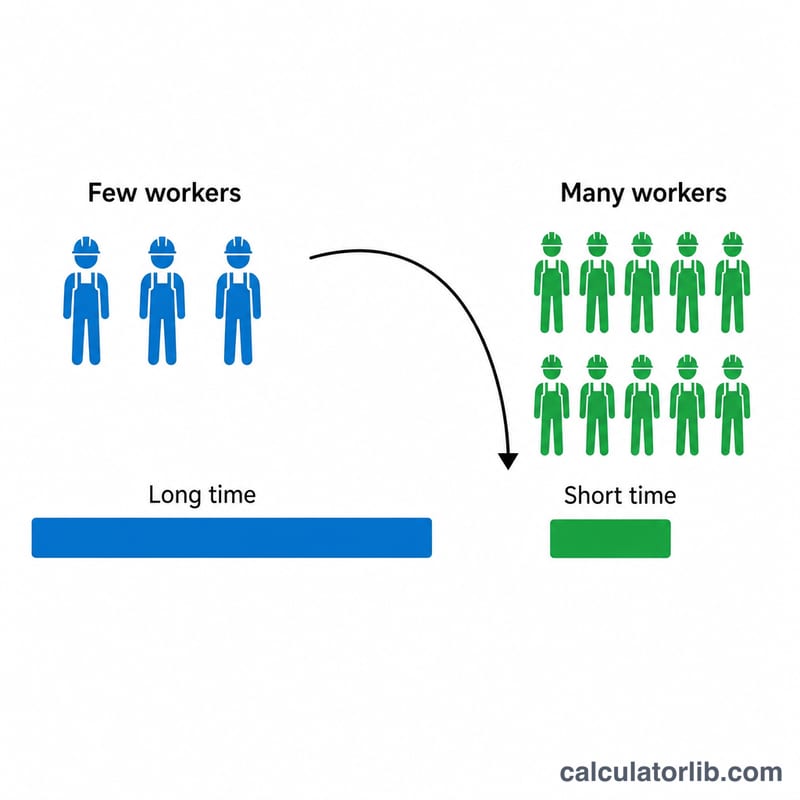
Baseline: 5 workers finished 1 job in 8 days. Target: finish 1 job in 4 days. The rate is \(1 / (5 \times 8) = 0.025\) units per person per day. Workers needed = $$\frac{5 \times 8 \times 1}{1 \times 4} = \frac{40}{4} = 10 \text{ people}$$ Halving the time doubles the workforce, exactly as expected.
FAQ
Why round up? Rounding down would leave the work unfinished by the deadline, so the practical answer always rounds up to the next whole worker.
What is a "work unit"? It is a dimensionless measure of how much work there is — a count of identical tasks or simply 1 for "one whole job". Use the same unit for baseline and target.
Can baseline and target work differ? Yes. Set baselineWork and targetWork to any positive values; the rate is derived from the baseline and reused for the target.