
What is Number Needed to Treat?
The Number Needed to Treat (NNT) is a key measure of clinical effectiveness used in evidence-based medicine. It tells you how many patients must receive a treatment, instead of the control, for one additional patient to benefit (avoid an adverse outcome). A lower NNT indicates a more effective treatment — an NNT of 1 would mean every treated patient benefits.
How to Use This Calculator
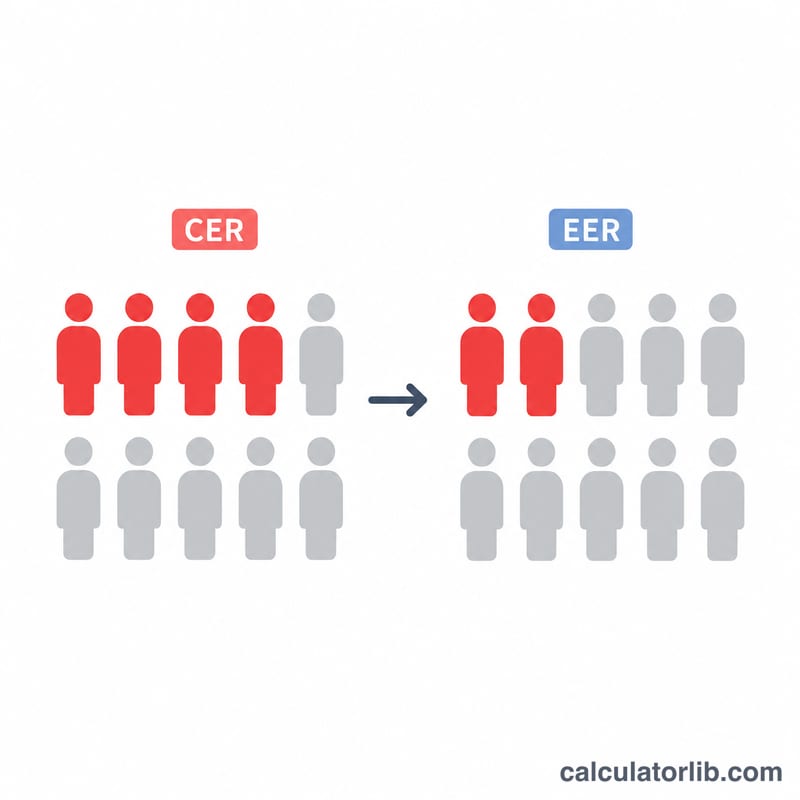
Enter the Control Event Rate (CER) — the proportion of patients who experienced the outcome in the control group — and the Experimental Event Rate (EER) — the proportion in the treatment group. Both are entered as percentages. The calculator returns the NNT, the Absolute Risk Reduction (ARR) and the Relative Risk Reduction (RRR).
The Formula Explained
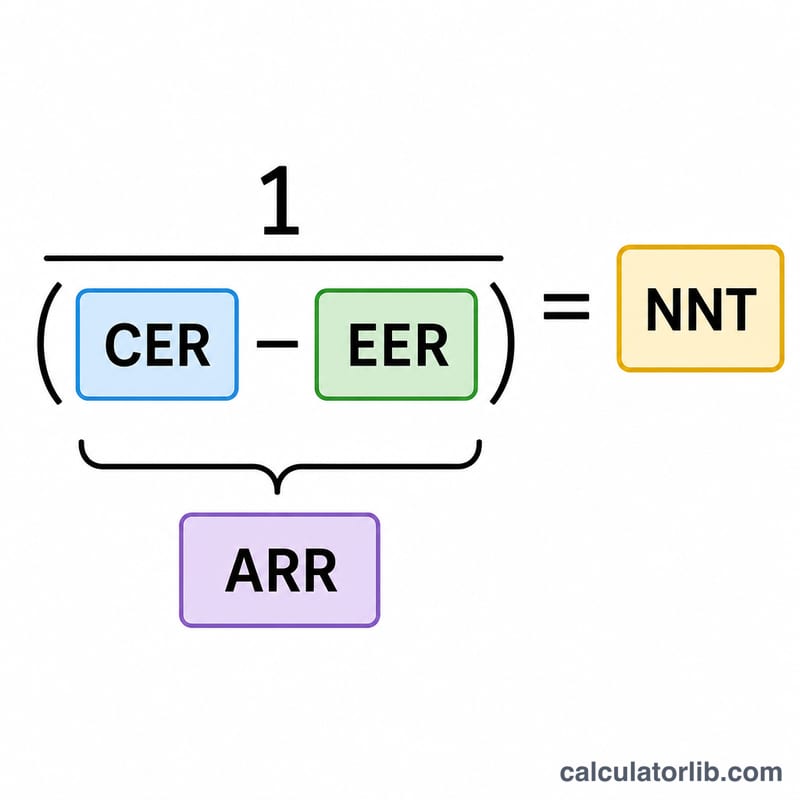
The Absolute Risk Reduction is the simple difference between the two rates: \(\text{ARR} = \text{CER} - \text{EER}\). The NNT is the reciprocal of the ARR:
$$\text{NNT} = \frac{1}{\left|\dfrac{\text{CER (\%)} - \text{EER (\%)}}{100}\right|}$$Because the NNT represents whole patients, it is conventionally rounded up to the next whole number. The Relative Risk Reduction expresses the same benefit as a proportion of the baseline risk: \(\text{RRR} = (\text{CER} - \text{EER}) / \text{CER}\).
Worked Example
Suppose a drug reduces the event rate from 30% in the control group to 20% in the treated group. The ARR is \(0.30 - 0.20 = 0.10\) (10%). The NNT is \(1 / 0.10 = 10\). So you would need to treat 10 patients to prevent one event. The RRR is \(0.10 / 0.30 = 33.3\%\).
FAQ
What is a good NNT? It depends on the condition and the severity of the outcome prevented; smaller is better, but even a high NNT can be worthwhile for serious outcomes.
Why round up? You cannot treat a fraction of a patient, so the NNT is rounded up to ensure at least one event is prevented.
What if EER is higher than CER? Then the treatment increases risk — the reciprocal is called the Number Needed to Harm (NNH). This tool uses the absolute difference for the magnitude.