
What is the Square of a Number?
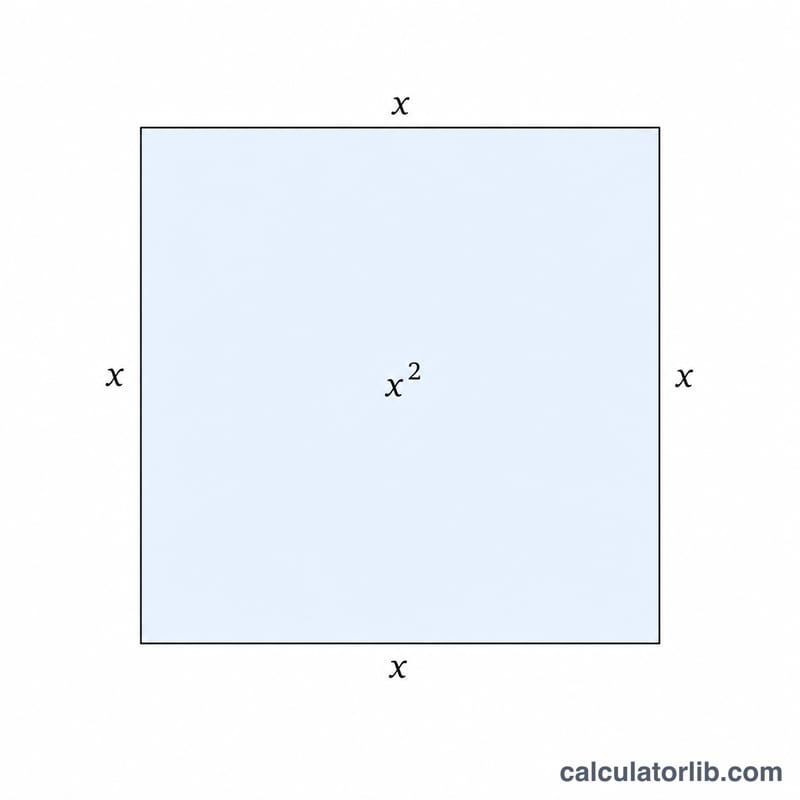
The square of a number is the result of multiplying that number by itself. It is written with a small raised "2" as an exponent: x squared equals x times x. Squaring is one of the most common operations in algebra, geometry (the area of a square with side x is x squared), and statistics. This calculator squares any real number you enter, including integers, decimals, negatives, and values in scientific E notation such as 1.5E3 (which means 1500).
How to Use It
Type a number into the field labeled "x =" and submit. The calculator returns the squared value plus a worked solution line so you can see exactly how the answer was reached, for example "3 squared = 3 times 3 = 9".
The Formula Explained
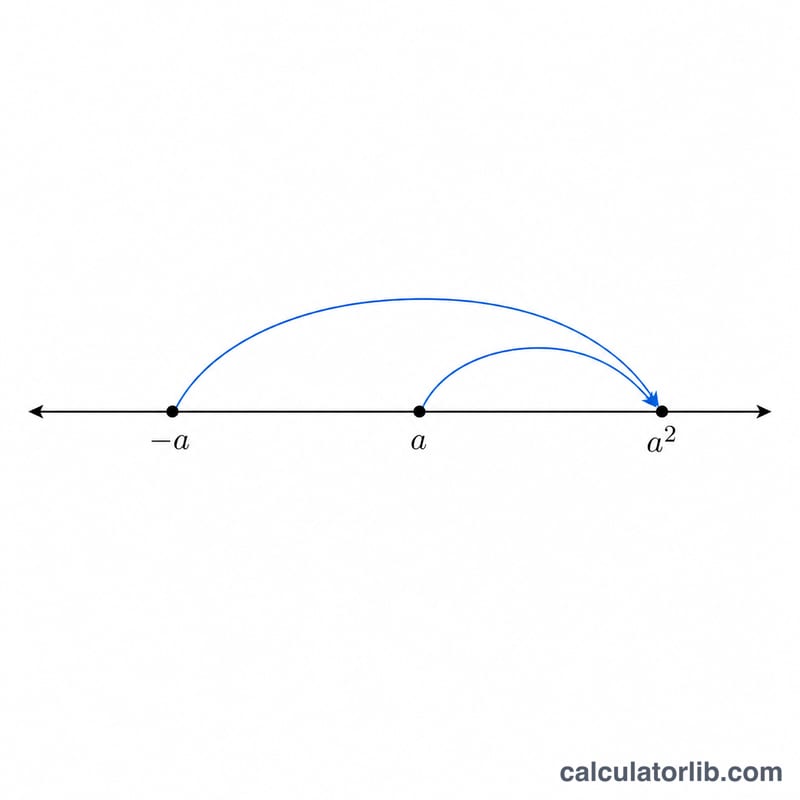
The rule is simply $$\text{x}^{2} = \text{x} \times \text{x}$$ For positive numbers and zero the result is always non-negative. For negative numbers the placement of the minus sign matters, following standard order of operations: exponentiation happens before a unary minus.
Worked Example
Enter 2.5. The calculator computes \(2.5 \times 2.5 = 6.25\) and shows $$2.5^{2} = 2.5 \times 2.5 = 6.25$$ Enter (-4) and you get 16, because the negative is squared. Enter -4 without parentheses and you get -16, because the minus is applied after squaring 4.
FAQ
Why does -4 give -16 but (-4) gives 16? By the standard order of operations, an exponent binds tighter than a leading minus. So -4 squared means the negative of (4 squared) = -16. Wrapping the value in parentheses, (-4), squares the negative number itself: \((-4) \times (-4) = 16\).
Can I square decimals and scientific notation? Yes. Decimals like 2.5 and E notation like 1.5E3 (= 1500) are accepted and parsed as real numbers.
What is the square of 0? Zero. \(0 \times 0 = 0\).