
What is the FOIL Method?
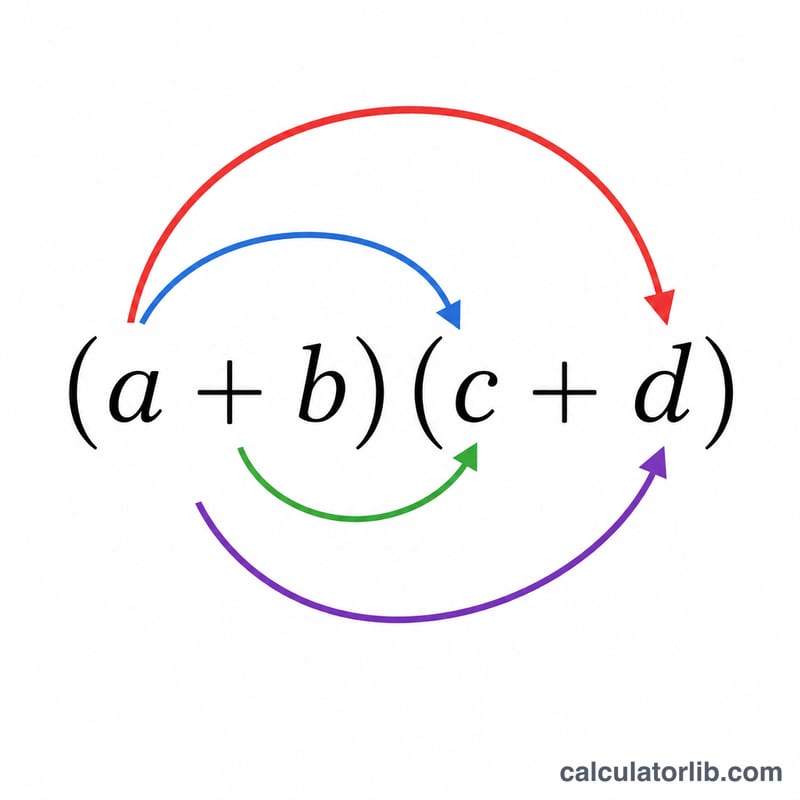
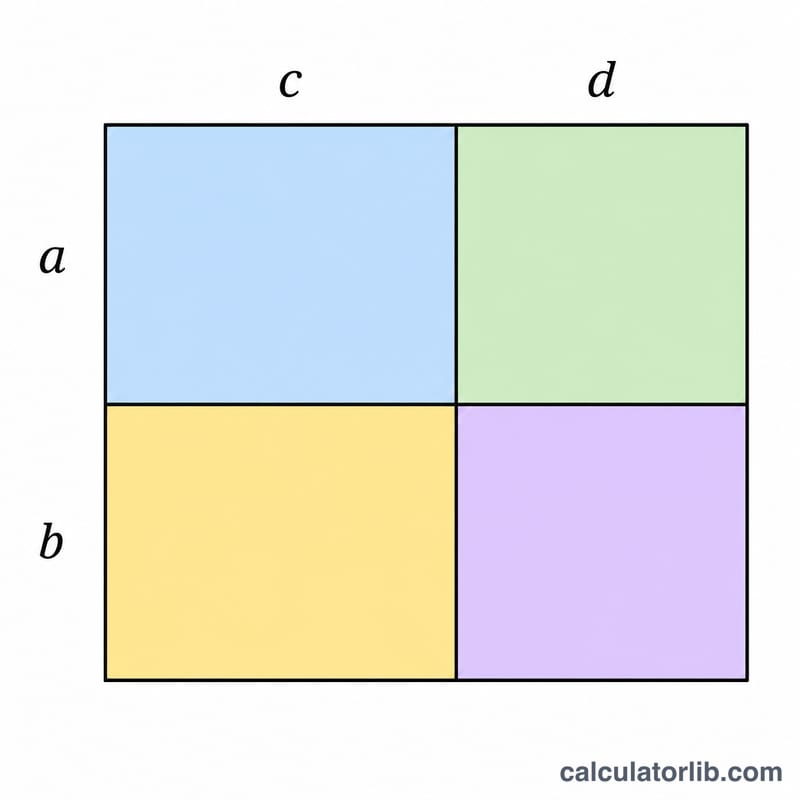
FOIL is a memory aid for multiplying two binomials. The letters stand for First, Outer, Inner, Last — the four pairs of terms you multiply when expanding a product like \((a + b)(c + d)\). Because each binomial has exactly two terms, the distributive property produces exactly four products: \(ac\), \(ad\), \(bc\), and \(bd\). This calculator parses your two factors, computes every product, combines like terms, and shows the simplified polynomial.
How to Use This Calculator
Type a product of two binomials in the Expand field, for example (3x - 2)(4x + 1). You can also enter a binomial squared such as (x - 5)^2, which is automatically rewritten as \((x - 5)(x - 5)\). Use the caret ^ for exponents (for example x^2). Coefficients of 1 may be omitted, and constants are allowed. Press calculate to see the answer plus a step-by-step breakdown.
The Formula Explained
For \((a + b)(c + d)\) you compute $$(a+b)(c+d) = \underbrace{a\cdot c}_{\text{First}} + \underbrace{a\cdot d}_{\text{Outer}} + \underbrace{b\cdot c}_{\text{Inner}} + \underbrace{b\cdot d}_{\text{Last}}$$ When multiplying monomials, multiply the coefficients and add the exponents of matching variables (\(x^{m}\cdot x^{n} = x^{m+n}\)). Finally, terms sharing the same variable and exponent are combined by adding their coefficients, and the result is sorted in descending order of degree.
Worked Example
Expand \((3x - 2)(4x + 1)\). First: \(3x\cdot 4x = 12x^{2}\). Outer: \(3x\cdot 1 = 3x\). Inner: \(-2\cdot 4x = -8x\). Last: \(-2\cdot 1 = -2\). Put them together: $$12x^{2} + 3x - 8x - 2$$ Combine the like terms \(3x\) and \(-8x\) to get \(-5x\). The simplified answer is \(12x^{2} - 5x - 2\).
FAQ
Does FOIL work for trinomials? No — FOIL is specific to multiplying two two-term factors. For longer factors you must distribute every term across every other term.
Can I use variables other than x? Yes, any single letter works, and products with two different variables (like \((x + y)(x - y) = x^{2} - y^{2}\)) are handled.
What if a coefficient is 1? You can omit it; the calculator treats x as 1x and displays results in standard simplified form.