
What is the Box Method?
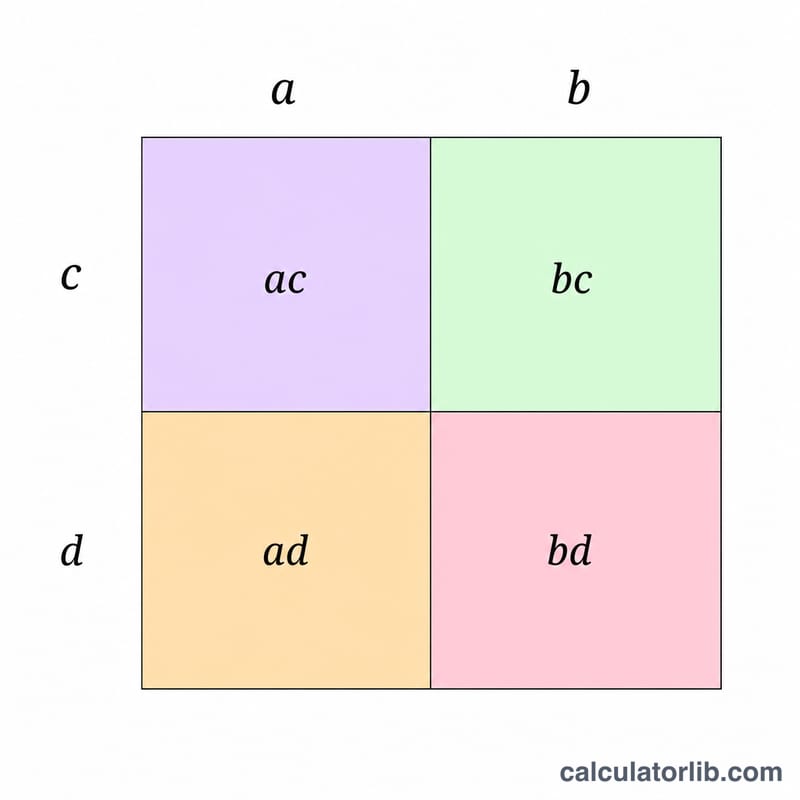
The box method — also called the area model or grid method — is a visual way to multiply multi-digit numbers. Instead of one tall column of carries, you break each number into its place-value parts (tens, ones, etc.), place them along the sides of a rectangle, multiply each pair to fill the boxes, and then add every partial product. It mirrors the algebraic identity \((a+b)(c+d) = ac + ad + bc + bd\).
How to use this calculator
Enter the two whole numbers you want to multiply and the calculator returns the product together with the sum of partial products and the size of the grid the method would build. The grid size tells you how many partial products are involved: a two-digit by two-digit problem builds a 2×2 box with four partial products.
The formula explained
Split each factor by place value. The general relationship is
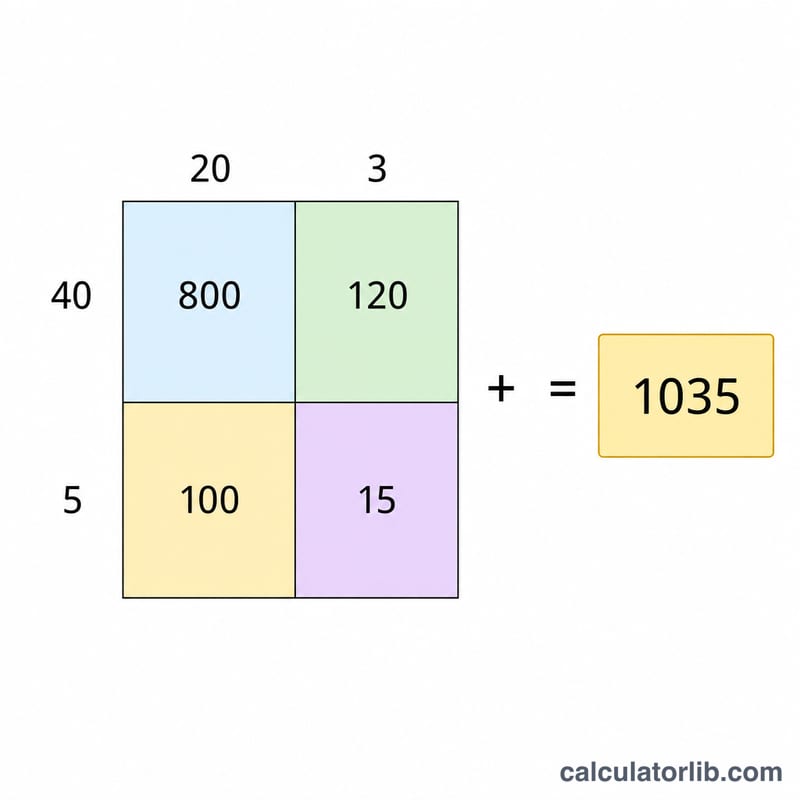
$$\text{First number} \times \text{Second number} = \sum_{i} \sum_{j} a_i \cdot b_j$$For 23 × 47, write 23 = 20 + 3 and 47 = 40 + 7. The four boxes are 20×40 = 800, 20×7 = 140, 3×40 = 120 and 3×7 = 21. Adding them gives
$$800 + 140 + 120 + 21 = 1{,}081,$$which equals 23 × 47.
Worked example
Multiply 12 × 13. Split into 10 + 2 and 10 + 3. Boxes: 10×10 = 100, 10×3 = 30, 2×10 = 20, 2×3 = 6. Sum =
$$100 + 30 + 20 + 6 = 156,$$so \(12 \times 13 = 156\).
How to Do the Box Method by Hand
The box method (also called the area model) multiplies two numbers by breaking each into its place-value parts, multiplying every pair of parts in a grid, and adding the results. It makes the distributive property visible. Here is the full procedure, worked through for \(34 \times 26\).
- Decompose each number by place value. Split each factor into tens, ones, and so on. Here \(34 = 30 + 4\) and \(26 = 20 + 6\).
- Draw the grid. For two two-digit numbers you need a \(2\times2\) grid. Write the parts of the first number across the top (\(30\) and \(4\)) and the parts of the second number down the side (\(20\) and \(6\)).
- Multiply each row–column pair. Fill each box with the product of its column heading and row heading:
- \(30 \times 20 = 600\)
- \(4 \times 20 = 80\)
- \(30 \times 6 = 180\)
- \(4 \times 6 = 24\)
- Write each partial product. The completed grid holds the four partial products:
| \(\times\) | 30 | 4 |
|---|---|---|
| 20 | 600 | 80 |
| 6 | 180 | 24 |
- Add all the boxes. Sum every partial product to get the final answer: \(600 + 80 + 180 + 24 = \) 884.
So \(34 \times 26 = 884\). This is exactly the distributive expansion \((30+4)(20+6) = 30\cdot20 + 30\cdot6 + 4\cdot20 + 4\cdot6\). The same four partial products appear if you expand \((a+b)(c+d)\) with FOIL, giving 884 when the parts are these place values.
Key Terms
- Box / area model
- A visual multiplication strategy in which each factor is split into place-value parts and the parts are multiplied in a grid of rectangles (boxes). The area of each box represents one partial product, and the total area equals the product.
- Grid method
- Another common name for the box method, emphasizing the rectangular grid used to organize the partial products.
- Place-value decomposition
- Rewriting a number as the sum of the values of its digits, e.g. \(347 = 300 + 40 + 7\). Each part becomes a heading along the top or side of the grid.
- Partial product
- The result of multiplying one part of the first number by one part of the second number, such as \(30 \times 20 = 600\). Each box in the grid holds one partial product, and the final answer is their sum.
- Factor
- A number being multiplied. In \(34 \times 26 = 884\), both \(34\) and \(26\) are factors and \(884\) is the product.
- Distributive identity \((a+b)(c+d) = ac + ad + bc + bd\)
- The algebraic rule that justifies the box method: a product of two sums equals the sum of all pairwise products of their parts. Each of the four terms \(ac, ad, bc, bd\) corresponds to one box in a \(2\times2\) grid.
FAQ
Does it work for any size number? Yes. More digits simply mean more boxes; the sum of all partial products always equals the product.
Why teach it instead of the standard algorithm? The box method makes place value explicit and connects directly to multiplying polynomials, so it builds intuition for later algebra.
Can I use negative numbers? Yes — the sign of the product follows the usual rule, and the partial products carry the matching sign.