
What this calculator does
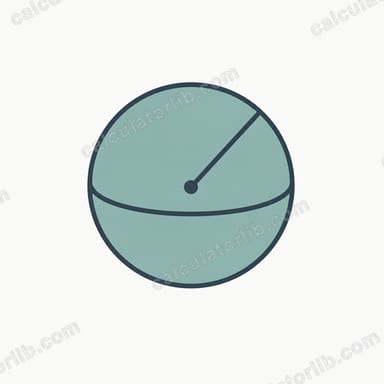
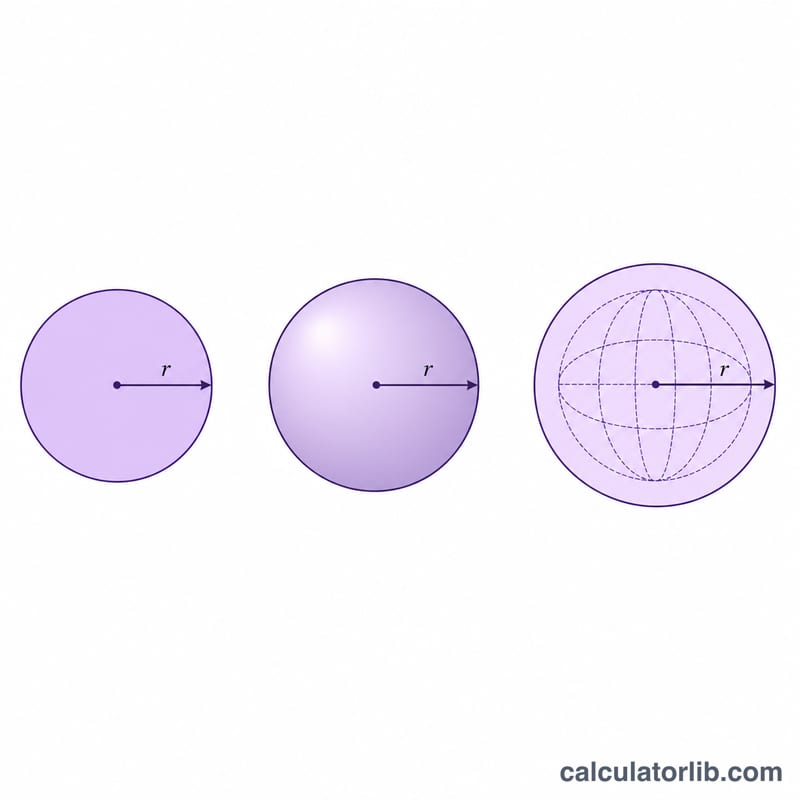
This tool computes the volume (n-dimensional content) and surface area (the measure of the bounding sphere) of an n-dimensional ball, also called a hypersphere. It generalizes the familiar circle and sphere to any number of Euclidean dimensions. For n = 2 you get the area and circumference of a disk; for n = 3 you get the ordinary volume and surface area of a ball; for higher n you get the analogous higher-dimensional quantities.
How to use it
Enter the dimension n (a positive integer such as 1, 2, 3, 4, ...) and the radius r (any non-negative real number, in whatever length unit you choose). The volume is reported in (length unit)n and the surface area in (length unit)n-1. There are no unit dropdowns: the inputs are treated as dimensionless real numbers.
The formula explained
The closed forms use the Gamma function, the continuous extension of the factorial. The volume is $$V_n(r) = \frac{\pi^{\,n/2}}{\Gamma\!\left(\frac{n}{2}+1\right)}\, r^{\,n},$$ and the surface area is $$S_n(r) = \frac{2\,\pi^{\,n/2}}{\Gamma\!\left(\frac{n}{2}\right)}\, r^{\,n-1}.$$ They are linked by \(S_n(r) = n \cdot V_n(r) / r\), equivalently \(V_n(r) = (r / n) \cdot S_n(r)\), and the surface area is the derivative of the volume with respect to \(r\). To stay numerically stable for large \(n\), this calculator evaluates everything through natural logarithms with a Lanczos log-Gamma approximation.
Worked example
Take \(n = 3\) and \(r = 1\). Then \(\Gamma(5/2) = \frac{3}{4}\sqrt{\pi} \approx 1.329340\), and \(\pi^{3/2} \approx 5.568328\), so $$V = \frac{5.568328}{1.329340} = 4.18879,$$ matching \(\frac{4}{3}\pi\). The surface area uses \(\Gamma(3/2) = \frac{1}{2}\sqrt{\pi} \approx 0.886227\), giving $$S = \frac{2 \cdot 5.568328}{0.886227} = 12.56637,$$ matching \(4\pi\).
FAQ
Can n be a non-integer? Mathematically yes, because the Gamma function is defined for all positive reals, so fractional dimensions give a valid value. The intended use, however, is positive integers.
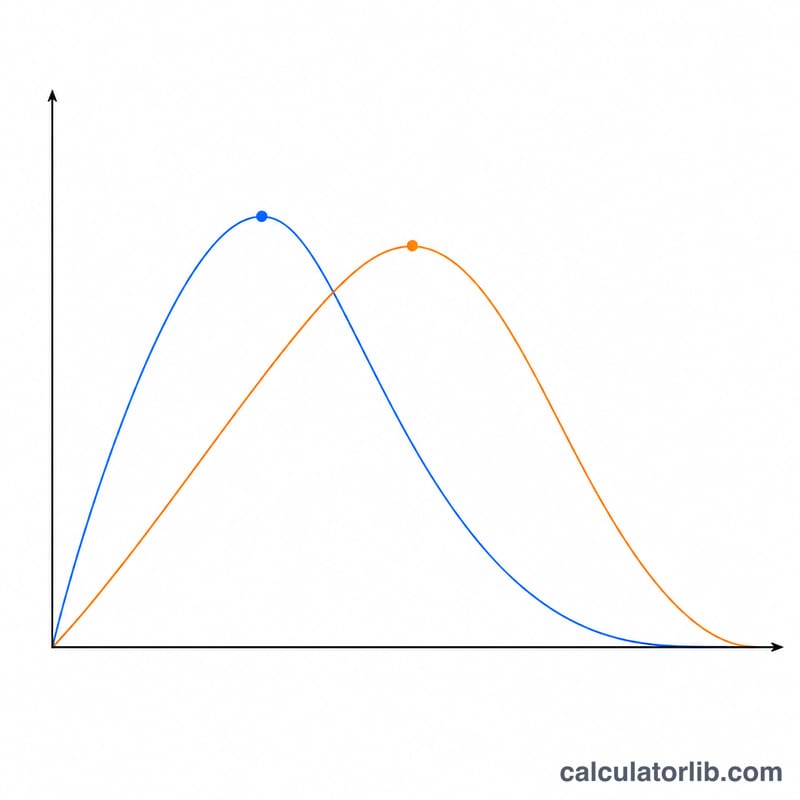
Why does the unit-ball volume shrink for large n? The volume of the unit ball peaks around \(n = 5\) and then tends to zero as \(n\) grows, a famous and counter-intuitive feature of high-dimensional geometry.
What does surface area mean for n = 1? The 1-ball is the segment \([-r, r]\) with "volume" \(2r\), and its boundary is the two endpoints, so its surface measure is 2.