
What this calculator does
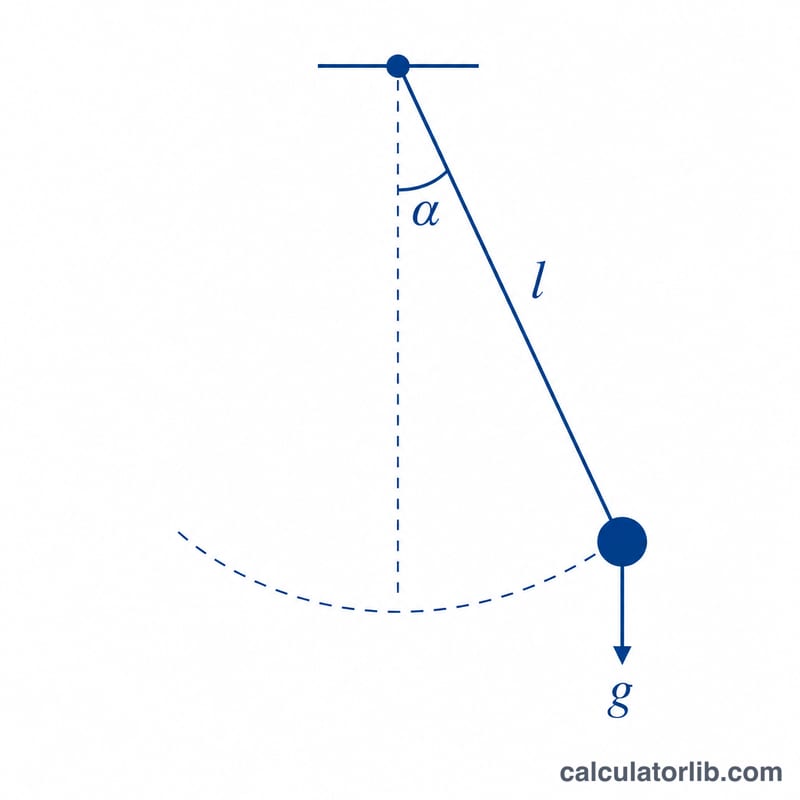
A simple pendulum's familiar period formula, \(T_0 = 2\pi\sqrt{l/g}\), is only an approximation valid for tiny swings. For finite release angles the real pendulum swings slower. This tool computes the exact period using the complete elliptic integral of the first kind and tabulates it next to the small-angle value and their ratio across a range of amplitude angles.
How to use it
Enter the string length l in meters and the gravitational acceleration g in m/s² (the default 9.80665 is standard gravity). Choose an amplitude step of 5° or 10°. The result shows the constant small-angle period T0 as the headline value, then a row for every amplitude α from the step up to just below 180°, with the exact period T and the ratio T/T0.
The formula explained
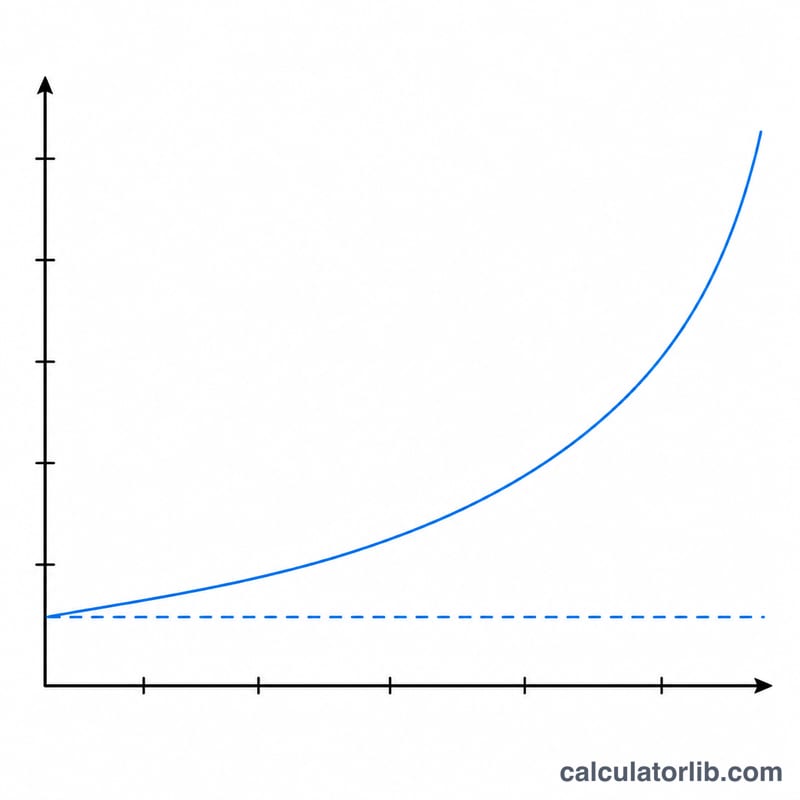
The exact period is $$T = 4\sqrt{\frac{l}{g}}\cdot K(k)$$ where \(k = \sin(\alpha/2)\) is the elliptic modulus and $$K(k) = \int_0^{\pi/2} \frac{d\varphi}{\sqrt{1-k^2\sin^2\varphi}}.$$ We evaluate K with the fast, exact arithmetic–geometric mean (AGM): start \(a_0=1\), \(b_0=\cos(\alpha/2)\), iterate \(a_{n+1}=(a_n+b_n)/2\) and \(b_{n+1}=\sqrt{a_n b_n}\) until they converge, then \(K = \pi/(2a_\infty)\). The ratio simplifies to \(\frac{2}{\pi}K(\sin(\alpha/2))\), which is 1 at zero amplitude and diverges as α approaches 180°.
Worked example
For l = 1 m and g = 9.80665 m/s²: \(\sqrt{l/g} = 0.319330\) s, so \(T_0 = 2.006419\) s. At \(\alpha = 30°\), \(k = \sin 15° = 0.258819\), \(K = 1.598142\), giving \(T = 2.041253\) s and ratio \(1.017362\) — about 1.74% longer than the small-angle estimate, matching the textbook \(1 + \alpha^2/16\) correction.
FAQ
Why does the period grow with amplitude? The restoring torque is proportional to \(\sin\theta\), not \(\theta\); for larger swings \(\sin\theta < \theta\), so the effective restoring force is weaker and each cycle takes longer.
Why does it stop before 180°? At exactly 180° the pendulum starts at the unstable inverted point, \(k = 1\), and K diverges to infinity, so the period is unbounded. The table caps just below 180°.
Is the AGM exact? It converges quadratically to machine precision in under ten iterations, so the tabulated values are exact to the displayed precision — far better than truncating the power series.