
What Is the Pendulum Period Calculator?
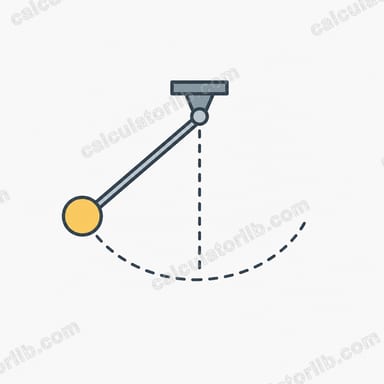
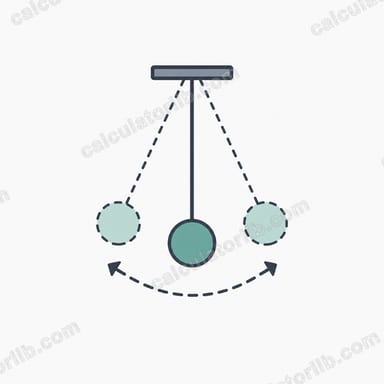
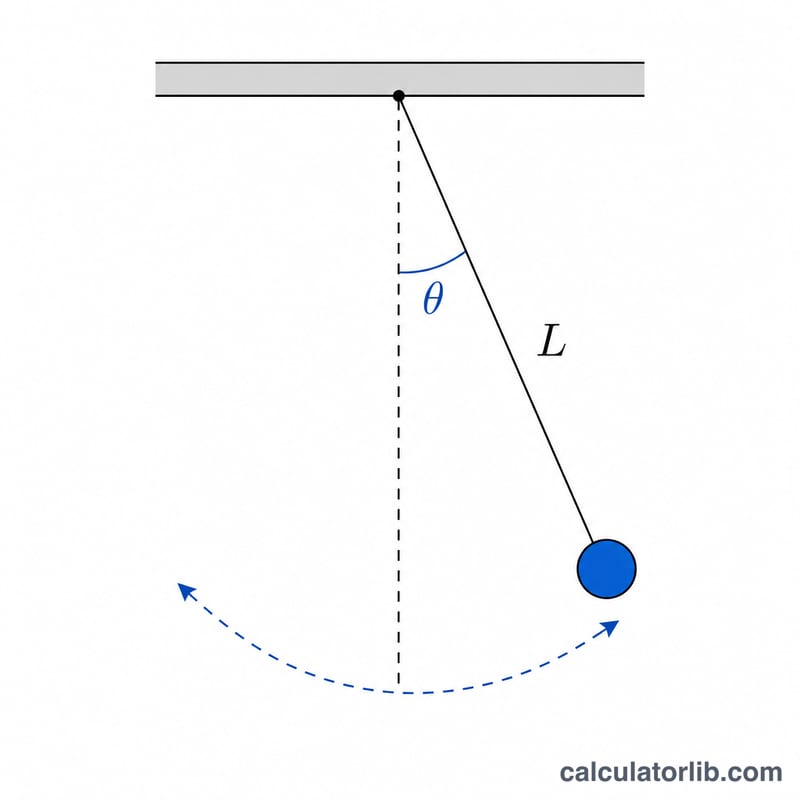
This calculator finds the period of a simple pendulum — the time it takes to complete one full back-and-forth swing. It uses the classic small-angle formula \(T = 2\pi\sqrt{L/g}\), where L is the length of the pendulum and g is the acceleration due to gravity. The tool also reports the swing frequency in hertz. This is a universal physics relationship and applies anywhere; only the value of g changes with location (about 9.81 m/s² on Earth's surface).
How to Use It
Enter the pendulum length in meters and the local gravitational acceleration (use 9.81 m/s² for Earth, 1.62 for the Moon, or 3.71 for Mars). Press calculate to see the period in seconds and the corresponding frequency. The formula assumes a small swing angle (under about 15°) and a massless, inextensible string with all mass at the bob.
The Formula Explained
The period depends only on length and gravity — not on the mass of the bob or the amplitude (for small angles). Because period grows with the square root of length, making a pendulum four times longer only doubles its period. Frequency is simply \(f = 1/T\).
$$T = 2\pi \sqrt{\dfrac{\text{Length (m)}}{\text{Gravity (m/s}^2\text{)}}}$$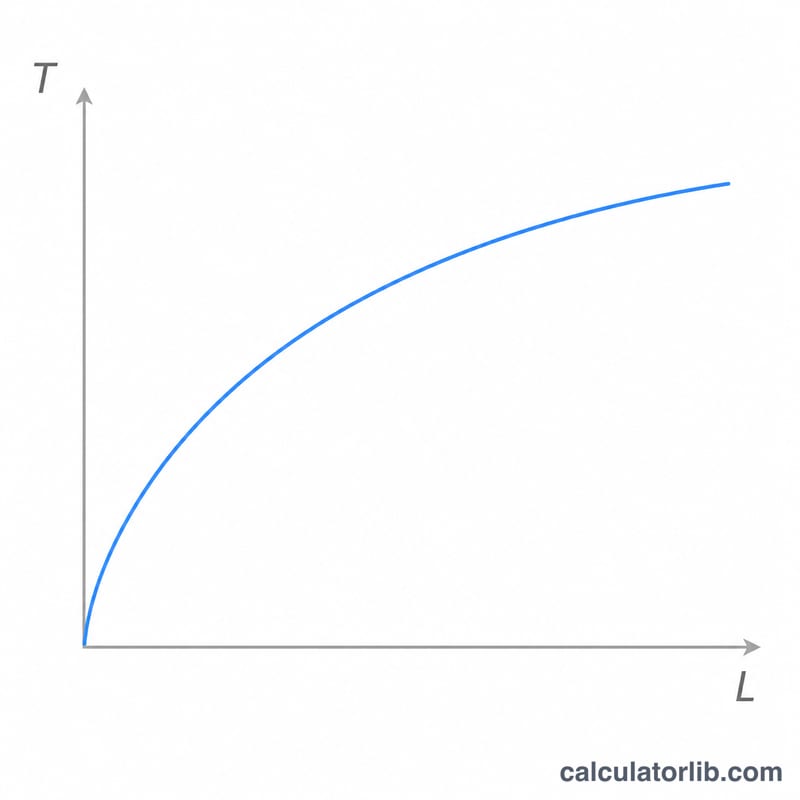
Worked Example
For a 1-meter pendulum on Earth (g = 9.81 m/s²):
$$T = 2\pi\sqrt{1/9.81} = 2\pi \times \sqrt{0.10193} = 2\pi \times 0.31926 \approx 2.006 \text{ seconds}$$Its frequency is \(1/2.006 \approx 0.498\) Hz.
FAQ
Does mass affect the period? No. For an ideal simple pendulum the period is independent of the bob's mass.
Why use 9.81 m/s²? That is the standard average surface gravity on Earth. It varies slightly by latitude and altitude.
Is this accurate for large swings? The formula is exact only in the small-angle limit. For large amplitudes the true period is slightly longer.