
What Is the Sphere Density Calculator?
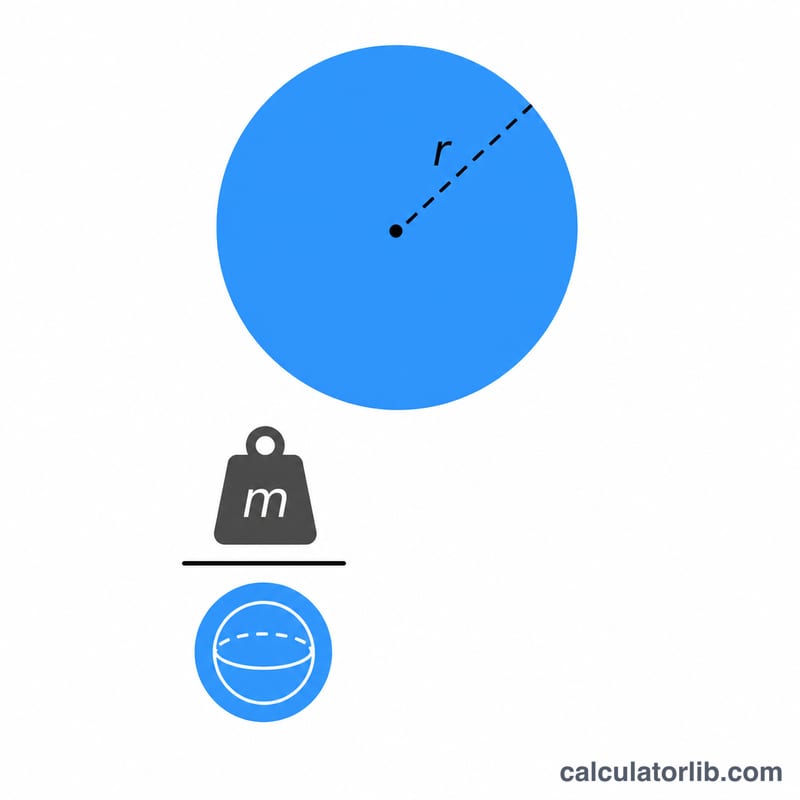
This calculator finds the density of a solid sphere from two measurements: its mass and its radius. Density tells you how much mass is packed into a given amount of space, and for a sphere it is simply the mass divided by the spherical volume. The tool is universal — it works with any consistent set of units (for example grams and centimetres, or kilograms and metres), and the resulting density is expressed in mass per unit volume.
How to Use It
Enter the sphere's mass and its radius, then read off the density and the computed volume. Make sure both inputs use compatible units so the answer is meaningful: if mass is in grams and radius in centimetres, density comes out in g/cm³. The radius must be greater than zero.
The Formula Explained
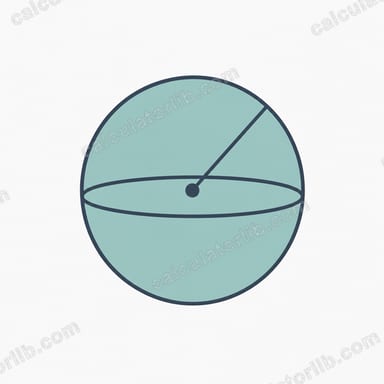
The volume of a sphere is \(V = \frac{4}{3}\cdot\pi\cdot r^{3}\). Density is mass per volume, so combining the two gives:
$$\rho = \frac{m}{\frac{4}{3}\cdot\pi\cdot r^{3}}$$
Because the radius is cubed, even a small change in radius dramatically changes the volume — and therefore the density. Measure the radius carefully for accurate results.
Worked Example
Suppose a metal ball has a mass of 100 g and a radius of 3 cm. Its volume is $$\frac{4}{3}\cdot\pi\cdot 3^{3} = \frac{4}{3}\cdot\pi\cdot 27 \approx 113.0973 \text{ cm}^{3}.$$ The density is \(100 \div 113.0973 \approx 0.8842\) g/cm³. That low value tells you this particular object is lighter than water for its size.
FAQ
Do I need a specific unit system? No. Any consistent pair works; the density unit is whatever mass unit per cubed length unit you used.
Does this work for hollow spheres? No — this assumes a solid sphere filling its full volume. For a hollow shell you would subtract the inner volume.
What if I only know the diameter? Divide the diameter by two to get the radius before entering it.