
What Is the Wavelength to Energy Calculator?
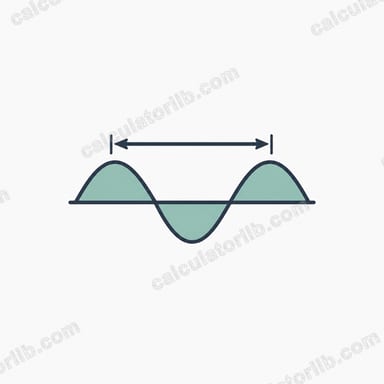
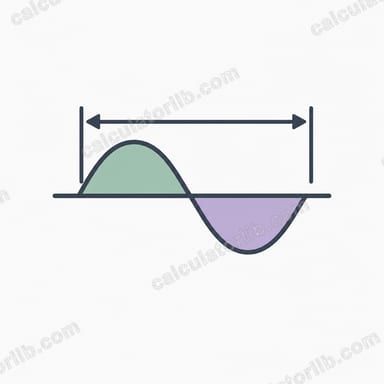
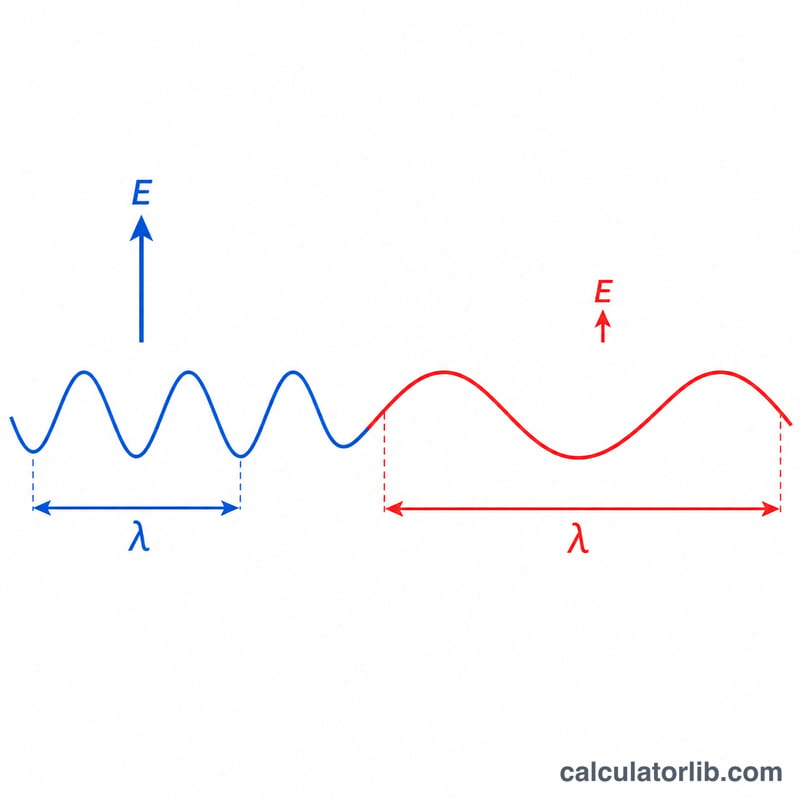
This tool converts the wavelength of light (or any electromagnetic radiation) into the energy carried by a single photon. It is based on the Planck–Einstein relation, a cornerstone of quantum physics. Because shorter wavelengths carry more energy, this conversion is essential in fields like spectroscopy, photochemistry, astronomy, and laser engineering. The calculator reports energy in both joules (J) and electronvolts (eV), the unit most commonly used at the atomic scale.
How to Use It
Enter the wavelength and choose its unit — nanometers (nm), micrometers (µm), angstroms (Å), or meters (m). The calculator internally converts your value to meters, then applies the formula. Press calculate to see the photon energy instantly.
The Formula Explained
The governing equation is $$E = \frac{h \cdot c}{\lambda}$$ where:
h = Planck's constant = \(6.62607015 \times 10^{-34}\ \text{J}\cdot\text{s}\)
c = speed of light = \(299{,}792{,}458\ \text{m/s}\)
λ = wavelength in meters.
Multiplying h and c gives a numerator of about \(1.98645 \times 10^{-25}\ \text{J}\cdot\text{m}\). Dividing by the wavelength in meters yields the energy in joules. To convert to electronvolts, divide the joule value by the elementary charge, \(1.602176634 \times 10^{-19}\ \text{C}\).
Worked Example
Consider green light with a wavelength of 500 nm = \(5 \times 10^{-7}\ \text{m}\). Then $$E = \frac{6.62607015 \times 10^{-34} \times 299{,}792{,}458}{5 \times 10^{-7}} \approx 3.973 \times 10^{-19}\ \text{J}.$$ Dividing by \(1.602176634 \times 10^{-19}\) gives about 2.48 eV — a typical value for visible light photons.
FAQ
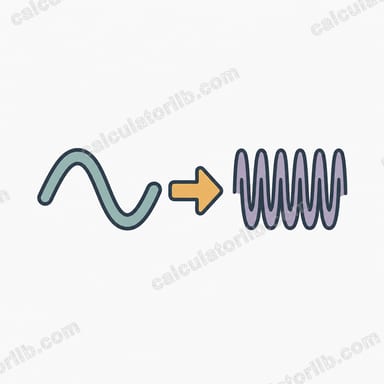
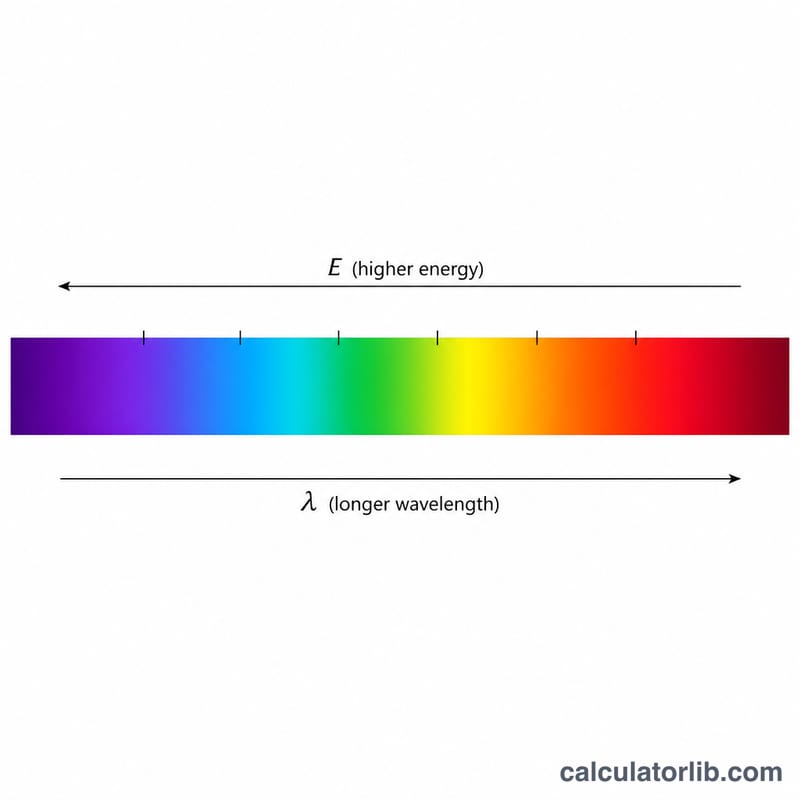
Why is energy higher for shorter wavelengths? Energy is inversely proportional to wavelength, so blue and ultraviolet light carry more energy per photon than red or infrared.
What is an electronvolt? One electronvolt is the energy gained by an electron moving through a potential difference of one volt — a convenient unit for atomic-scale energies.
Does this work for X-rays and radio waves? Yes. The relation applies to all electromagnetic radiation; just enter the appropriate wavelength.