What this calculator does
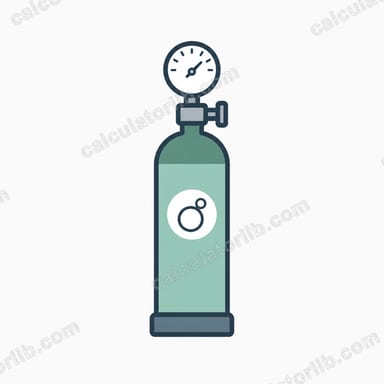
This tool estimates how much oxygen gas is still inside a medical or diving oxygen cylinder, and roughly how many minutes it can keep supplying gas at a chosen flow rate. It is a universal physics calculation and works for any cylinder; the default size options simply reflect common Japanese medical oxygen cylinder specifications. The maximum fill pressure for typical medical cylinders is about 14.7 MPa.
How to use it
Pick the cylinder's internal (water) capacity in liters, enter the value shown on the pressure gauge, choose the pressure unit (MPa or kgf/cm2), set a safety factor (usually 0.8), and select the oxygen flow rate in liters per minute. The result shows the remaining gas volume and the estimated usable time, color-coded green (over 60 min), yellow (30 to 60 min) or red (under 30 min).
The formula explained
A cylinder of internal water capacity C (liters) at gauge pressure P holds a gas volume of roughly \(C \times P\), when P is expressed in kgf/cm2 (since about 1 kgf/cm2 equals 1 atmosphere). Because 1 MPa is approximately 10 kgf/cm2, an MPa reading is multiplied by 10 (the multiplier M) before multiplying by capacity. So Remaining = \(C \times P \times M\). Usable time then equals the remaining volume times the safety factor, divided by the flow rate. Both results are truncated (floored) to whole numbers.
$$T = \left\lfloor \frac{V \cdot S}{F} \right\rfloor$$ $$\text{where}\quad \left\{ \begin{aligned} V &= \left\lfloor \text{Capacity (L)} \cdot \text{Pressure} \cdot \text{Unit factor} \right\rfloor \\ S &= \text{Safety factor} \\ F &= \text{Flow rate (L/min)} \end{aligned} \right.$$

Worked example
With a 3.4 L cylinder reading 14 MPa (M = 10), safety factor 0.8 and flow 5 L/min: Remaining = $$3.4 \times 14 \times 10 = 476 \text{ L}.$$ Usable time = $$476 \times 0.8 / 5 = 76.16,$$ floored to 76 minutes. Since 76 is over 60, the status is green.

Pressure Unit Conversion Table
Oxygen cylinder gauges are not labelled the same way everywhere. Japanese and much of European medical equipment reads in MPa or bar, older Japanese and some industrial gauges read in kgf/cm², and gauges in the United States almost always read in psi. Because this calculator multiplies capacity by the gauge number, you must know which unit your gauge uses before entering a value.
The exact factors are:
- \(1\ \text{MPa} = 10.197\ \text{kgf/cm}^2\) (this tool uses the common field approximation of 10, via the "Unit factor" input)
- \(1\ \text{MPa} = 10\ \text{bar} = 145.04\ \text{psi}\)
- \(1\ \text{kgf/cm}^2 = 0.9678\ \text{atm} = 0.0980665\ \text{MPa} = 14.223\ \text{psi}\)
| Gauge reading (MPa) | kgf/cm² (×10.197) | bar (×10) | psi (×145.04) |
|---|---|---|---|
| 1 | 10.2 | 10 | 145 |
| 2 | 20.4 | 20 | 290 |
| 5 | 51.0 | 50 | 725 |
| 10 | 102.0 | 100 | 1450 |
| 12 | 122.4 | 120 | 1741 |
| 14.7 | 149.9 (≈150) | 147 | 2132 |
So the familiar "full" Japanese medical reading of 14.7 MPa is the same pressure as about 150 kgf/cm², 147 bar, or 2132 psi.
These are gauge pressures, not absolute pressures. A gauge reads zero when the cylinder is at ambient atmospheric pressure, so absolute pressure is roughly the gauge value plus 0.1 MPa (1 bar, about 14.7 psi). Treating the gauge value as absolute — which is what the simple capacity × pressure estimate does — understates the free gas volume by well under 1% at high pressure, an error in the safe direction. Note also that the tool's 1 MPa → 10 kgf/cm² shortcut is about 1.9% lower than the exact 10.197, again erring slightly conservative.
Common Oxygen Cylinder Sizes and Full Gas Volumes
A cylinder's stamped capacity is its internal (water) capacity — the physical volume of the shell in litres. The usable gas volume is far larger, because the oxygen is compressed. For a gauge reading of about 150 kgf/cm² (14.7 MPa), the free gas volume is roughly:
$$V \approx C \times 150$$where \(C\) is the internal capacity in litres and \(V\) is the free (expanded, ambient-pressure) gas volume in litres. Usable time then follows from the tool's formula, with a safety factor of 0.8 reserving 20% of the contents:
$$T = \left\lfloor \frac{V \times 0.8}{F} \right\rfloor$$| Internal capacity (L) | Gas volume at 14.7 MPa (L) | Usable min at 2 L/min (SF 0.8) | Usable min at 5 L/min (SF 0.8) |
|---|---|---|---|
| 0.5 | 75 | 30 | 12 |
| 1.5 | 225 | 90 | 36 |
| 2.8 | 420 | 168 | 67 |
| 3.4 | 510 | 204 | 81 |
| 10 | 1500 | 600 | 240 |
| 40 | 6000 | 2400 | 960 |
| 47 | 7050 | 2820 | 1128 |
Worked example for the 3.4 L row at 5 L/min:
$$V = \lfloor 3.4 \times 150 \times 1 \rfloor = 510\ \text{L}, \qquad T = \left\lfloor \frac{510 \times 0.8}{5} \right\rfloor = \lfloor 81.6 \rfloor = 81\ \text{min}$$Country/standard note: the 3.4 L shell at a 14.7 MPa filling pressure (nominally about 500 L of oxygen) reflects common Japanese medical cylinder specifications; the 10 L, 40 L and 47 L sizes are typical industrial/hospital manifold cylinders. Cylinder designations and filling pressures differ by country — for example US medical cylinders are commonly rated around 2015 psi and are identified by letter codes (D, E, M, H) rather than litres — so always read the markings on your own cylinder rather than assuming a size.
Capacity is not gas volume. The capacity figure is stamped on the cylinder shoulder (together with the test pressure, tare weight and inspection dates); it is the water capacity of the shell, so a "3.4 L" cylinder holds roughly 500 L of breathable oxygen when full, not 3.4 L. Volumes here are rounded estimates that assume ideal-gas behaviour and ignore regulator and tubing dead volume and temperature effects; real oxygen at 15 MPa is slightly non-ideal, so treat all figures as planning estimates.
Usable Time Across Flow Rates and Gauge Readings
The table below holds a 3.4 L cylinder constant and varies the gauge reading (entered in MPa, so the unit factor is 10) against the delivered flow rate, with a safety factor of 0.8. Remaining volume is \(V = \lfloor 3.4 \times P \times 10 \rfloor\) and usable minutes are floored, so a partial minute is never counted.
| Gauge (MPa) | Remaining volume (L) | 1 L/min | 2 L/min | 5 L/min | 10 L/min |
|---|---|---|---|---|---|
| 14 | 476 | 380 min — Green | 190 min — Green | 76 min — Green | 38 min — Yellow |
| 10 | 340 | 272 min — Green | 136 min — Green | 54 min — Yellow | 27 min — Red |
| 5 | 170 | 136 min — Green | 68 min — Green | 27 min — Red | 13 min — Red |
| 2 | 68 | 54 min — Yellow | 27 min — Red | 10 min — Red | 5 min — Red |
Status bands used by this tool: Green above 60 minutes, Yellow 30–60 minutes, Red below 30 minutes.
Check of the 14 MPa / 5 L/min cell:
$$V = \lfloor 3.4 \times 14 \times 10 \rfloor = 476\ \text{L}, \qquad T = \left\lfloor \frac{476 \times 0.8}{5} \right\rfloor = \lfloor 76.16 \rfloor = 76\ \text{min}$$Two patterns are worth reading off the table. First, usable time is inversely proportional to flow: doubling the flow rate halves the time, so a cylinder that is comfortably Green at 2 L/min can fall into Yellow or Red at 10 L/min without the gauge moving at all. Second, the gauge is linear in contents, so a half-full cylinder genuinely gives about half the time — but because the safety factor withholds 20%, the practical endpoint arrives sooner than the gauge suggests. Lower the safety factor only if you understand that you are planning to draw the cylinder closer to empty, where regulator output becomes unreliable.
Flow rates above a few litres per minute are also device-dependent: a simple mask or reservoir mask consumes the set flow continuously, whereas a demand/conserving regulator draws gas only on inspiration and will last considerably longer than these continuous-flow figures.
This is general information for planning and training purposes, not professional medical or diving advice. Always follow the prescription, protocol or dive plan set by your clinician, equipment manufacturer or certifying agency, verify the reading on your own gauge, and carry reserve capacity for transport and delays.
FAQ
Why a safety factor? Gauges and flow are imprecise, and you should never run a cylinder fully empty. A factor of 0.8 reserves a margin.
What if I use kgf/cm2? Choose that unit and the multiplier becomes 1, so Remaining = \(C \times P\) directly.
Is this exact? No. It is a planning estimate only and not a substitute for direct monitoring or clinical judgment.