
What is the flow rate formula?
Volumetric flow rate measures how much fluid passes a point per unit of time. It is found by dividing the volume of fluid by the time it took to move that volume: \(Q = V / t\). This universal physics relationship applies to water in pipes, fuel through pumps, air through ducts and any fluid you can measure by volume and time.
$$Q = \frac{\text{Volume (V)}}{\text{Time (t)}}$$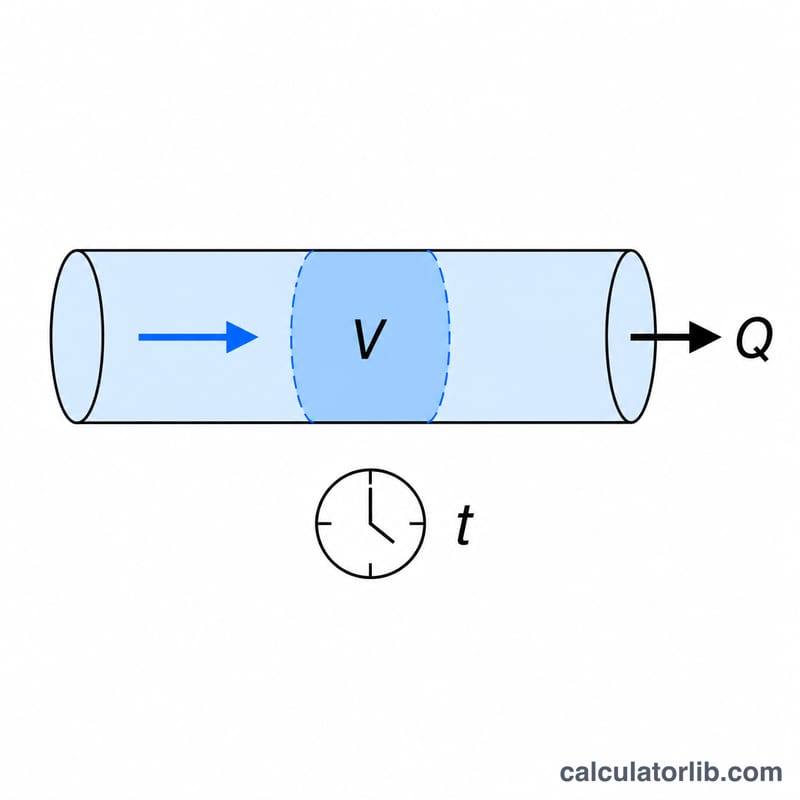
How to use this calculator
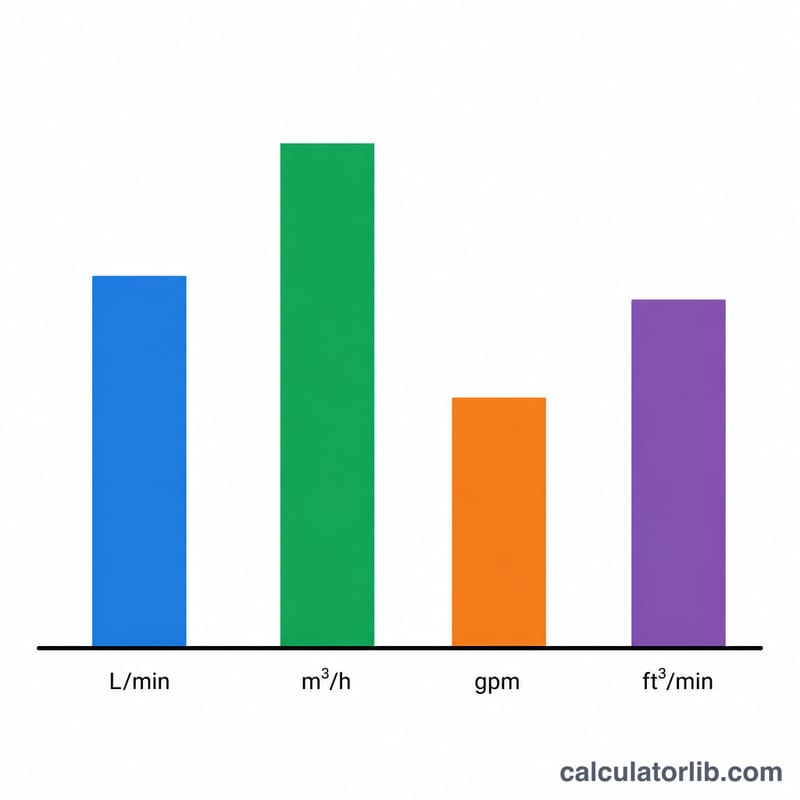
Enter the volume of fluid that moved, choose its unit (liters, cubic meters or US gallons), then enter the elapsed time and its unit (seconds, minutes or hours). The calculator returns the flow rate in your entered units and also converts it to the four most common engineering units: liters per second (L/s), liters per minute (L/min), cubic meters per hour (m³/h) and US gallons per minute (GPM).
Worked example
Suppose a bucket collects 100 liters of water in 5 minutes. The flow rate in entered units is \(100 \div 5 = \) 20 L/min. Converting: 100 L over 300 seconds = 0.3333 L/s, which is 20 L/min, 1.2 m³/h and about 5.28 GPM.
FAQ
What units does flow rate use? Any volume-over-time unit works. Common SI units are m³/s and L/s; m³/h and GPM are widely used in water and HVAC engineering.
How do I find time from flow rate? Rearrange to \(t = V / Q\). To fill a 600 L tank at 20 L/min takes 30 minutes.
Is this mass flow rate? No. This is volumetric flow rate. Mass flow rate = density \(\times\) volumetric flow rate, so multiply by the fluid density if you need kg/s.