
What This Calculator Does
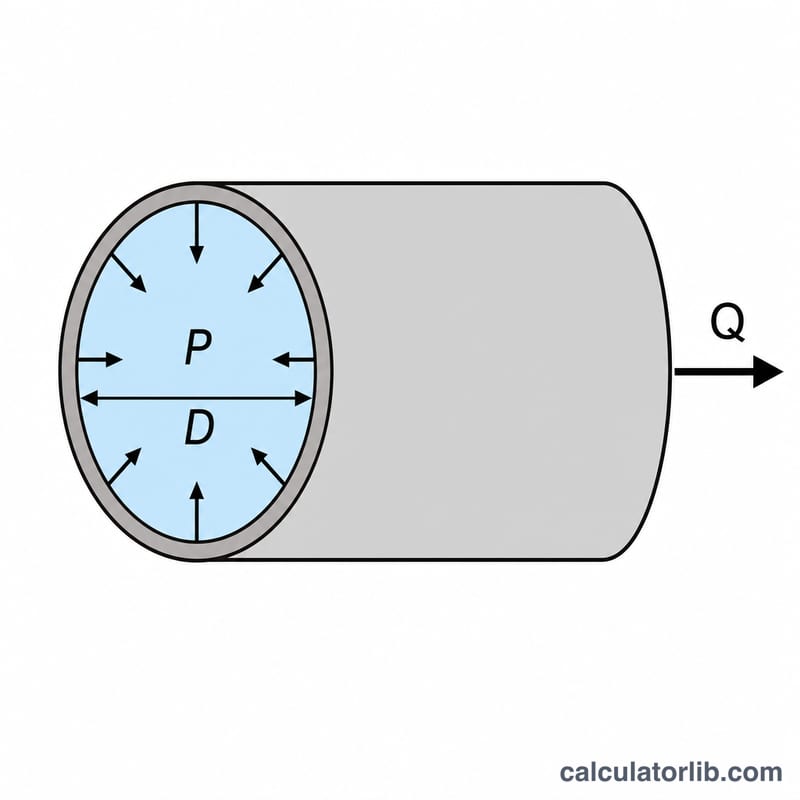
This tool estimates the volumetric flow rate of water (or another fluid) escaping from a pipe based on the driving pressure and the pipe inner diameter. It applies the idealized Bernoulli/Torricelli relationship, converting pressure energy into kinetic energy to predict the exit velocity and then multiplying by the pipe cross-sectional area.
How to Use It
Enter the gauge pressure in pascals (Pa), the pipe inner diameter in millimetres (mm), and the fluid density in kilograms per cubic metre (kg/m³). Water at room temperature is about 1000 kg/m³. The calculator returns the flow rate in litres per minute, cubic metres per second, and cubic metres per hour, along with the flow velocity and pipe cross-section area.
The Formula Explained
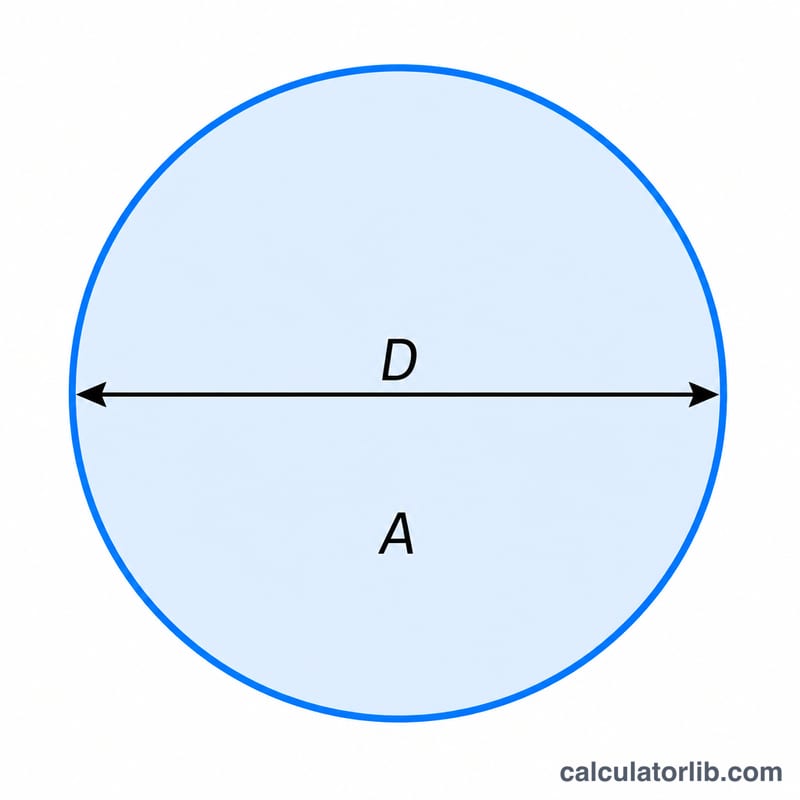
The exit velocity comes from equating pressure energy to kinetic energy: \(v = \sqrt{2P/\rho}\). The pipe cross-section area for a round pipe is \(A = \pi D^{2}/4\). Multiplying velocity by area gives the volumetric flow rate $$Q = A\cdot\sqrt{\frac{2P}{\rho}}.$$ This is an ideal result — it ignores friction losses, fittings, viscosity, and the discharge coefficient, so real-world flow will be lower.
Worked Example
For \(P = 100{,}000\ \text{Pa}\), \(D = 50\ \text{mm}\) and \(\rho = 1000\ \text{kg/m}^3\): $$A = \pi\cdot\frac{(0.05)^{2}}{4} = 0.0019635\ \text{m}^2.$$ Velocity $$v = \sqrt{\frac{2\cdot 100000}{1000}} = \sqrt{200} \approx 14.142\ \text{m/s}.$$ So $$Q = 0.0019635 \times 14.142 \approx 0.02777\ \text{m}^3\text{/s},$$ which equals about 1,666 L/min.
FAQ
Is this exact? No. It is a theoretical upper bound assuming frictionless, inviscid flow. Apply a discharge coefficient (often 0.6–0.9) for practical estimates.
What pressure should I enter? Use the pressure driving the flow (gauge pressure). 1 bar = 100,000 Pa; 1 psi ≈ 6,895 Pa.
Can I use other fluids? Yes — just enter that fluid's density. The physics is the same.