
What is the Flow Rate to Velocity Converter?
This tool converts a volumetric flow rate (Q) flowing through a circular pipe into the average fluid velocity (v). It is widely used in plumbing, HVAC, irrigation, and process engineering to check whether the velocity in a pipe is within recommended limits (typically 1–3 m/s for water in supply lines). The calculator is universal — it works for any liquid or gas in any consistent unit system.
How to use it
Enter the volumetric flow rate and choose its unit (m³/s, m³/h, L/s, L/min, or US GPM). Then enter the inside pipe diameter and select mm, cm, m, or inches. The converter normalizes everything to SI units, computes the circular cross-sectional area, and returns the average velocity in metres per second and feet per second.
The formula explained
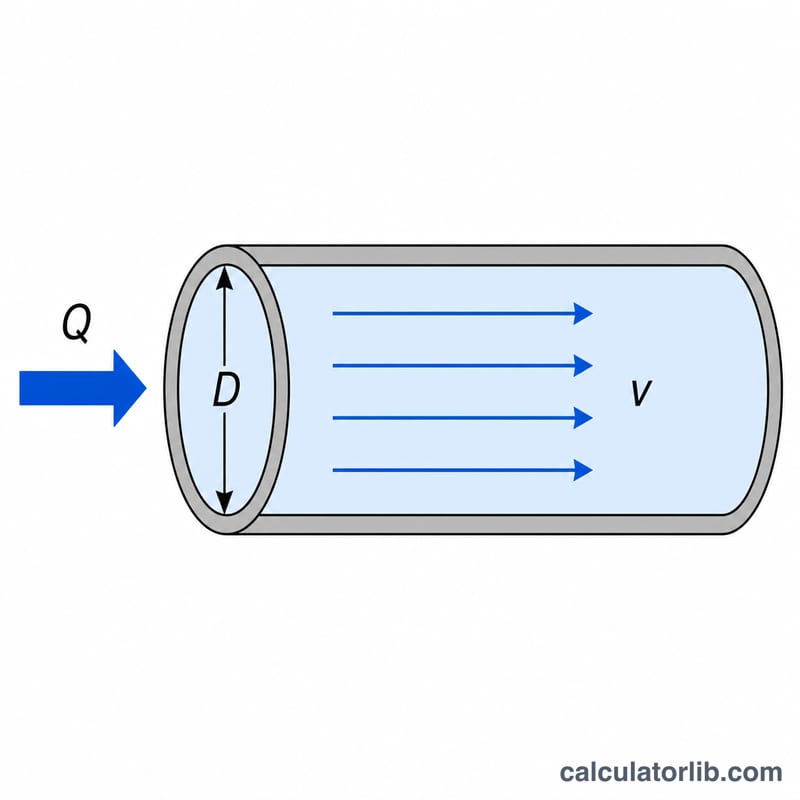
The continuity equation states that flow rate equals velocity times area: \(Q = v \cdot A\). For a round pipe the area is \(A = \pi D^{2} / 4\), where \(D\) is the inside diameter. Rearranging gives $$v = \frac{Q}{\frac{\pi}{4}\,D^{2}}$$ Because area grows with the square of the diameter, doubling the diameter cuts velocity to one quarter for the same flow.
Worked example
Suppose \(Q = 0.05\ \text{m}^3/\text{s}\) through a 100 mm (0.1 m) pipe. Area $$A = \pi \times 0.1^{2} / 4 = 0.0078539816\ \text{m}^2.$$ Velocity $$v = \frac{0.05}{0.0078539816} = \mathbf{6.366\ \text{m/s}}.$$ That is fast for water — a larger pipe would reduce the velocity.
FAQ
Should I use inside or outside diameter? Always use the inside (bore) diameter, since that is the actual flow area.
Is this the average or peak velocity? It is the cross-sectional average velocity. The local peak velocity at the pipe centre is higher in laminar flow.
Does this work for gases? Yes, as long as the gas is treated as roughly incompressible at the conditions of interest; for compressible high-speed flow density changes must be considered.