
What is the Venturi Flow Rate Calculator?
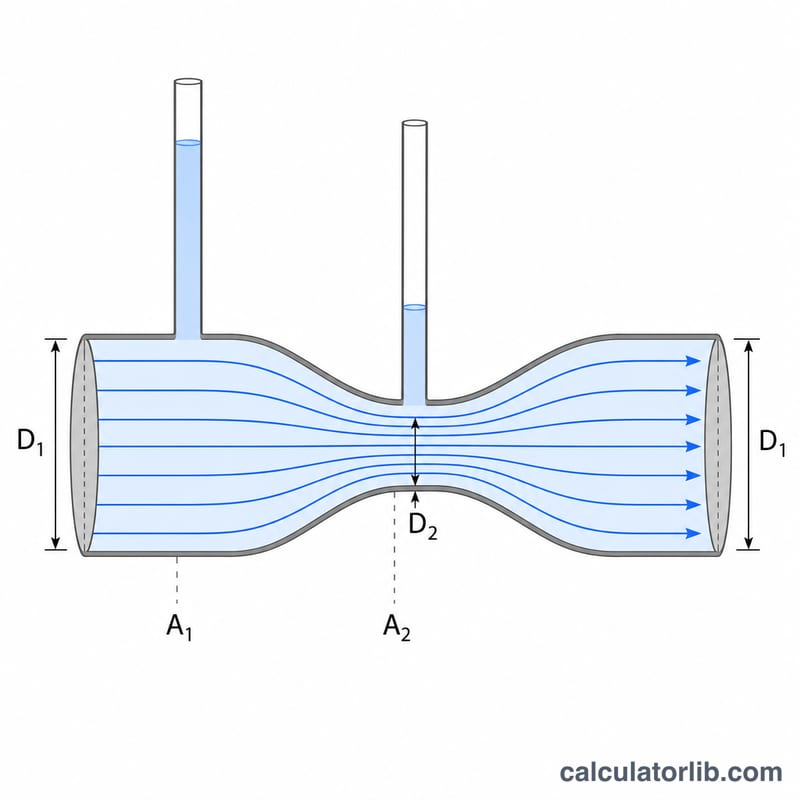
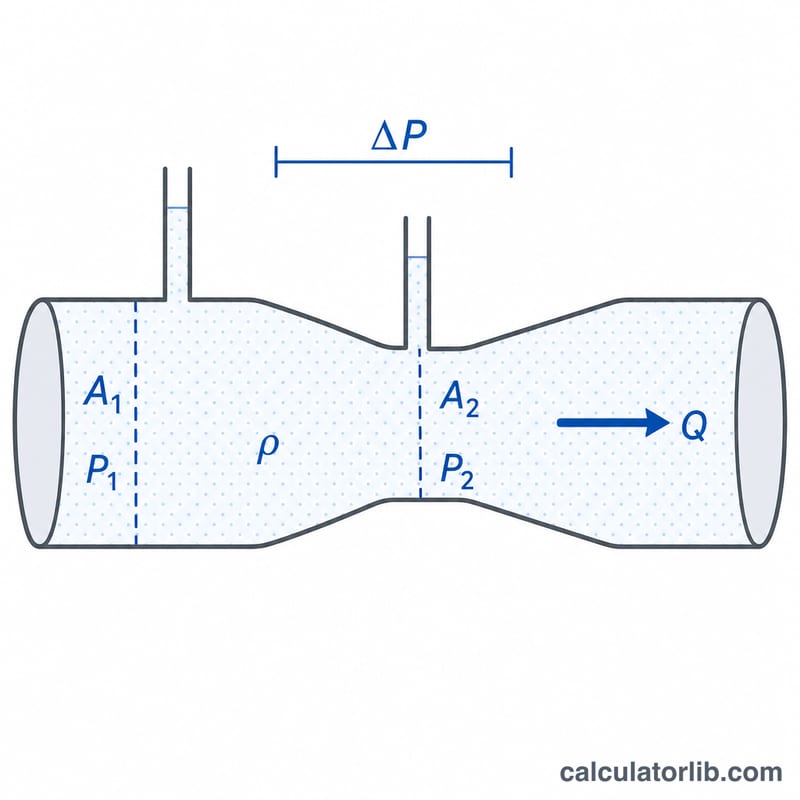
A Venturi meter measures the volumetric flow rate of a fluid through a pipe by exploiting Bernoulli's principle: as fluid accelerates through a narrowed throat, its pressure drops. By measuring that pressure difference between the inlet and the throat, you can compute the flow rate. This universal calculator works for any incompressible fluid in any consistent SI unit set.
How to use it
Enter the inlet diameter \(D_1\) and throat diameter \(D_2\) (in metres), the measured pressure difference \(\Delta P\) (in pascals), the fluid density \(\rho\) (in kg/m³), and the discharge coefficient \(C_d\) (typically 0.95–0.99 for a well-made Venturi). The calculator returns the volumetric flow rate in m³/s and L/s, the throat velocity, and both cross-sectional areas.
The formula explained
The governing equation is:
$$Q = \text{C}_d \cdot A_2 \cdot \sqrt{\dfrac{2\,\Delta P}{\rho\left(1 - \left(\frac{A_2}{A_1}\right)^2\right)}}$$
where \(A_1 = \frac{\pi}{4}\text{D}_1^{2}\) and \(A_2 = \frac{\pi}{4}\text{D}_2^{2}\) are the inlet and throat areas. The discharge coefficient \(C_d\) corrects for real-world friction and non-ideal flow. The throat velocity is simply \(v_2 = Q/A_2\).
Worked example
For \(D_1 = 0.1\) m, \(D_2 = 0.05\) m, \(\Delta P = 5000\) Pa, \(\rho = 1000\) kg/m³ and \(C_d = 1\): \(A_1 = 0.0078540\) m², \(A_2 = 0.0019635\) m², area ratio \(= 0.25\), so \(1 - 0.25^2 = 0.9375\). Then $$Q = 1 \times 0.0019635 \times \sqrt{\frac{10000}{937.5}} = 1 \times 0.0019635 \times 3.2660 = 0.006413 \text{ m}^3/\text{s},$$ and throat velocity \(= 0.006413 / 0.0019635 \approx 3.266\) m/s. With \(C_d = 0.98\), velocity scales to about 3.20 m/s.
FAQ
What value should I use for \(C_d\)? A classical Venturi tube typically has a discharge coefficient between 0.95 and 0.99. Use 1.0 for an idealized theoretical calculation.
Does this work for gases? The equation assumes an incompressible fluid, so it is accurate for liquids and for gases at low velocity/low pressure-drop. For compressible flow you need an expansibility factor.
Why is the throat velocity higher than the inlet velocity? Conservation of mass (continuity) forces the fluid to speed up through the smaller throat area, which is exactly why the pressure drops there.