
What is the IV Flow Rate Calculator?
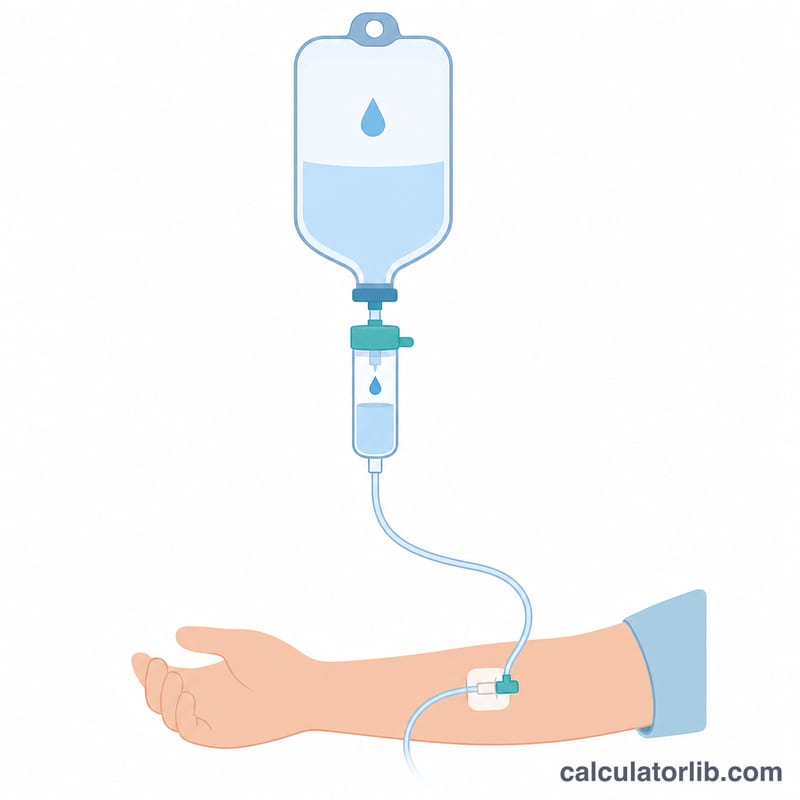
This calculator determines the intravenous (IV) flow rate in milliliters per hour (mL/hr) and, optionally, the manual drip rate in drops per minute (gtt/min). It is a quick bedside tool for nurses, students, and clinicians who need to set an infusion pump or regulate a gravity drip accurately. The math is universal and not tied to any country.
How to use it
Enter the total volume to be infused (mL) and the total infusion time (hours). The calculator returns the pump rate in mL/hr. If you are using gravity tubing, choose the drop factor printed on the tubing package (commonly 10, 15, or 20 gtt/mL for macrodrip, 60 gtt/mL for microdrip) to also get the drip rate in gtt/min. Leave drop factor as "None" if you only need the pump rate.
The formula explained
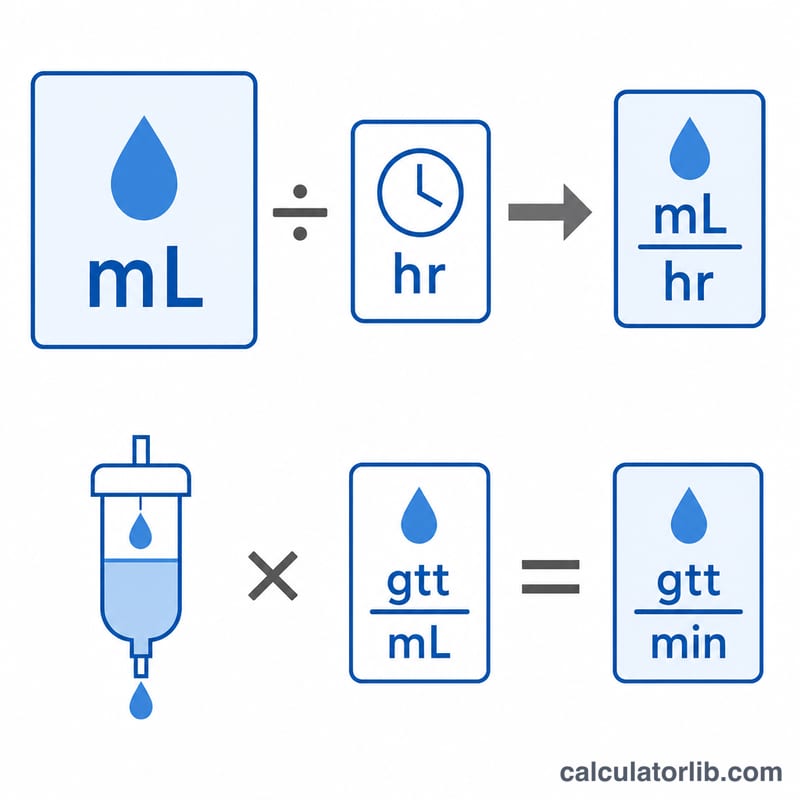
The flow rate is simply total volume divided by time: $$\text{mL/hr} = \frac{\text{Volume}}{\text{Time}}$$ To convert that into drops per minute for a gravity set, multiply by the drop factor and divide by 60 (minutes per hour): $$\text{gtt/min} = \frac{\text{mL/hr} \times \text{drop factor}}{60}$$ Drops per minute are usually rounded to the nearest whole drop in practice.
Worked example
Infusing 1000 mL over 8 hours gives $$1000 \div 8 = \textbf{125 mL/hr}.$$ With a 15 gtt/mL macrodrip set, the drip rate is $$\frac{125 \times 15}{60} = \frac{1875}{60} = \textbf{31.25 gtt/min},$$ which rounds to 31 drops per minute.
FAQ
Do I need a drop factor? Only for manual gravity drips. Infusion pumps are set directly in mL/hr, so the drop factor is optional.
What is the difference between macrodrip and microdrip? Macrodrip tubing (10–20 gtt/mL) is used for routine and rapid infusions; microdrip tubing (60 gtt/mL) delivers small, precise volumes such as pediatric or critical medications.
What if time is in minutes? Convert minutes to hours (divide by 60) before entering the time, since this tool expects hours.