What Is FTP?
Functional Threshold Power (FTP) is the highest average power, measured in watts, that a cyclist can sustain for roughly one hour. It is the cornerstone metric for setting training zones, pacing time trials, and tracking fitness over time. Because a true one-hour all-out test is brutal, the most common practical method estimates FTP from a shorter 20-minute test.
How to Use This Calculator
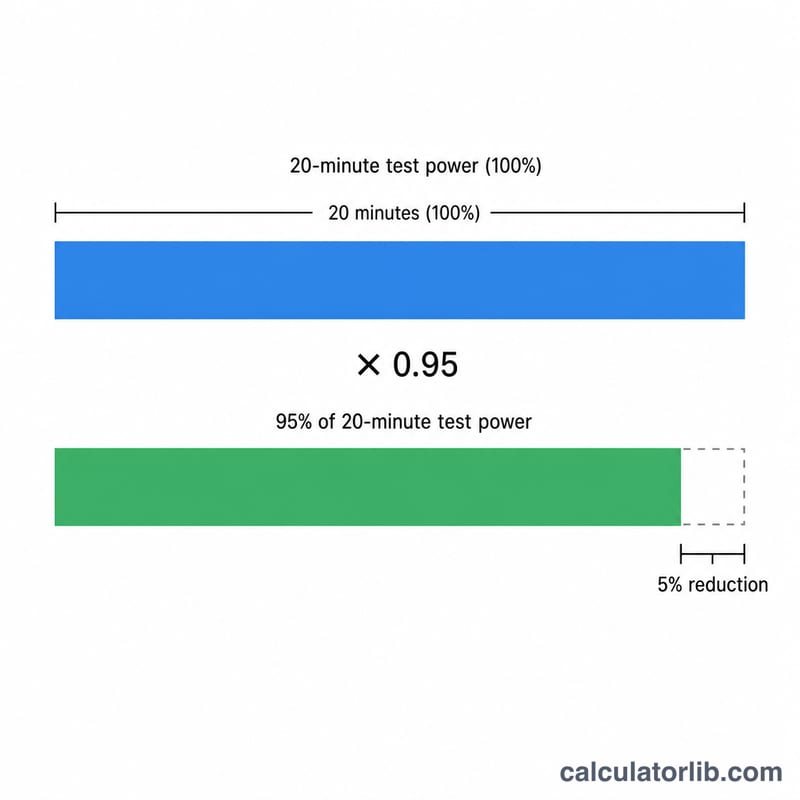
After a proper warm-up, ride as hard as you can sustain evenly for 20 minutes and record your average power. Enter that number in watts. Optionally enter your body weight in kilograms to also get your power-to-weight ratio (W/kg), which is useful for comparing climbing performance. The calculator multiplies your 20-minute power by 0.95 to estimate the power you could hold for an hour.
The Formula Explained
The equation is $$\text{FTP} = 0.95 \times P_{20\text{min}}$$ The 5% reduction accounts for the fact that you can produce more power over 20 minutes than over a full hour. Power-to-weight is simply FTP divided by your weight in kilograms: $$\text{W/kg} = \frac{\text{FTP}}{\text{weight}_{kg}}$$
Worked Example
Suppose your 20-minute test averaged 280 watts and you weigh 70 kg. $$\text{FTP} = 0.95 \times 280 = \textbf{266 watts}$$ Power-to-weight = \(266 \div 70 \approx 3.8\ \text{W/kg}\). You would then build training zones around 266 W (e.g. sweet spot at 88–94%, threshold at 95–105%).
Coggan Power Training Zones (% of FTP)
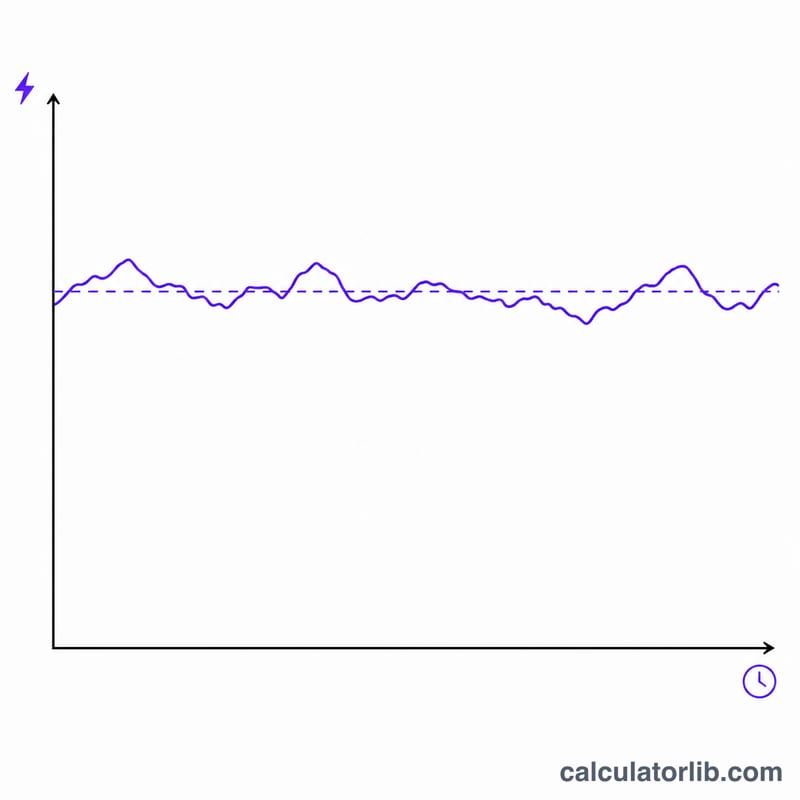
Andrew Coggan's 7-level power zones express training intensity as a percentage of FTP. The watt column uses an example FTP of 266 W, which is what a 20-minute average of 280 W gives: \(0.95 \times 280 = \)266 W.
| Zone | Name | % of FTP | Watts (FTP 266 W) |
|---|---|---|---|
| 1 | Active Recovery | <55% | <146 W |
| 2 | Endurance | 56–75% | 149–200 W |
| 3 | Tempo | 76–90% | 202–239 W |
| 4 | Lactate Threshold | 91–105% | 242–279 W |
| 5 | VO2max | 106–120% | 282–319 W |
| 6 | Anaerobic Capacity | 121–150% | 322–399 W |
| 7 | Neuromuscular Power | Maximal effort (not defined by % of FTP) | Very short, all-out efforts |
Watt values are rounded to the nearest whole watt. For example, \(0.91 \times 266 \approx 242\) W and \(1.05 \times 266 \approx 279\) W.
Typical W/kg Ranges by Rider Level
The table below gives approximate FTP-per-kilogram bands in the style of Coggan power profiling (from Training and Racing with a Power Meter). The figures are rounded, approximate population guides. Published versions differ by source, so treat the boundaries as rough indicators rather than exact cut-offs.
| Category | Men (W/kg, approx.) | Women (W/kg, approx.) |
|---|---|---|
| Untrained | below 2.0 | below 1.6 |
| Fair | 2.0–2.8 | 1.6–2.3 |
| Moderate | 2.8–3.5 | 2.3–2.9 |
| Good | 3.5–4.2 | 2.9–3.5 |
| Very good | 4.2–4.9 | 3.5–4.1 |
| Excellent | 4.9–5.6 | 4.1–4.7 |
| Exceptional | 5.6–6.4 | 4.7–5.3 |
| World class | above about 6.4 | above about 5.3 |
Your W/kg is \(\text{FTP} \div \text{body mass (kg)}\). For example, 266 W at 70 kg is \(266 \div 70 = 3.8\) W/kg.
Interpreting Your FTP Result
What FTP represents. FTP is the highest power a rider can roughly sustain in a quasi-steady state for about an hour. It approximates the lactate threshold, or maximal metabolic steady state, but it is a performance estimate and not a direct lab measurement of either.
W/kg versus absolute watts. On steep, prolonged climbs, gravity is the main resistance. Speed therefore depends largely on power-to-weight, so W/kg is the more useful number there. On flat terrain, aerodynamic drag dominates. Absolute watts and aerodynamic position (CdA) matter more, so a heavier rider with a high absolute FTP can be fast on the flat even with an average W/kg.
The 0.95 factor. The formula \(\text{FTP} = 0.95 \times P_{20}\) assumes your 20-minute power is about 5% above your one-hour power. This is an average rule of thumb. The true gap varies between individuals, depending on whether a rider is more anaerobic or more endurance-oriented, and the factor may over- or underestimate FTP.
Caveats.
- Pacing errors: starting too hard and fading, or finishing with energy left, distorts the 20-minute average.
- Fatigue and recovery: a test done on tired legs, or after poor sleep or nutrition, will read low.
- Test conditions: heat, altitude, indoor versus outdoor riding, and power meter calibration all affect the result. Comparing results is most reliable when the same equipment and setup are used.
- Context: FTP can change with training, so retesting periodically keeps training zones relevant.
This is general information about how the metric is used, not individualized training advice.
FAQ
Is the 20-minute test accurate? It is a widely used estimate. Pacing matters — go out too hard and you'll fade, underestimating FTP.
How often should I retest? Every 4–8 weeks of focused training is typical to track progress.
Can I use a ramp test instead? Yes, but ramp tests use a different multiplier; this calculator is specific to the 20-minute protocol.