
What are cycling power zones?
Power zones split your training intensity into ranges defined as percentages of your Functional Threshold Power (FTP) — the highest average power you can sustain for about an hour. Training by power zone lets you target a specific physiological adaptation (fat burning, sustained endurance, lactate threshold, VO₂ max) instead of guessing by feel. This calculator uses the widely adopted Andrew Coggan 7-zone model.
How to use this calculator
Enter your current FTP in watts and the calculator instantly returns the watt ranges for all seven zones. If you don't know your FTP, estimate it as roughly 95% of your best 20-minute average power, or take a dedicated FTP test. Re-test every 4–6 weeks and update the number, since fitness gains shift every zone upward.
The formula explained
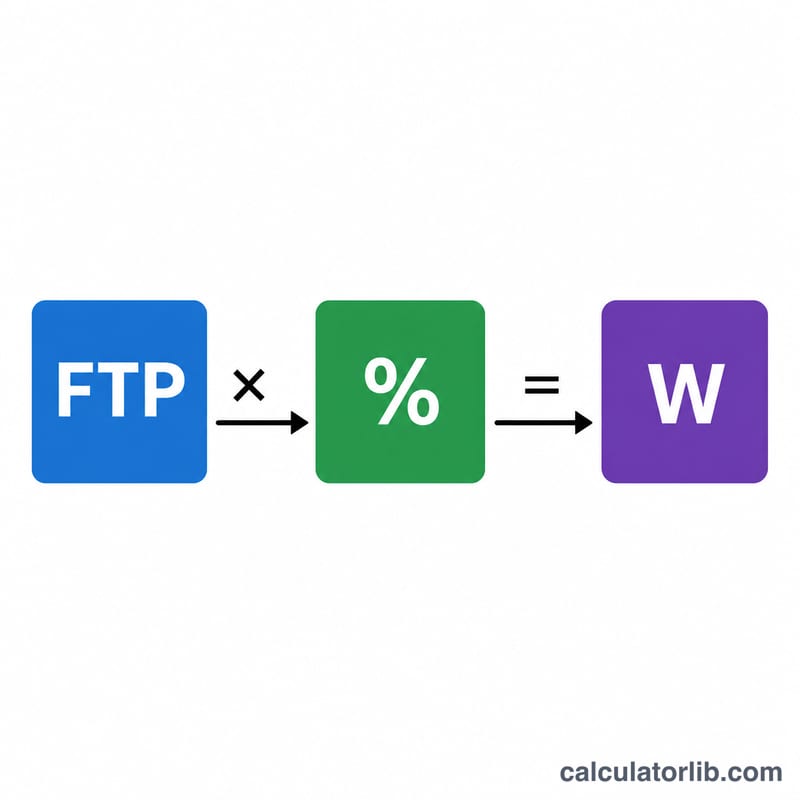
Every zone boundary is simply your FTP multiplied by a percentage: Zone watts = FTP × percent.
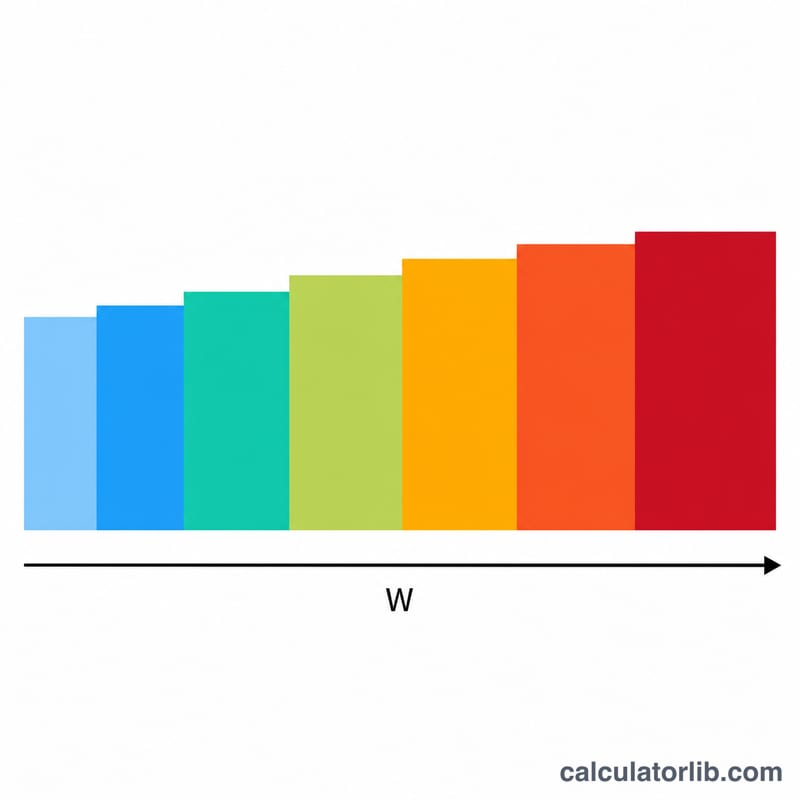
$$\text{Zone Bound} = \text{FTP (W)} \times \%_{\text{FTP}}$$The Coggan model defines the boundaries as: Z1 ≤55%, Z2 56–75%, Z3 76–90%, Z4 91–105%, Z5 106–120%, Z6 121–150%, and Z7 >150% (neuromuscular sprints).
Worked example
Suppose your FTP is 250 W. Zone 2 (Endurance) runs from \(250 \times 0.56 = 140\) W up to \(250 \times 0.75 = 188\) W. Zone 4 (Threshold) runs from \(250 \times 0.91 = 228\) W to \(250 \times 1.05 = 263\) W. So a steady endurance ride should keep you around 140–188 W, while threshold intervals push you to roughly 228–263 W.
FAQ
Do these zones work for heart rate too? No — these are power (watt) zones. Heart-rate zones use different percentages of threshold HR and lag behind effort.
Why does Z4 go above 100%? FTP is defined near the threshold midpoint, so the threshold zone straddles it (91–105%). Short threshold efforts can briefly exceed FTP.
How often should I update my FTP? Every 4–6 weeks, or after a noticeable change in fitness, so your zones stay accurate.