
What Is the Power of 2 Calculator?
The Power of 2 Calculator computes 2 raised to the power of n, written as \(2^{n}\). Powers of two appear everywhere in computing — memory sizes, binary numbers, data structures, and storage units (kilobytes, megabytes, gigabytes) are all built on them. This tool gives you the exact value for any exponent, including negative exponents and decimals.
How to Use It
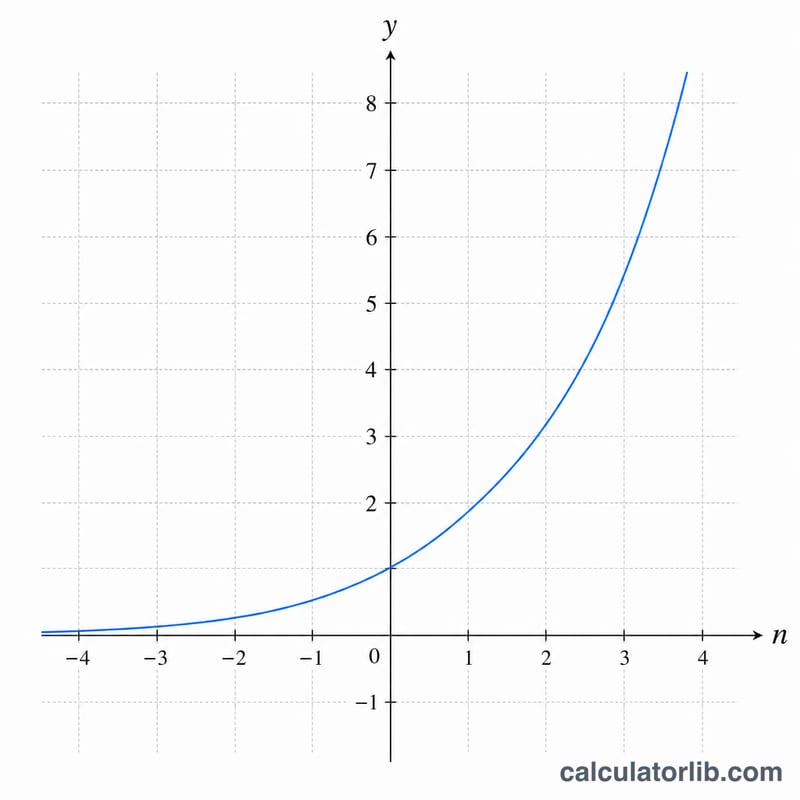
Enter the exponent n in the input box and submit. The calculator returns \(2^{n}\). Use whole numbers like 10 or 16 for typical binary calculations, negative numbers like -3 for fractions (\(2^{-3} = 0.125\)), or decimals like 0.5 for roots (\(2^{0.5} \approx 1.414\), the square root of 2).
The Formula Explained
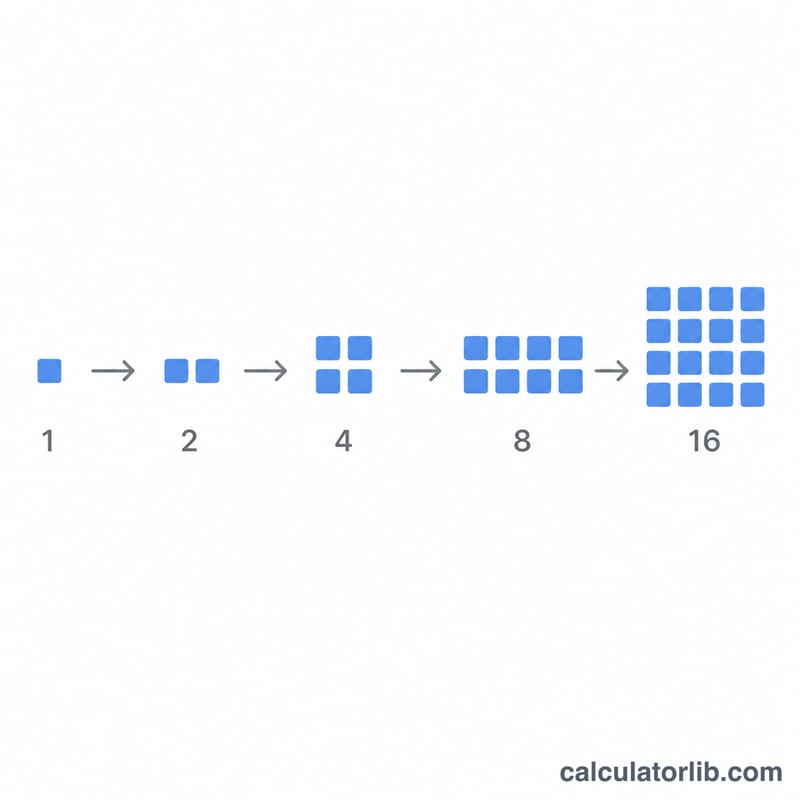
The formula is simply $$\text{result} = 2^{n}$$ Multiplying 2 by itself n times doubles the value with each step: \(2^{1}=2\), \(2^{2}=4\), \(2^{3}=8\), and so on. For negative exponents, \(2^{-n} = 1 \div 2^{n}\). For fractional exponents, \(2^{1/2}\) equals the square root of 2.
Worked Example
Suppose you want to know how many distinct values can be stored in 10 bits. That is \(2^{10}\). Calculating: $$2 \times 2 \times \dots \text{ (ten times)} = 1{,}024$$ So 10 bits can represent 1,024 different values — which is also why a kilobyte is often defined as 1,024 bytes.
FAQ
What is 2 to the power of 0? Any nonzero number raised to the power 0 equals 1, so \(2^{0} = 1\).
Can I use negative exponents? Yes. \(2^{-2} = 1/4 = 0.25\).
Can I use decimal exponents? Yes. For example \(2^{0.5} \approx 1.41421\), the square root of 2.