
What is the Power / Exponent Calculator?
This tool computes x raised to the power y, written as \(x^y\) or xy. Exponentiation means multiplying the base x by itself y times when y is a whole number, and it extends naturally to fractional, negative and zero exponents. The calculator accepts any real base and any real exponent and returns the exact double-precision value.
How to use it
Enter the base (x) and the exponent (y), choose how many decimal places to display, and read the result instantly. Both inputs are pure dimensionless numbers, so there are no units to pick.
The formula explained
The core rule is simply $$\text{result} = x^y$$ Useful special cases:
- \(x^0 = 1\) for any base (including \(0^0 = 1\) by convention here).
- \(1^y = 1\) for any exponent.
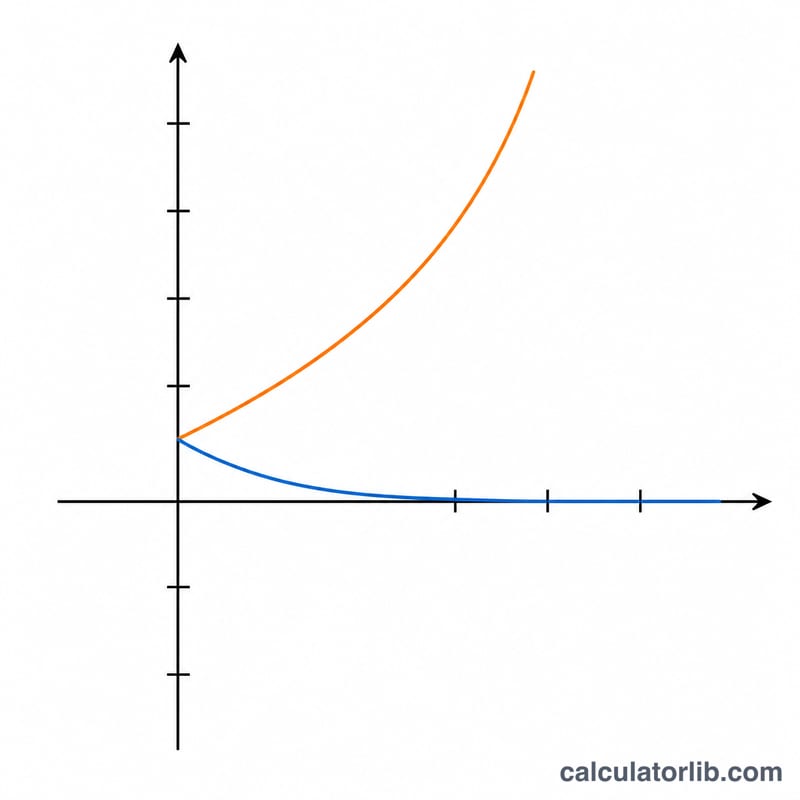
- \(x^{-y} = 1 / x^y\) — a negative exponent gives the reciprocal.
- \(0^y\) = 0 if \(y > 0\), 1 if \(y = 0\), and +infinity if \(y < 0\) (dividing by zero diverges).
Worked example
For \(x = 3\) and \(y = 1.5\): $$3^{1.5} = 3^1 \times 3^{0.5} = 3 \times \sqrt{3} = 3 \times 1.7320508 = \mathbf{5.196152422706632}$$
FAQ
Why does a negative base with a fractional exponent show "undefined"? Something like \((-2)^{0.5}\) is the square root of a negative number, which is a complex value. This is a real-valued calculator, so it reports the result as undefined rather than an imaginary number.
Why does my answer say Infinity? Either you raised 0 to a negative power, or the magnitude exceeded the range of standard double precision (about \(1.8 \times 10^{308}\)).
Is \(0^0\) really 1? Yes — by the common convention used here, \(0^0\) is defined as 1.