
What Is a Power Set?
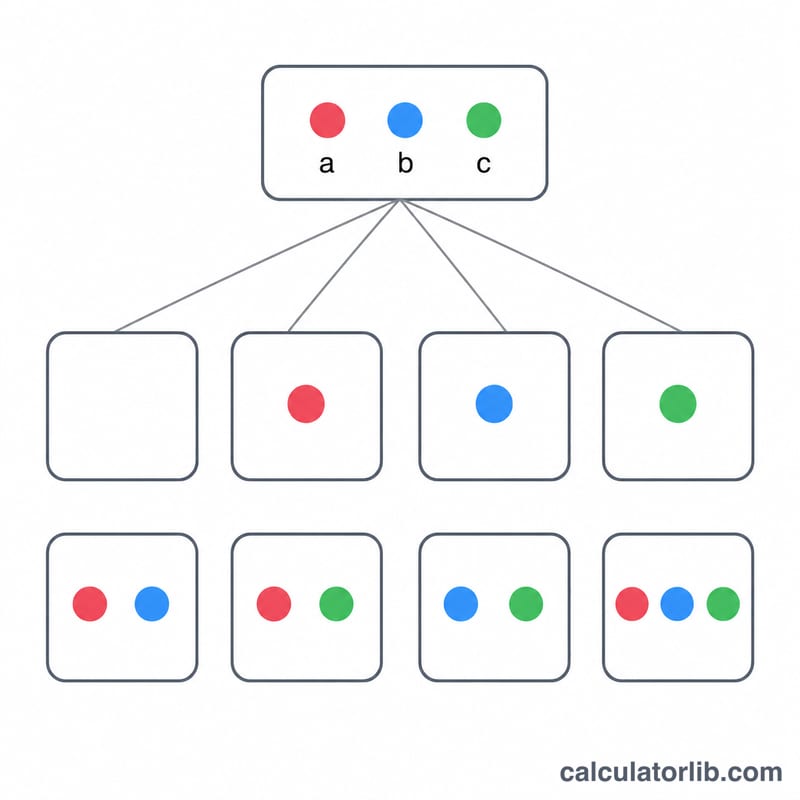
The power set of a set S, written P(S), is the set of all possible subsets of S — from the empty set ∅ all the way up to S itself. For example, the power set of {a, b} is { {}, {a}, {b}, {a, b} }. This Power Set Calculator counts how many subsets a set has and, for small sets, lists every single one of them.
The Formula Explained
If a set S has n distinct elements (its cardinality \(|S| = n\)), then the number of subsets is exactly \(2^{n}\). The reasoning is simple: for each element you make an independent binary choice — include it in the subset or leave it out. With n independent yes/no choices, you get $$2 \times 2 \times \cdots \times 2 = 2^{n}$$ distinct combinations, and each combination is one subset.
$$\left| \mathcal{P}(S) \right| = 2^{n}, \quad n = \left| \text{Distinct Elements} \right|$$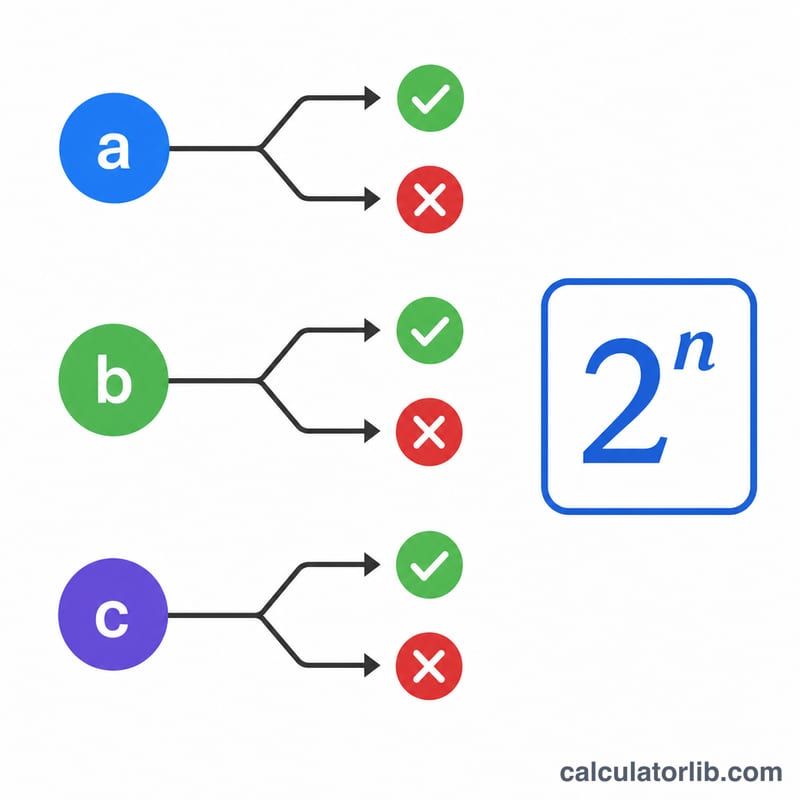
How to Use the Calculator
Type the elements of your set separated by commas (for example 1, 2, 3 or red, green, blue). Duplicate entries are ignored automatically, because sets contain only distinct elements. Choose whether you want the full list of subsets — listing is only shown for sets of 12 or fewer elements, since \(2^{13}\) already exceeds 8,000 subsets.
Worked Example
Take S = {a, b, c}, so \(n = 3\). The number of subsets is $$2^{3} = 8.$$ They are: {}, {a}, {b}, {c}, {a, b}, {a, c}, {b, c}, and {a, b, c}. Notice the empty set and the full set are both included — that is what makes it a power set.
FAQ
Is the empty set always included? Yes. Every power set contains the empty set ∅ and the original set S itself.
What is the power set of the empty set? It has \(2^{0} = 1\) element, namely { {} } — a set containing just the empty set.
Why doesn't it list subsets for big sets? A set of 20 elements has over a million subsets, which is impractical to display. The count (\(2^{n}\)) is always shown regardless of size.