
What is the n×n Matrix Determinant Calculator?
This tool computes the determinant \(\det(A)\) of any square n×n matrix of real numbers, plus its reciprocal \(\frac{1}{\det(A)}\). The determinant is a single number that tells you whether a matrix is invertible (det ≠ 0) or singular (det = 0), and it appears throughout linear algebra, geometry (signed volume scaling) and systems of equations. The math is universal — it works the same everywhere.
How to use it
Set the matrix size n (1 to 10), then fill in each entry aij in the grid. Entries may be negative, decimal or zero. Pick how many digits to display if you want extra precision. The calculator returns the determinant and, when the matrix is invertible, the reciprocal \(\frac{1}{\det(A)}\). If the determinant is zero it flags the matrix as singular and reports the reciprocal as undefined.
The formula
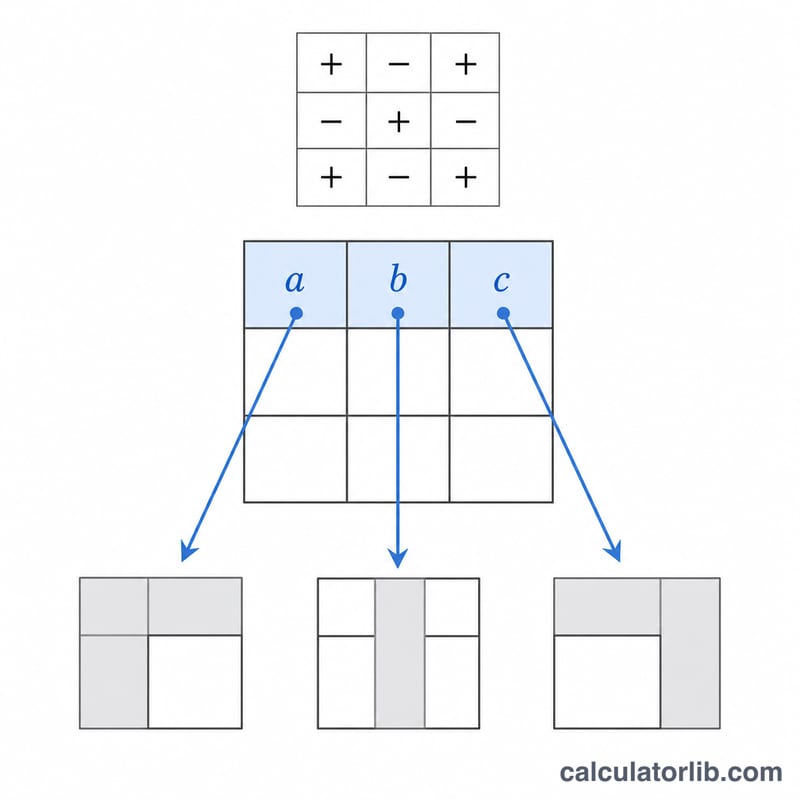
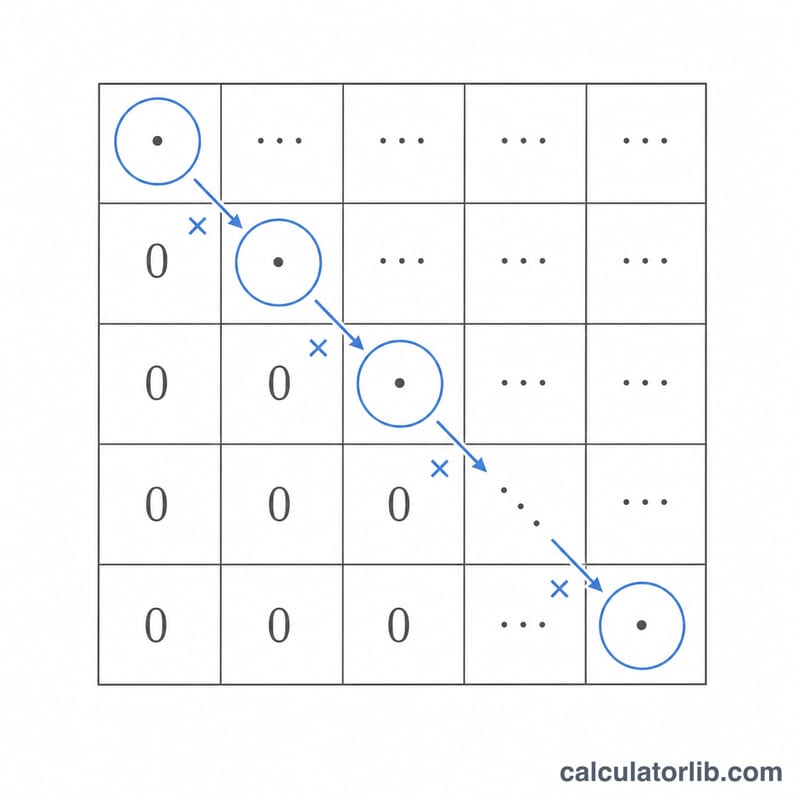
The determinant can be defined by Laplace (cofactor) expansion along a row: $$\det(A) = \sum_{j} a_{ij}\cdot(-1)^{i+j}\cdot M_{ij}$$ where \(M_{ij}\) is the minor obtained by deleting row i and column j. For \(n = 2\), \(\det = a_{11}a_{22} - a_{21}a_{12}\). For numerical stability and speed this calculator instead uses Gaussian elimination with partial pivoting: reduce A to upper-triangular form, track row-swap sign changes, and multiply the diagonal pivots — $$\det(A) = \operatorname{sign} \cdot \prod_{k=1}^{\text{n}} U_{kk}$$
Worked example
For A = [[1,2,3],[4,5,6],[7,8,10]]: $$\det = 1(5\cdot10 - 6\cdot8) - 2(4\cdot10 - 6\cdot7) + 3(4\cdot8 - 5\cdot7) = 1(2) - 2(-2) + 3(-3) = 2 + 4 - 9 = -3$$ So \(\det(A) = -3\) and \(\frac{1}{\det(A)} \approx -0.3333\).
FAQ
What does a determinant of 0 mean? The matrix is singular: its rows or columns are linearly dependent, it has no inverse, and \(\frac{1}{\det(A)}\) is undefined.
Can entries be decimals or negative? Yes — any real numbers are accepted.
Why use elimination instead of cofactor expansion? Cofactor expansion costs \(O(n!)\) operations; Gaussian elimination is \(O(n^3)\) and numerically stable for larger matrices.