
What is a Matrix Inverse?
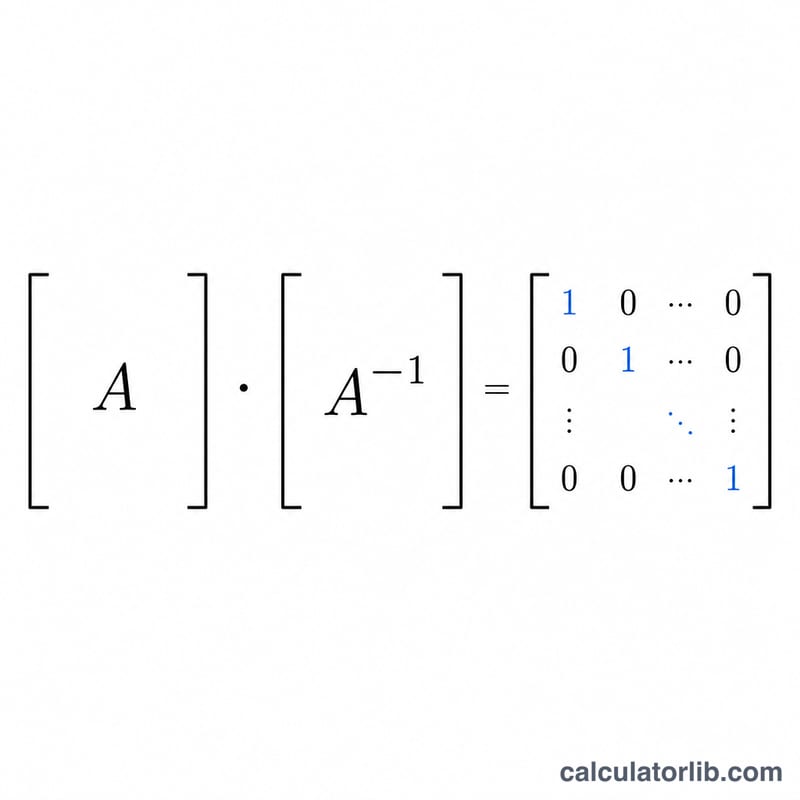
The inverse of a square matrix A, written \(A^{-1}\), is the matrix that satisfies \(A\cdot A^{-1} = A^{-1}\cdot A = I\), where \(I\) is the identity matrix. An inverse exists only when the matrix is non-singular — that is, when its determinant is not zero. This calculator finds the determinant and inverse of any 2×2 or 3×3 matrix.
How to Use This Calculator
Select whether your matrix is 2×2 or 3×3, then type each entry into the labelled cells (\(a_{11}\) is the top-left element, \(a_{23}\) is row 2 column 3, and so on). For a 2×2 matrix only the top-left four cells are used. Press calculate to see the determinant and, if it is non-zero, the full inverse matrix.
The Formula Explained
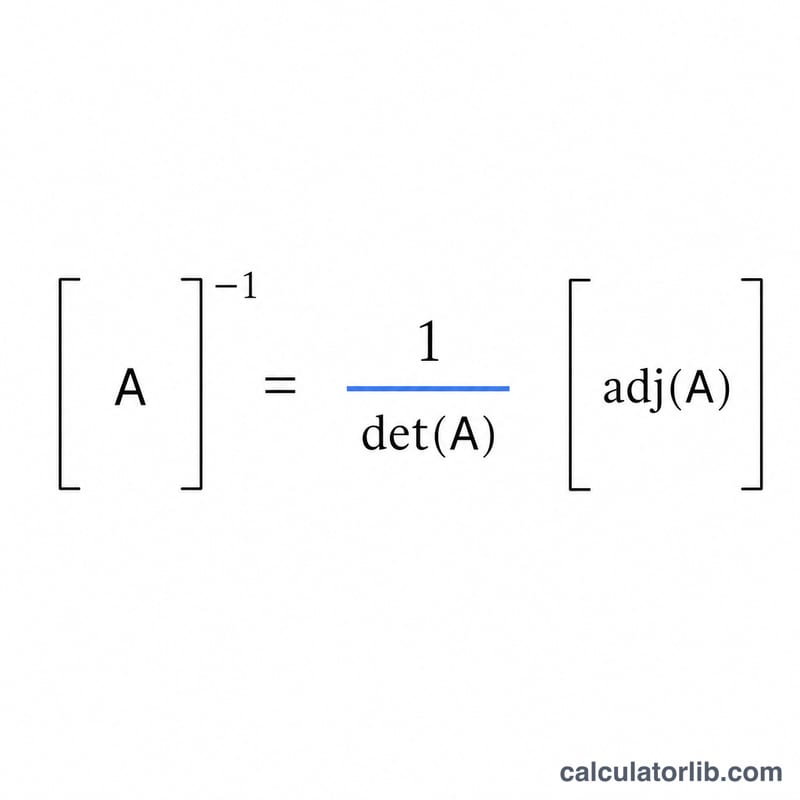
The inverse is computed as $$A^{-1} = \frac{1}{\det A}\,\operatorname{adj}(A)$$ The adjugate, \(\operatorname{adj}(A)\), is the transpose of the cofactor matrix. Each cofactor is a signed minor of the original matrix. Dividing the adjugate by the determinant rescales it so the product with A gives the identity. If \(\det A = 0\) the division is undefined and the matrix has no inverse — it is called singular.
Worked Example
Take the 2×2 matrix \(\begin{bmatrix} 4 & 7 \\ 2 & 6 \end{bmatrix}\). The determinant is $$4\cdot 6 - 7\cdot 2 = 24 - 14 = 10$$ The inverse is $$\frac{1}{10}\begin{bmatrix} 6 & -7 \\ -2 & 4 \end{bmatrix} = \begin{bmatrix} 0.6 & -0.7 \\ -0.2 & 0.4 \end{bmatrix}$$ You can verify by multiplying: the result is the identity matrix.
FAQ
Why is my matrix not invertible? Its determinant is zero. Singular matrices map space onto a lower dimension, so the operation cannot be reversed.
Does the order of rows matter? Yes — \(a_{11}\), \(a_{12}\), \(a_{21}\), \(a_{22}\) each occupy a fixed position, so enter values exactly as they appear in your matrix.
Can it handle larger matrices? This tool supports 2×2 and 3×3. Larger systems are usually solved with Gaussian elimination or software like NumPy.