
What Is Polynomial Long Division?
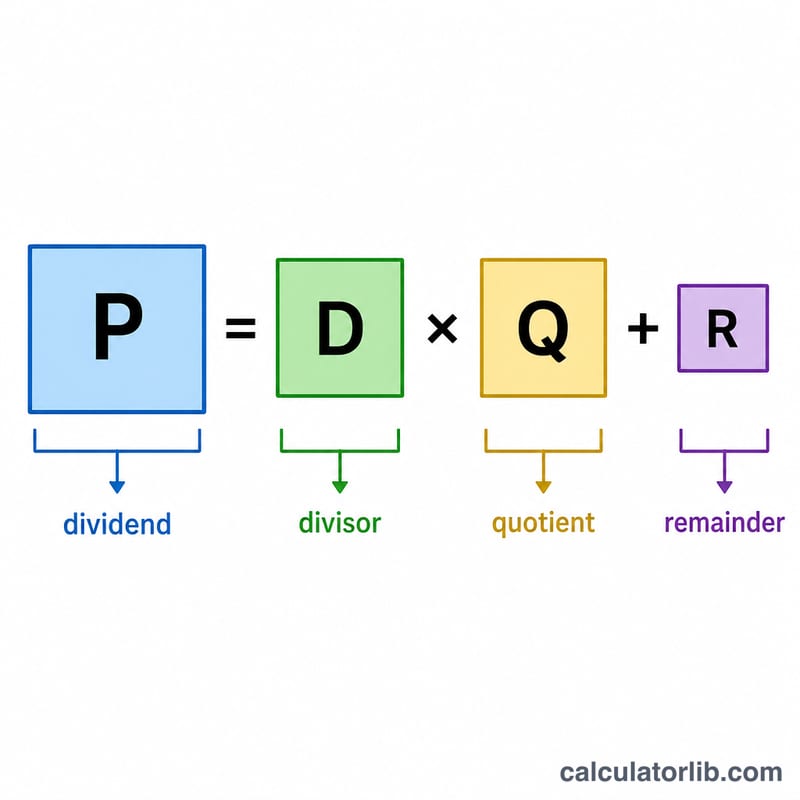
Polynomial long division is the algebraic analogue of the long division you learned for numbers. Given a dividend polynomial \(P(x)\) and a divisor polynomial \(D(x)\), it produces a quotient \(Q(x)\) and a remainder \(R(x)\) that satisfy the identity \(P(x) = D(x)\cdot Q(x) + R(x)\), where the degree of \(R(x)\) is strictly less than the degree of \(D(x)\). This calculator handles dividends and divisors of any degree.
How to Use This Calculator
Enter the coefficients of each polynomial from the highest degree term down to the constant, separated by spaces. Include zeros for any missing powers. For example, \(x^3 - 3x + 5\) has no \(x^2\) term, so you would type 1 0 -3 5. The divisor \(x - 2\) is typed as 1 -2. Press calculate to see the quotient and remainder.
The Formula Explained
$$\text{Dividend}(x) = Q(x)\cdot\text{Divisor}(x) + R(x)$$
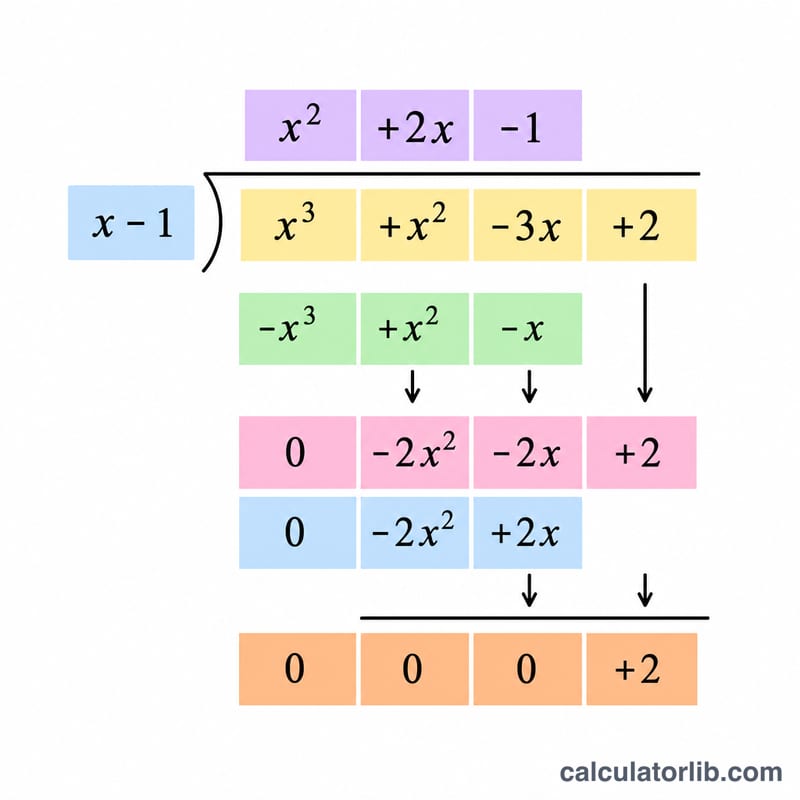
At each step you divide the leading term of the current dividend by the leading term of the divisor to get the next quotient term. You multiply the whole divisor by that term, subtract it from the dividend, and repeat with the new, lower-degree polynomial. When the running polynomial's degree drops below the divisor's degree, what remains is the remainder.
Worked Example
Divide \(x^2 - 3x + 5\) by \(x - 2\). Type dividend 1 -3 5 and divisor 1 -2. First, \(x^2 \div x = x\); subtracting \(x(x-2)=x^2-2x\) leaves \(-x + 5\). Then \(-x \div x = -1\); subtracting \(-1(x-2)=-x+2\) leaves \(3\). So \(Q(x) = x - 1\) and \(R(x) = 3\), meaning $$x^2-3x+5 = (x-2)(x-1) + 3.$$
FAQ
What if the divisor has higher degree than the dividend? Then the quotient is 0 and the entire dividend is the remainder.
How do I write missing terms? Use 0 as the coefficient for any power that is absent, keeping every position in order.
Does a remainder of 0 mean the divisor is a factor? Yes — if \(R(x) = 0\), the divisor divides the dividend exactly.