
What is the Long Division Calculator?
This calculator performs integer (Euclidean) division: it divides a dividend by a divisor and returns a whole-number quotient plus the remainder left over. It also reproduces the full step-by-step long-division layout, so students can check each line of hand-worked problems. It works for any positive whole numbers and stops at the integer remainder rather than continuing into decimals.
How to use it
Enter the Dividend (the number being divided, written inside the bracket) and the Divisor (the number you divide by, written outside the bracket). The tool returns the quotient, the remainder, an answer sentence in the form dividend / divisor = quotient R remainder, and the worked steps. The divisor must be greater than zero.
The formula explained
The quotient is the floor of the division: \( Q = \left\lfloor \frac{\text{Dividend}}{\text{Divisor}} \right\rfloor \), meaning you drop any fractional part. The remainder is then \( R = \text{Dividend} - \text{Divisor} \times Q \). Together they satisfy $$\text{Dividend} = \text{Divisor} \times Q + R$$ where the remainder is always between 0 and one less than the divisor.
Worked example
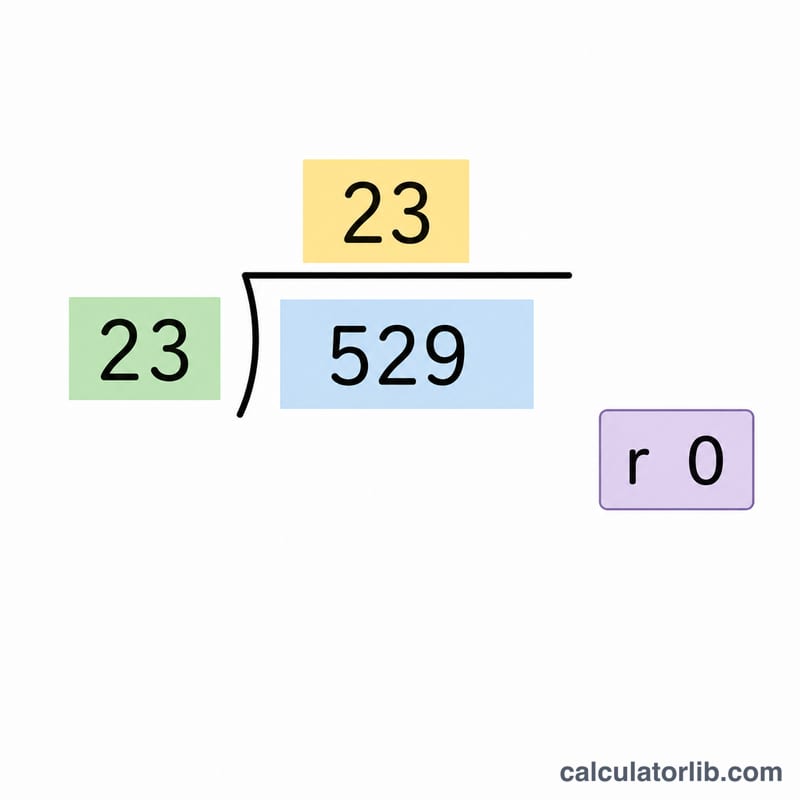
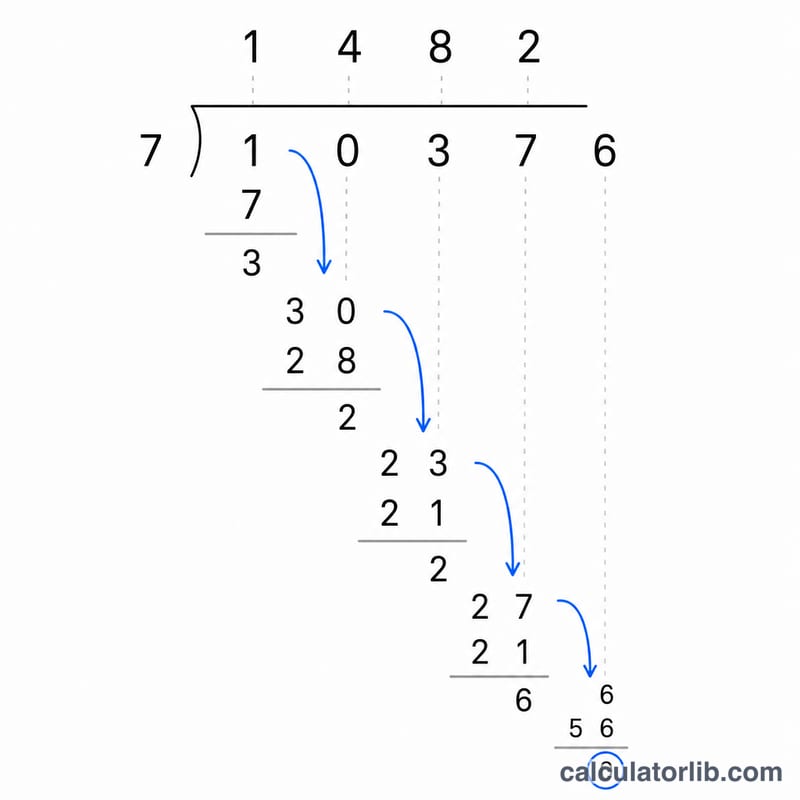
Divide 487 by 32. The quotient is \( \left\lfloor 487 / 32 \right\rfloor = \left\lfloor 15.21875 \right\rfloor = \) 15. The remainder is $$487 - (32 \times 15) = 487 - 480 = 7$$ Check: \( 32 \times 15 + 7 = 487 \). So the answer is "487 / 32 = 15 R 7". Working digit by digit: 4 / 32 = 0 (carry 4); bring down 8 to make 48, 48 / 32 = 1 (carry 16); bring down 7 to make 167, 167 / 32 = 5 (carry 7). The quotient digits 0, 1, 5 form 15 and the final carry 7 is the remainder.
FAQ
What if the divisor is bigger than the dividend? The quotient is 0 and the remainder equals the dividend, e.g. 4 / 32 = 0 R 4.
What if it divides evenly? The remainder is 0, for example 100 / 25 = 4 R 0.
Can I get a decimal answer? No - this tool deliberately stops at the integer remainder. For a decimal quotient you would continue dividing past the decimal point.