
What is the Long Multiplication Calculator?
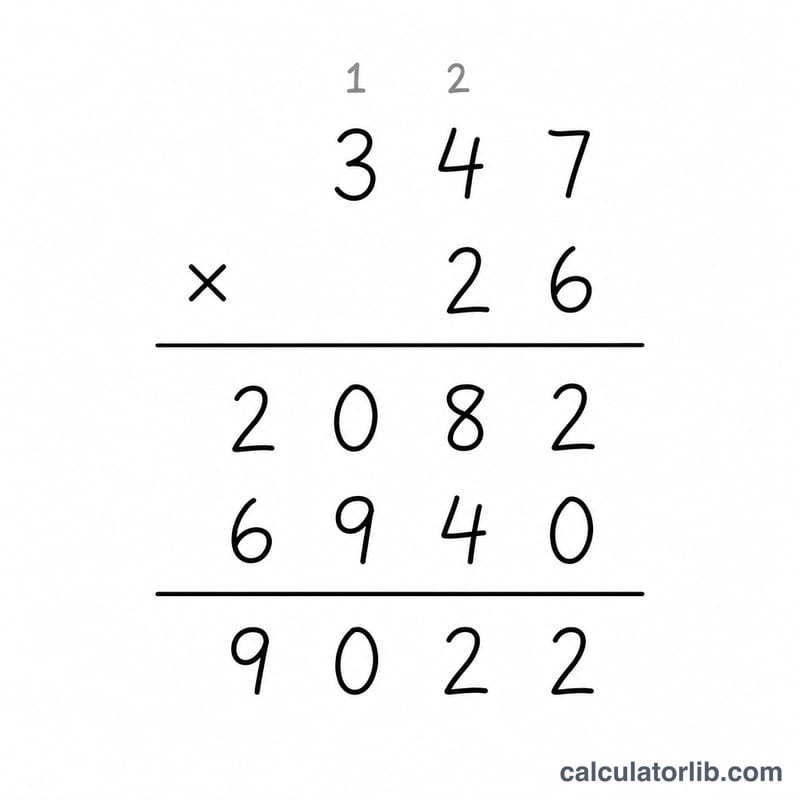
This tool multiplies two numbers using the standard algorithm for long multiplication — the column method taught in school. Beyond just giving the answer, it reproduces the full hand-written solution: a right-aligned digit grid, every partial product, the carry digits, and a plain-language step-by-step breakdown. It works with positive numbers, negative numbers, and decimals.
How to use it
Enter the Multiplicand (the top number) and the Multiplier (the bottom number), then read off the product and the worked solution. You can use a minus sign for negatives and a decimal point for fractions. The grid and steps are computed on the absolute, decimal-point-free values so the columns line up exactly as you would write them by hand.
The formula explained
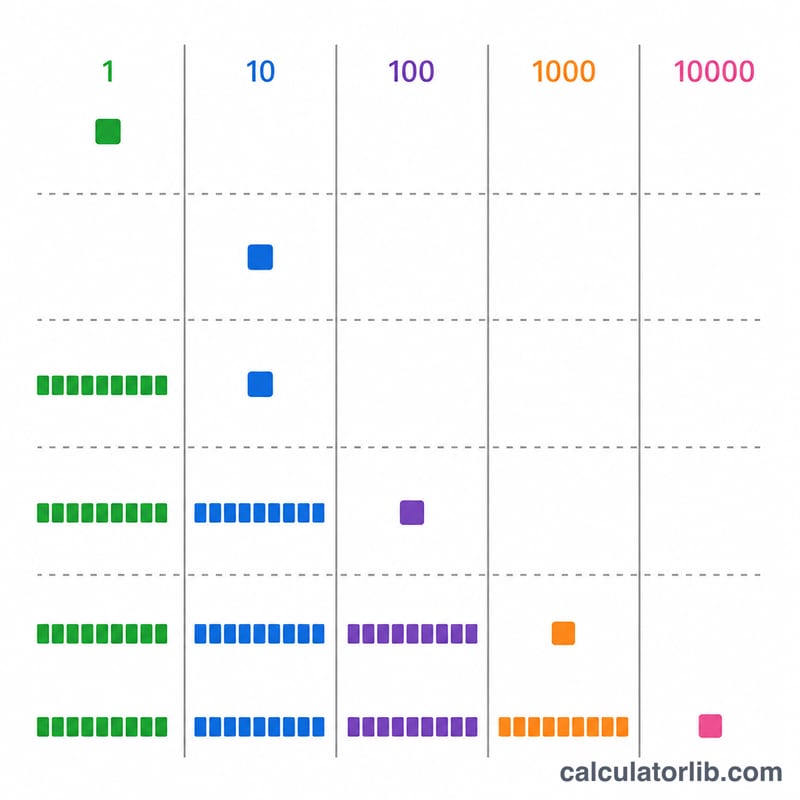
The product is simply $$\text{Product} = \text{Multiplicand} \times \text{Multiplier}$$ The algorithm shows how that result is built: take each digit of the multiplier from right to left at place k (ones = 0, tens = 1, ...), multiply the whole multiplicand by that single digit, and shift the partial product left by k columns. Summing every shifted partial product gives the final answer: $$\text{product} = \sum (|M| \cdot m_k) \times 10^k$$ Signs combine separately (negative \(\times\) negative = positive), and decimal places add: if the inputs have \(d_A\) and \(d_B\) fractional digits, the product has \(d_A + d_B\).
Worked example
For \(2552 \times 64\): multiply by the ones digit 4 to get $$2552 \times 4 = 10208$$ Multiply by the tens digit 6 to get \(2552 \times 6 = 15312\), then shift left one place \(\rightarrow 153120\). Add the partial products: $$10208 + 153120 = \mathbf{163{,}328}$$
FAQ
Does it handle decimals? Yes. For example \(2.55 \times 6.4\): drop the points to get \(255 \times 64 = 16320\), then place the point so there are 3 fractional digits \(\rightarrow 16.32\).
How are negatives treated? The grid is built from the magnitudes, and the final product gets the combined sign, so \(-2.5 \times 6 = -15\).
What if a multiplier digit is 0? That partial product is a row of zeros, still shifted into its column, and contributes nothing to the sum.