
What is the Decimal Multiplication Calculator?
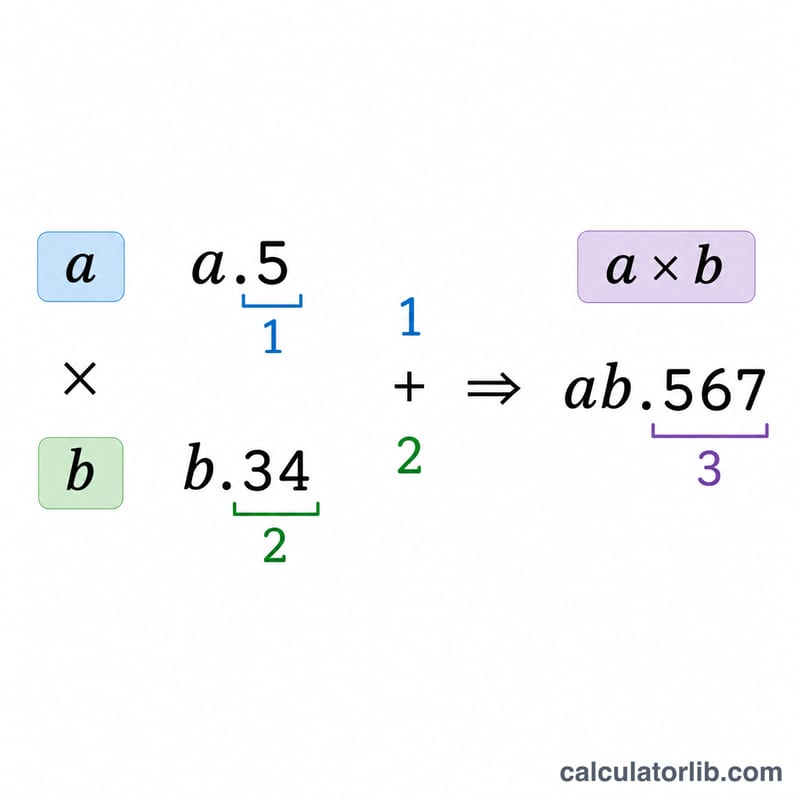
This calculator multiplies two decimal numbers and returns their exact product. It also shows the classic decimal-place rule that makes multiplying decimals easy to do by hand: count the digits after the decimal point in each factor, add those counts, and that is how many decimal places the answer has.
How to use it
Enter your first number (a) and second number (b). Each can be a whole number, a decimal, or a negative value. Press calculate and you'll see the product along with the number of decimal places in a, in b, and in the result.
The formula explained
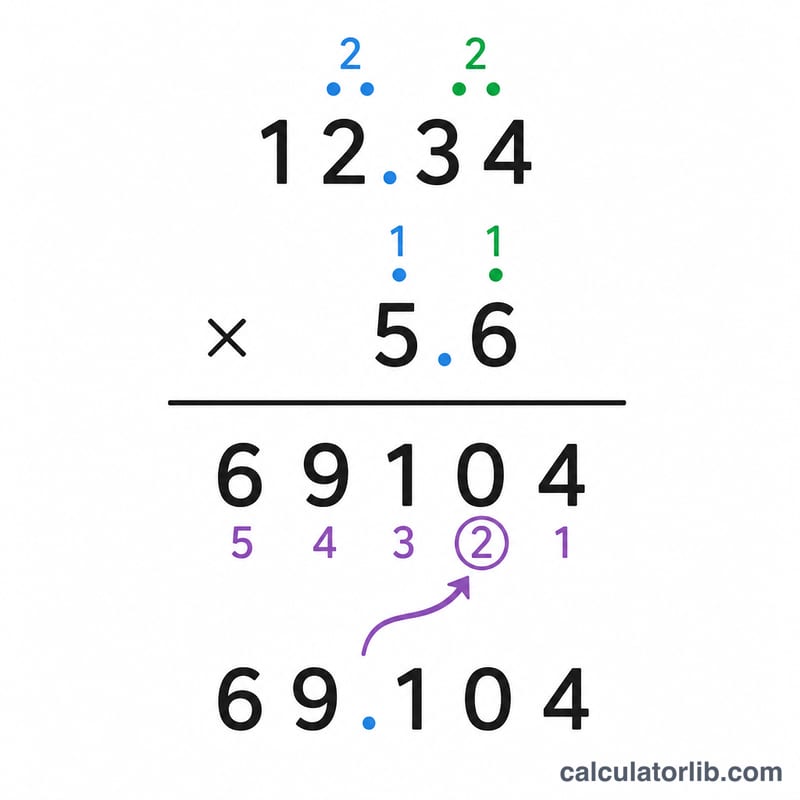
The product is simply $$\text{Product} = \text{a} \times \text{b}$$ To place the decimal point without a calculator, ignore the points and multiply the numbers as if they were whole. Then count the total decimal places in both factors and insert the point that many digits from the right of the answer: \(d(\text{product}) = d(a) + d(b)\).
Worked example
Multiply \(1.5 \times 2.4\). Ignoring decimals, $$15 \times 24 = 360.$$ The factor 1.5 has 1 decimal place and 2.4 has 1 decimal place, so the product has \(1 + 1 = 2\) decimal places. Placing the point two digits from the right of 360 gives \(3.60 = 3.6\).
FAQ
Why does the decimal-place count work? Each decimal place represents a division by ten. Multiplying a value with m places by one with n places multiplies the denominators (\(10^m \times 10^n = 10^{m+n}\)), giving m + n places.
What about trailing zeros? The rule predicts decimal places before trailing zeros are dropped. \(1.5 \times 2.4\) gives 3.60, which simplifies to 3.6.
Can I multiply negatives? Yes. A negative times a positive is negative; two negatives give a positive product.