
What Is Simple Interest?
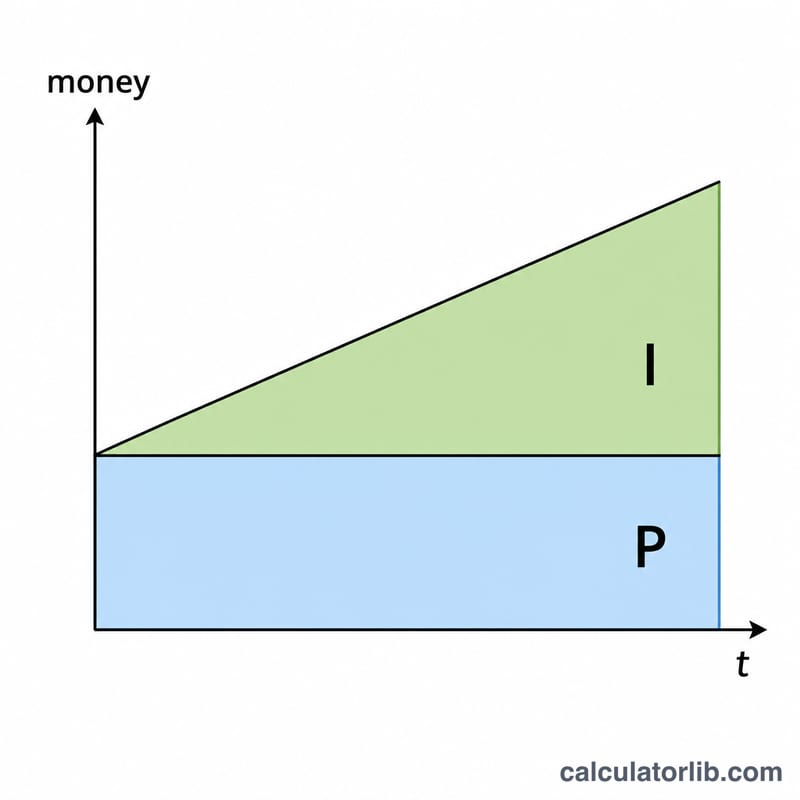
Simple interest is interest calculated only on the original amount of money you deposit or invest — the principal. Unlike compound interest, it does not earn interest on previously accumulated interest. This makes it easy to predict exactly how much a savings deposit, bond, or fixed-term account will pay out over time.
How to Use This Calculator
Enter three values: your initial deposit (principal), the annual interest rate as a percentage, and the time in years. The calculator instantly shows the interest you will earn and your total final balance.
The Formula Explained
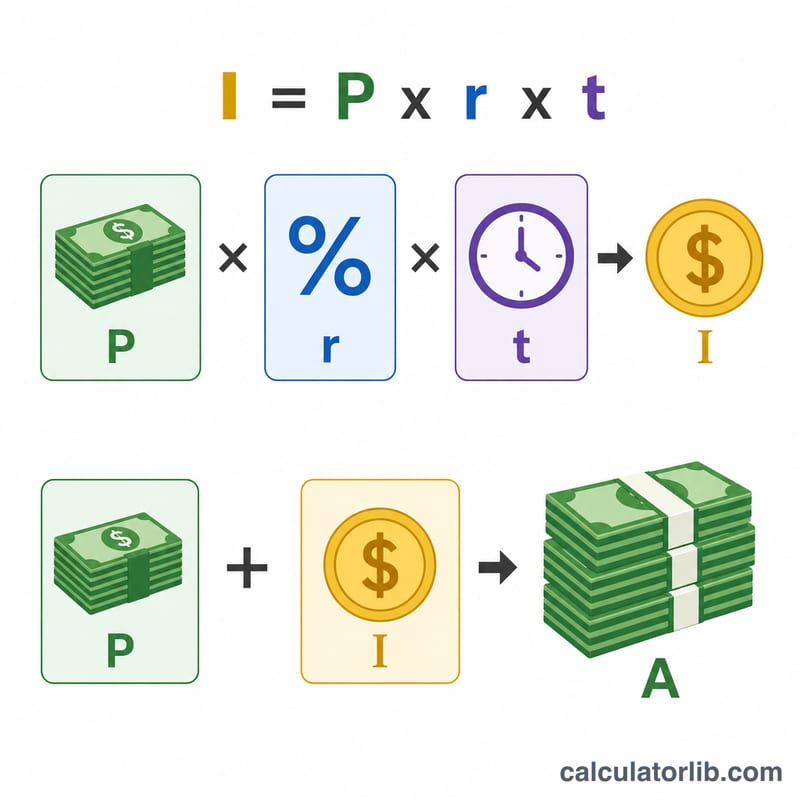
The core equation is $$I = P \times r \times t$$ where I is the interest, P is the principal, r is the annual rate as a decimal (\(5\% = 0.05\)), and t is the number of years. Your total balance is then \(A = P + I\). Because the rate is applied to the same principal each year, the interest earned per year stays constant.
Worked Example
Suppose you deposit $1,000 at an annual rate of 5% for 3 years. Convert the rate to a decimal: \(5\% \div 100 = 0.05\). Then $$I = 1000 \times 0.05 \times 3 = \$150.$$ Your total balance is $$A = 1000 + 150 = \$1{,}150.$$ You earned $150 in interest over the three years.
FAQ
Does this account for compounding? No. This tool uses simple interest, which is calculated only on the principal. For accounts that compound, the total would be slightly higher.
What if my term is in months? Convert months to years by dividing by 12 — for example, \(18 \text{ months} = 1.5 \text{ years}\).
Can I use it for loans? Yes. The same formula gives the interest charged on a simple-interest loan, where the total represents the amount to repay.