
What Is a Simple Interest Deposit Calculator?
This calculator works out how much interest a lump-sum deposit earns under simple interest, where interest is computed only on the original principal — never on previously earned interest. It returns both the interest earned and the total balance at the end of the term. Simple interest is common for short-term deposits, certain fixed-term notes, and many loan and bond conventions.
How to Use It
Enter three values: the principal (your initial deposit), the annual interest rate as a percentage, and the term in years. The term can be a fraction — use 0.5 for six months. Click calculate to see the interest earned and the maturity balance.
The Formula Explained
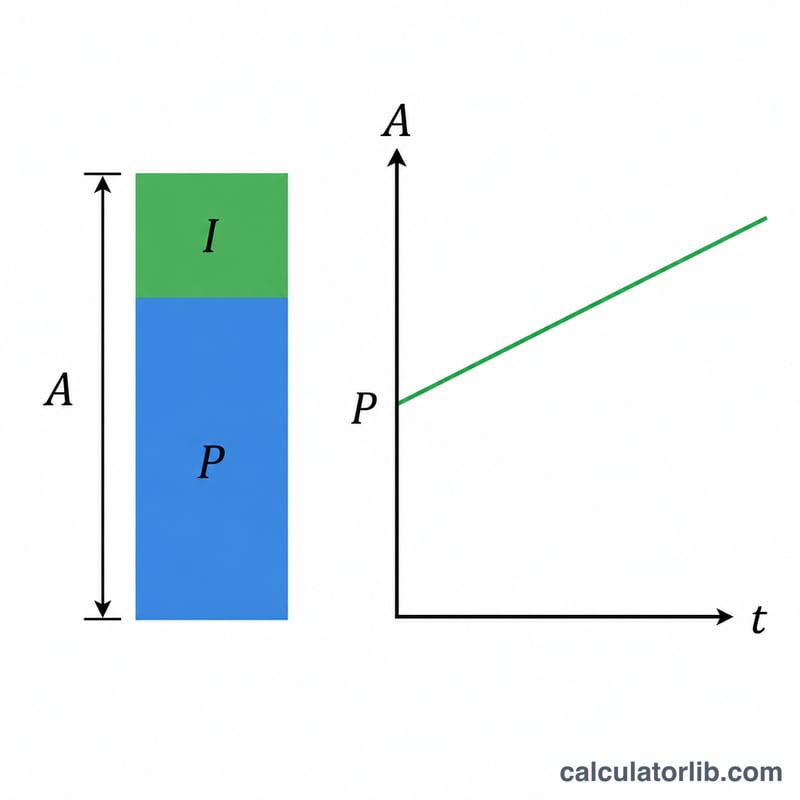
Simple interest is given by $$I = P \times r \times t$$ where P is the principal, r is the annual rate expressed as a decimal (5% = 0.05), and t is the time in years. The total balance is $$A = P \times (1 + r \times t)$$ Because the rate is never applied to accumulated interest, simple interest grows linearly with time, unlike compound interest which grows exponentially.
Worked Example
Deposit $10,000 at 5% annual simple interest for 3 years. Convert the rate: \(r = 0.05\). Interest:
$$\text{Interest} = 10{,}000 \times 0.05 \times 3 = \$1{,}500$$Total balance:
$$\text{Total} = 10{,}000 \times (1 + 0.05 \times 3) = 10{,}000 \times 1.15 = \$11{,}500$$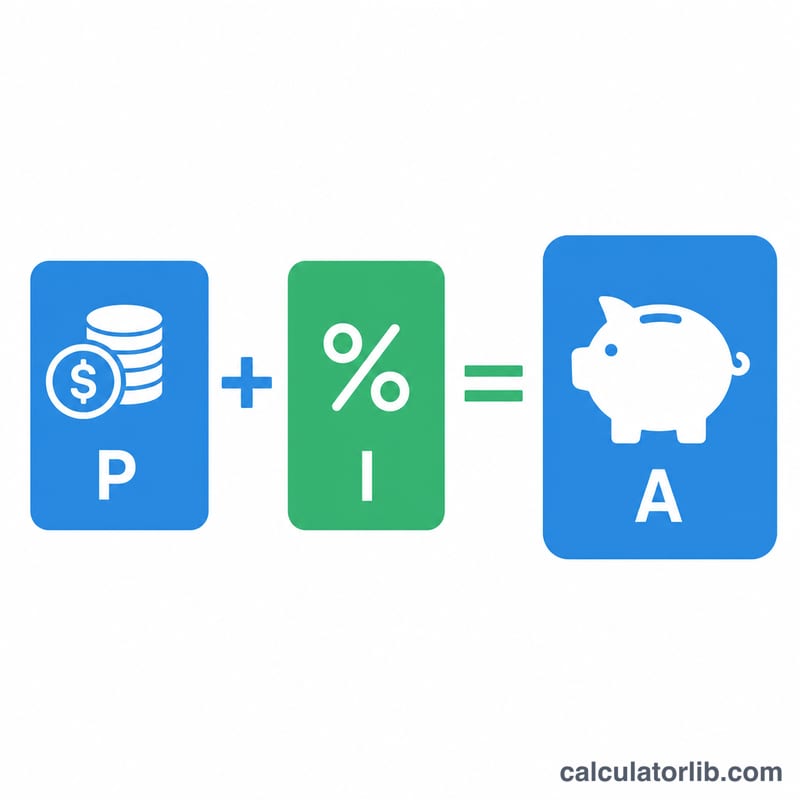
FAQ
How is simple interest different from compound interest? Simple interest is calculated only on the original principal, so earnings are the same each year. Compound interest adds earned interest back to the balance, so later interest is larger.
Can I use a partial year? Yes — enter a decimal such as 1.5 years or 0.25 for three months.
What rate should I enter? Enter the nominal annual percentage rate. The calculator divides it by 100 internally.