What is the VinFast VF7 Charging Time Calculator?
This tool estimates how long it takes to charge a VinFast VF7 electric SUV from a given starting state of charge to a target level. The VF7 is offered with battery packs around 59.6 kWh (Eco) and 75.3 kWh (Plus), so you can match the calculator to your trim by entering the right capacity. It works for home AC charging, workplace chargers and public DC fast charging.
How to use it
Enter your battery capacity in kWh, the rated power of the charger you are using in kW, your current charge level and your target charge level as percentages, and a charging efficiency (typically 85–95% for AC, slightly lower for DC). The calculator returns the estimated time in decimal hours and as hours and minutes, plus the energy added.
The formula explained
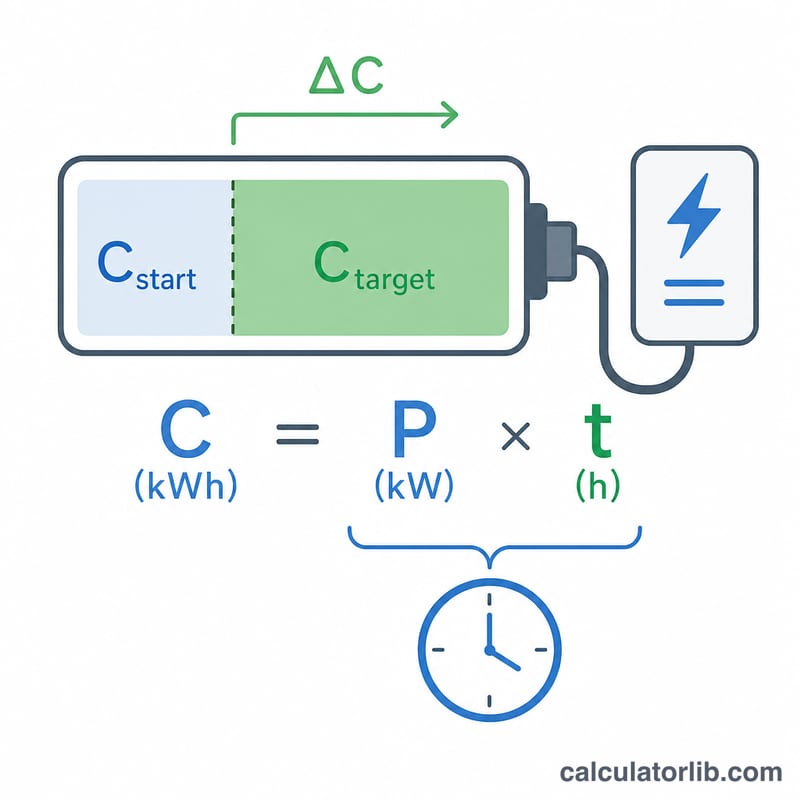
The energy needed is the battery capacity multiplied by the percentage gap between target and start. Dividing that by the effective charging power (charger power × efficiency) gives the time. The efficiency factor accounts for energy lost as heat in the cables, charger and battery management system.
$$t = \frac{\text{battery} \times \dfrac{\text{target} - \text{start}}{100}}{\text{charger} \times \text{efficiency}}$$
Worked example
For a 75.3 kWh VF7 Plus charging from 20% to 80% on an 11 kW home charger at 90% efficiency: energy = \(75.3 \times 60/100 = 45.18\) kWh. Effective power = \(11 \times 0.9 = 9.9\) kW. Time = \(45.18 \div 9.9 \approx 4.56\) hours, or about 4 h 34 min.
Typical Charger Power and Efficiency Ranges
The calculator assumes the charger delivers a constant power. In practice, the time you get is only as good as the weakest link: the charger, the cable, the grid connection and the car's own charging limits. The ranges below are general figures for EVs, not official VinFast specifications. Check the VF7 owner's manual or VinFast's official specifications for the exact battery capacity (usable vs. gross) and the maximum AC and DC charging power of your variant and market.
Typical charger power tiers
| Charging type | Typical power | Notes |
|---|---|---|
| Level 1 / household socket | ~2-3 kW | Slowest option. Often needs many hours or multiple days for a large charge. Availability depends on the country's mains voltage and outlet type. |
| AC wallbox (single-phase) | ~7.4 kW | Common home or workplace setup. Suited to overnight charging. |
| AC wallbox (three-phase) | ~11 kW | Requires three-phase supply. Only useful if the car's onboard charger accepts it. |
| DC fast charging | ~30-150+ kW | Public stations. The power shown on the station is a maximum, not what the car will always draw. |
Typical charging efficiency
| Charging type | Typical efficiency |
|---|---|
| AC charging | ~85-95% |
| DC fast charging | ~85-92% |
Efficiency accounts for losses in the onboard charger, cable, battery heating or cooling and conversion. Losses are generally higher in very cold or hot weather, at low charging power, and when the battery conditioning system is running. A value of around 90% is a reasonable starting point if you do not know your own figure.
Common start and target charge windows
- Start: many drivers plug in at roughly 10-20% state of charge (SoC).
- Target: 80% is a common target for daily use and for DC fast charging, because charging speed usually tapers noticeably above that level. Charging to 100% is typically reserved for long trips.
- Manufacturers often recommend a specific daily charging limit to preserve battery life. Follow the guidance in your VF7 manual.
Limits that cap the effective rate
- Onboard AC charger limit: on AC, the car converts AC to DC with its onboard charger, so the VF7 cannot charge faster than that charger's maximum, even on a more powerful wallbox. If your wallbox is rated above the VF7's onboard limit, enter the lower of the two values as the charger power.
- Maximum DC acceptance: on DC fast chargers, the vehicle's maximum accepted power caps the effective rate. A 150 kW station will not deliver 150 kW if the car accepts less.
- Charging curve: DC power typically falls as the battery fills, especially above ~80%, and is lower when the battery is cold. For DC sessions, use an average power rather than the peak figure to get a realistic estimate.
Because the calculator uses a single constant power value, treat the result as an estimate. Real sessions will usually be somewhat longer for DC fast charging and for charging into the upper SoC range.
FAQ
Why is real charging slower than this estimate? DC fast charging tapers off above roughly 80% to protect the battery, so the real curve is not linear. This calculator gives a useful average estimate.
What efficiency should I use? Around 90% for AC charging and 85–92% for DC are reasonable starting points.
Is this an official VinFast tool? No, it is an independent estimate. Always check VinFast's specifications for your exact trim and charger.