
What this calculator does
The VinFast VF7 Charging Cost Calculator estimates how much electricity you'll pay to charge your VF7 from one state of charge to another. It accounts for real-world charging losses (efficiency) so the figure reflects what your meter actually records, not just the energy stored in the battery. Enter your own electricity price in whatever currency you pay, so the tool works in any country.
How to use it
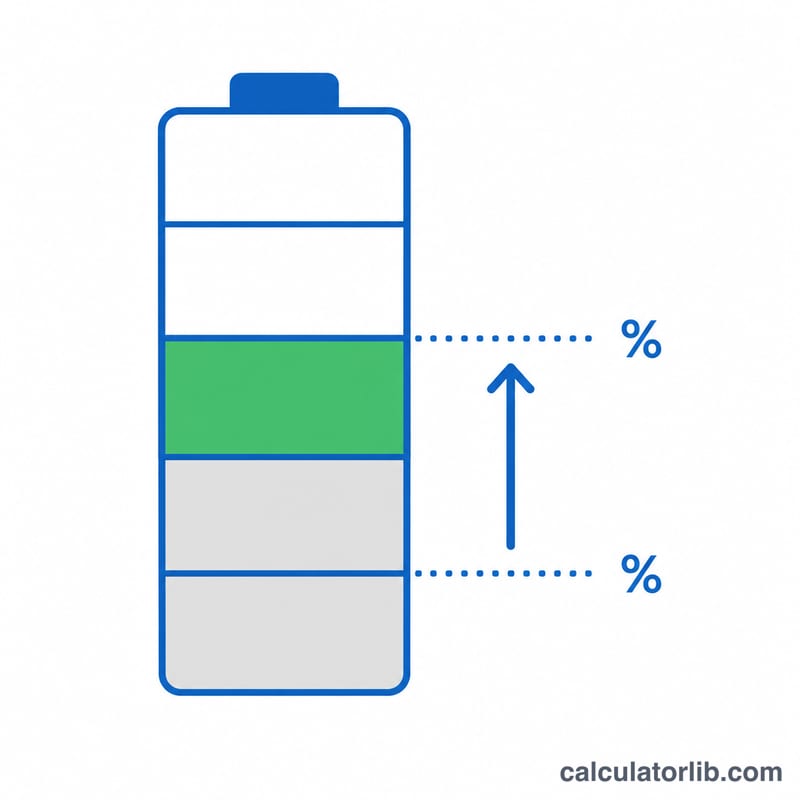
Enter your battery capacity in kWh (the VF7 ships with packs around 59.6 kWh for the Eco trim and 75.3 kWh for the Plus trim — use the value matching your car). Set your starting charge level and your target charge level as percentages. Add a charging efficiency (typically 85–95% for home AC charging) to allow for losses in the charger and battery. Finally, enter your electricity price per kWh, then read the estimated session cost.
The formula explained
First the calculator finds the energy added to the battery: \( \text{Battery} \times \dfrac{\text{Target \%} - \text{Start \%}}{100} \). Because some energy is lost as heat, the energy drawn from the grid is higher: divide by the efficiency fraction. Multiply by your price per kWh to get the cost. In short:
$$\text{Cost} = \frac{\text{Battery} \times \dfrac{\text{Target} - \text{Start}}{100}}{\dfrac{\text{Efficiency}}{100}} \times \text{Price}$$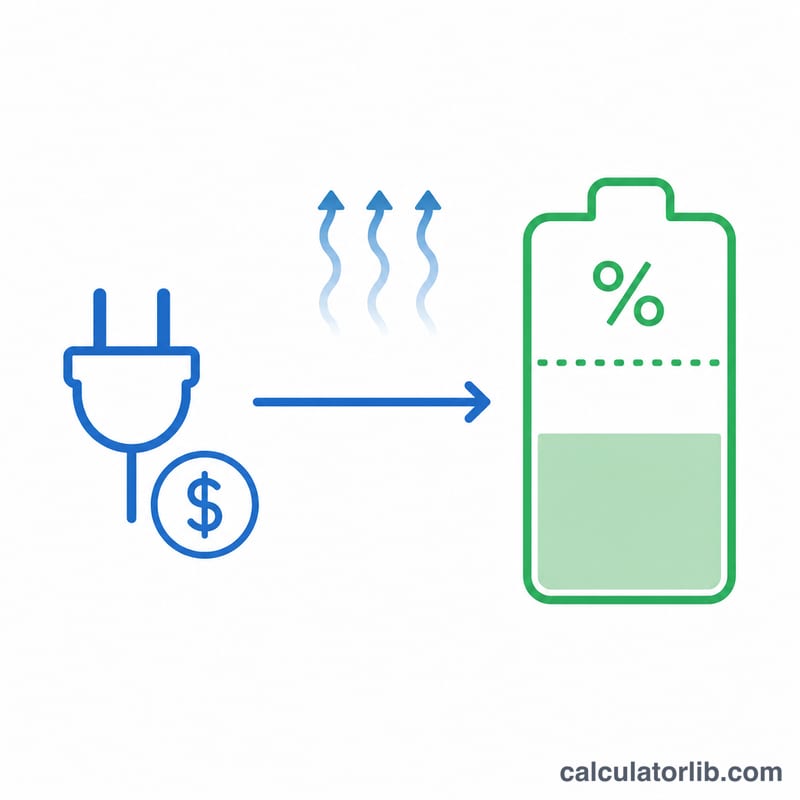
Worked example
For a 75.3 kWh VF7 charged from 20% to 80% at 90% efficiency, with electricity at $0.15/kWh: energy to battery = \( 75.3 \times \frac{60}{100} = 45.18 \) kWh. Energy from grid = \( 45.18 \div 0.90 = 50.2 \) kWh. Cost = \( 50.2 \times 0.15 = \) $7.53.
FAQ
Why use efficiency? Charging is never 100% efficient — some power is lost as heat, so you pay for more than the battery stores. 90% is a reasonable default for home AC charging.
Does this work for DC fast charging? Yes, but enter the price your fast-charge provider charges and a slightly higher efficiency if known. Public charging is usually priced per kWh.
Which battery size should I enter? Use your trim's usable battery capacity. If unsure, check your owner's manual or charging app.