
What Is the Savings Doubling Time Calculator?
This calculator tells you how many years it takes for a savings balance to double when it grows at a fixed annual interest rate with yearly compounding. It shows both the mathematically exact answer and the popular Rule of 72 shortcut, so you can see how close the mental estimate really is.
How to Use It
Enter your expected annual interest rate as a percentage (for example, type 6 for 6%). The calculator instantly returns the exact number of years required for your money to double, alongside the Rule of 72 estimate for comparison. It works for any positive rate.
The Formula Explained
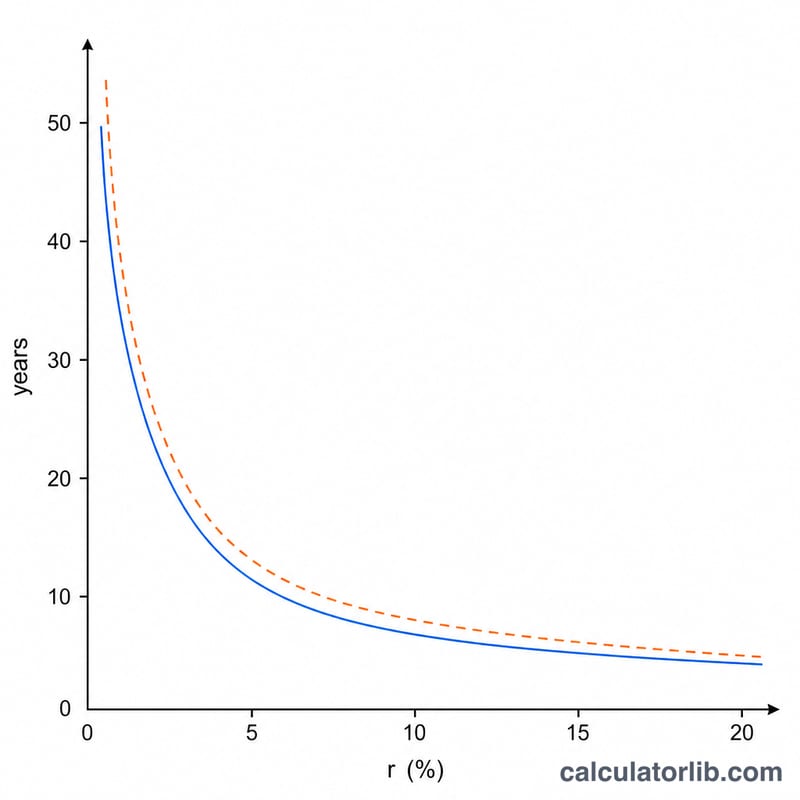
Doubling means the future value equals twice the present value: \((1 + r)^t = 2\). Solving for \(t\) gives the exact expression $$t = \frac{\ln(2)}{\ln(1 + r)}$$ where \(r\) is the annual rate written as a decimal. The familiar Rule of 72 approximates this as 72 divided by the rate percentage, which is accurate to within a fraction of a year for typical rates between 4% and 12%.
Worked Example
Suppose your savings earn 6% per year. The exact calculation is $$\frac{\ln(2)}{\ln(1.06)} = \frac{0.6931}{0.0583} \approx 11.90 \text{ years}$$ The Rule of 72 gives \(72 / 6 = 12\) years — only about a tenth of a year off, which is why the rule is so widely used.
Interpreting Your Result
The number of years returned by this calculator is the time required for your savings balance to grow to twice its starting value, based on the exact compounding formula \( t = \dfrac{\ln 2}{\ln\left(1 + \frac{r}{100}\right)} \), where \(r\) is the annual interest rate as a percentage. The Rule of 72 estimate (\( t \approx 72 / r \)) is a quick mental approximation of the same idea and is most accurate for rates in roughly the 6%–10% range.
Keep these assumptions and limitations in mind when reading the result:
- Fixed rate assumed. The calculation treats your annual interest rate as constant for the entire period. In practice, savings account and deposit rates change frequently as central-bank policy and market conditions shift, so the true doubling time can be longer or shorter than shown.
- Annual compounding assumed. The formula uses one compounding period per year. If interest is compounded more often (monthly, daily) your balance grows slightly faster, so the actual doubling time will be marginally shorter than the figure here.
- Inflation erodes the real result. Doubling the number of currency units in your account is not the same as doubling its purchasing power. If prices rise over the same period, the real (inflation-adjusted) value doubles more slowly — and at low interest rates that are below the inflation rate, real purchasing power may not double at all.
- Taxes and fees are ignored. This figure is a gross, pre-tax estimate. Interest income may be taxable, and account fees or charges reduce the effective rate of return, both of which lengthen the real-world time needed to double your money.
As an example, at a steady annual rate of 4% the exact doubling time is about 17.67 years, while the Rule of 72 quick estimate gives \(72 / 4 = 18\) years — close, but not identical to the exact value.
Treat the result as a planning illustration of how compounding works, not a guaranteed outcome. This is general information, not financial advice.
FAQ
Why is the Rule of 72 not exact? It is a simplification of the logarithmic formula. It is most accurate around 8% and drifts slightly at very high or very low rates.
Does this assume annual compounding? Yes. More frequent compounding (monthly, daily) doubles money slightly faster, but the difference is small for typical savings rates.
What rate should I use? Use the effective annual yield (APY) of your savings or investment for the most realistic result.