
What This Calculator Does
This tool converts the molarity of a solution (moles of solute per litre) into its mass percent concentration (grams of solute per 100 grams of solution, % w/w). The conversion requires two extra pieces of information: the molar mass of the solute and the density of the final solution. It is a universal chemistry conversion valid for any aqueous or non-aqueous solution.
How to Use It
Enter the molarity in mol/L, the molar mass of your solute in g/mol, and the density of the solution in g/mL. The calculator instantly returns the mass percent. For dilute aqueous solutions the density is close to 1.0 g/mL, but concentrated acids and bases can have densities well above this, so use a measured or tabulated value for accuracy.
The Formula Explained
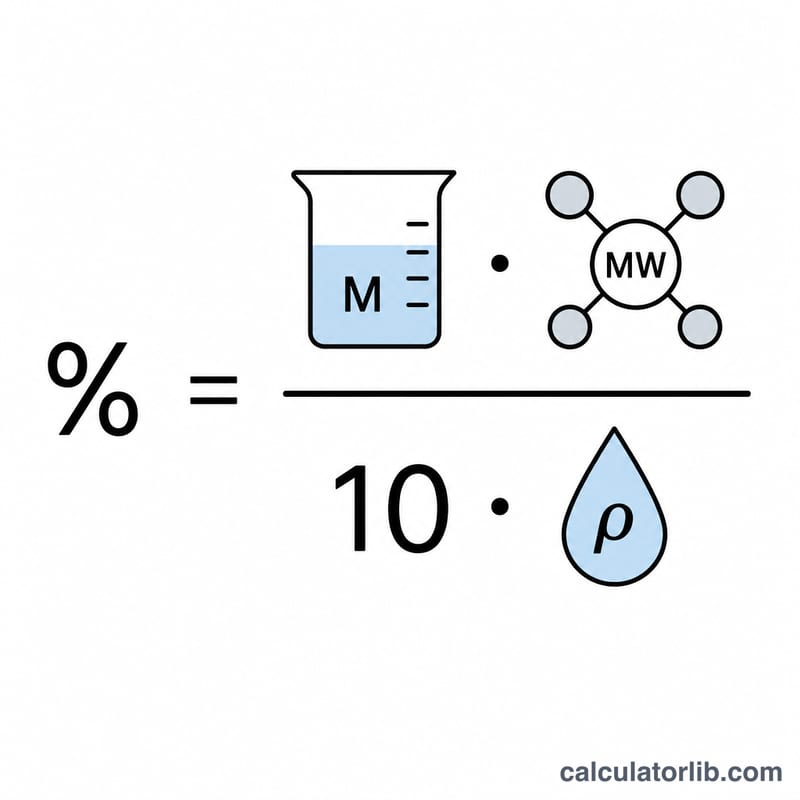
The relationship is:
$$\text{mass\%} = \frac{M \times MW}{10 \times \rho}$$
Here \(M\) is molarity (mol/L), \(MW\) is molar mass (g/mol) and \(\rho\) is density (g/mL). The numerator \(M \times MW\) gives the grams of solute in one litre. Multiplying density by 1000 mL gives the grams of one litre of solution; dividing solute grams by solution grams and multiplying by 100 to get a percent simplifies to dividing by \(10\rho\).
Worked Example
Consider 1 M sodium chloride (NaCl, MW = 58.44 g/mol) with a solution density of 1.0 g/mL. $$\text{mass\%} = \frac{1 \times 58.44}{10 \times 1.0} = \frac{58.44}{10} = \mathbf{5.844\%}.$$ So a 1 molar NaCl solution is about 5.84% by mass.
FAQ
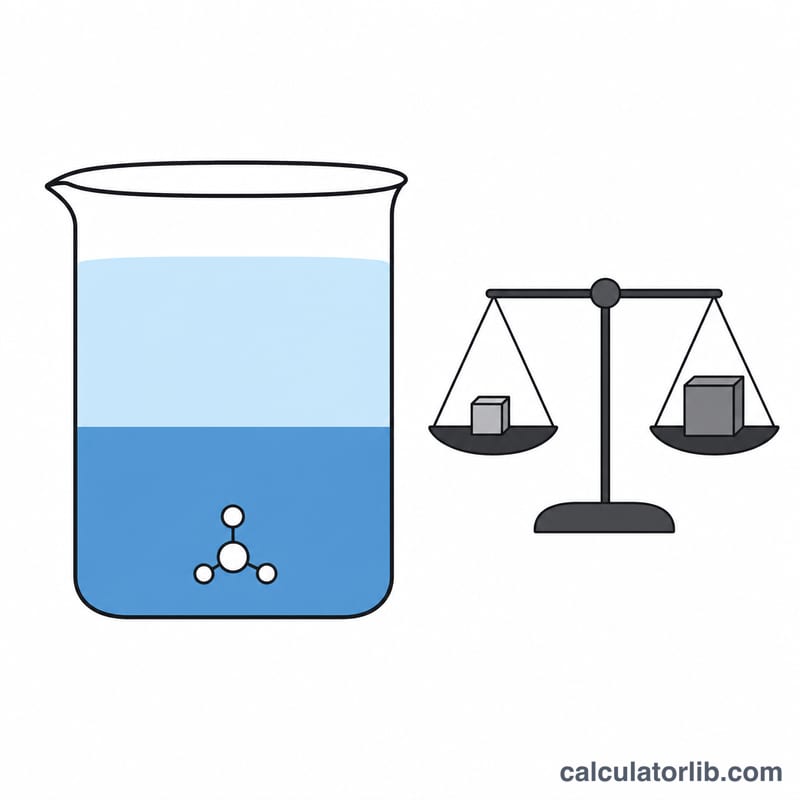
Why do I need the density? Molarity is per volume of solution while mass percent is per mass of solution. Density bridges volume and mass, so it is essential.
What units should density be in? Grams per millilitre (g/mL), which equals kg/L. Pure water is ~1.0 g/mL at room temperature.
Does temperature matter? Yes—density changes with temperature, so use the density at your working temperature for best accuracy.