
What Is Mass Percent?
Mass percent (also written percent by mass, % w/w, or mass fraction × 100) is a way to express the concentration of a solution. It tells you how many grams of solute are present in every 100 grams of solution. Because it is based on mass, it does not change with temperature, making it a reliable concentration unit in chemistry, food science, and manufacturing.
How to Use This Calculator
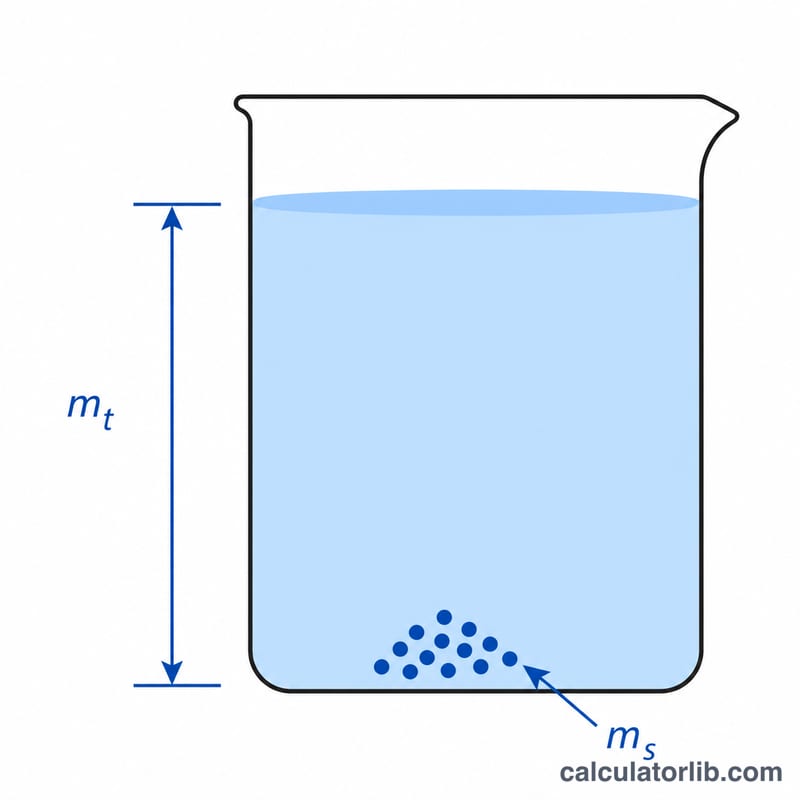
Enter the mass of the solute (the substance being dissolved) and the total mass of the solution (solute plus solvent). The calculator divides the two, multiplies by 100, and instantly returns the mass percent. It also shows the mass of solvent for reference. Use any consistent mass unit — grams are typical, but kilograms or pounds work as long as both inputs use the same unit.
The Formula Explained
The equation is straightforward:
$$\text{Mass \%} = \frac{\text{Mass of Solute (g)}}{\text{Total Mass of Solution (g)}} \times 100$$
The total mass of solution equals the mass of the solute plus the mass of the solvent. If you only know the solvent mass, add it to the solute mass first to get the total.
Worked Example
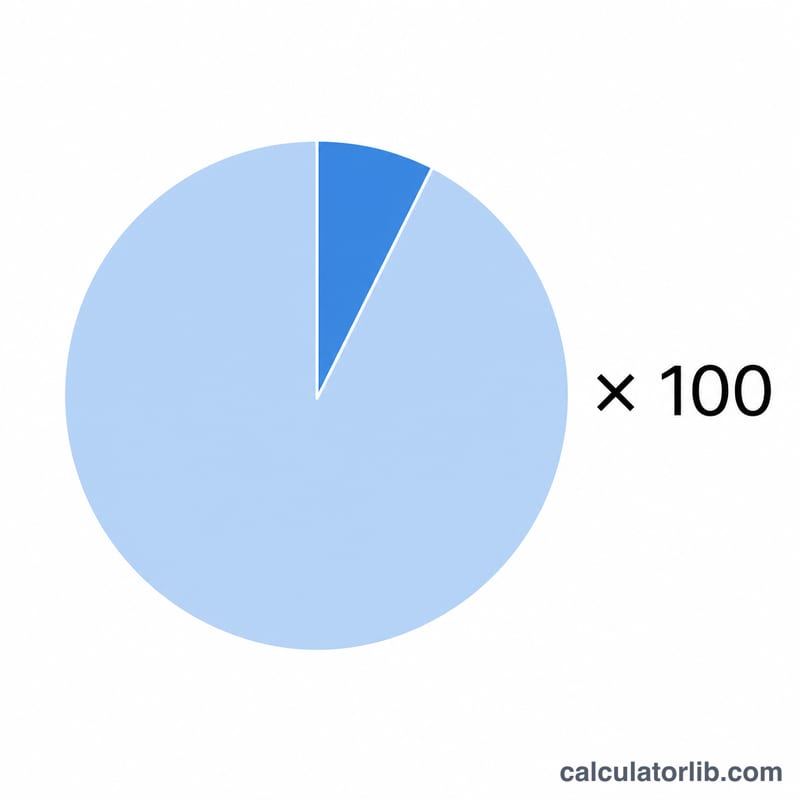
Suppose you dissolve 25 g of salt in 175 g of water. The total mass of the solution is \(25 + 175 = 200\) g. The mass percent is $$(25 \div 200) \times 100 = 12.5\%$$ So the solution is 12.5% salt by mass.
FAQ
Is mass percent the same as weight percent? Yes — "weight percent" (% w/w) is an everyday name for mass percent; they refer to the same calculation.
What if I know the solvent mass instead of the total? Add the solute mass and solvent mass together to get the total solution mass, then enter that total.
Does mass percent depend on temperature? No. Unlike molarity or volume-based concentrations, mass percent is independent of temperature because mass does not change when a solution is heated or cooled.