
What Is the Neutralization Calculator?
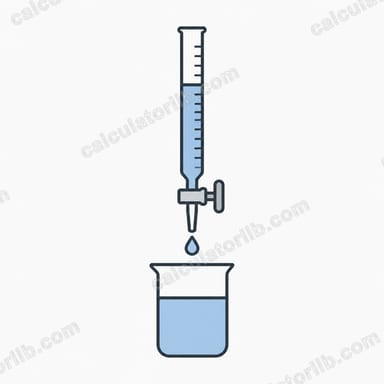
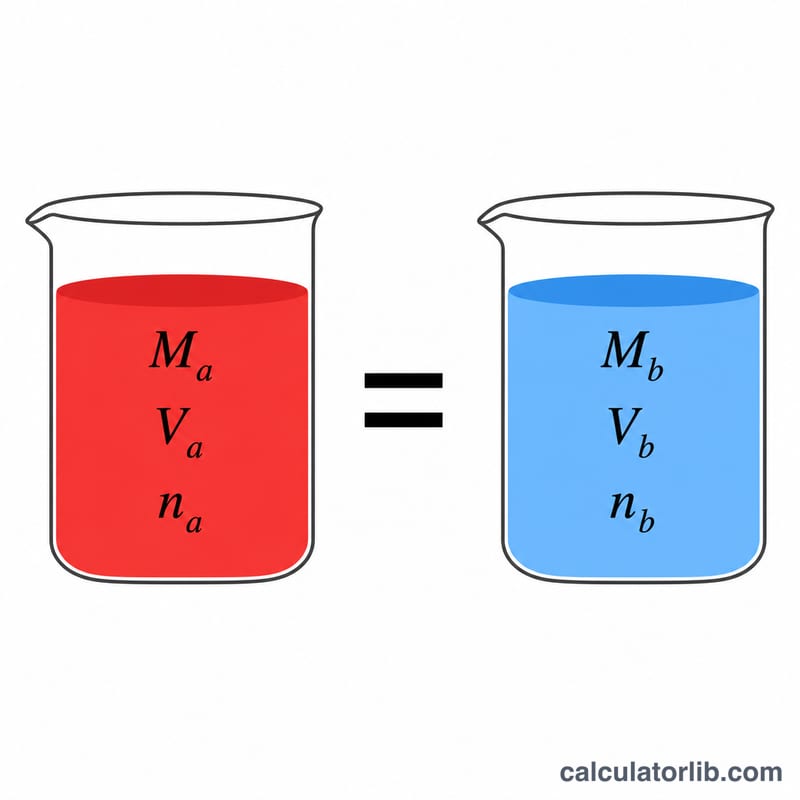
This calculator solves acid–base neutralization and titration problems using the equivalence relationship \(\text{M}_a \cdot \text{V}_a \cdot \text{n}_a = \text{M}_b \cdot \text{V}_b \cdot \text{n}_b\). At the equivalence point, the moles of hydrogen ions (H⁺) supplied by the acid exactly equal the moles of hydroxide ions (OH⁻) supplied by the base. The tool lets you enter any five of the six quantities and solves for the missing concentration or volume. It is a universal chemistry tool and applies anywhere.
How to Use It
Enter the molar concentration (M) and volume (mL) of the acid and the base you know. The values nacid and nbase are the number of reactive protons per formula unit — for example HCl has n=1, H₂SO₄ has n=2, and Ca(OH)₂ has n=2. Pick what you want to solve for from the dropdown and read the answer. Volume units cancel, so milliliters in give milliliters out.
The Formula Explained
Because moles = concentration × volume, the acid provides \(\text{M}_a \cdot \text{V}_a\) moles, each releasing \(\text{n}_a\) protons. Setting acid proton moles equal to base hydroxide moles gives the equivalence equation. Rearranging to find the base volume:
Worked Example
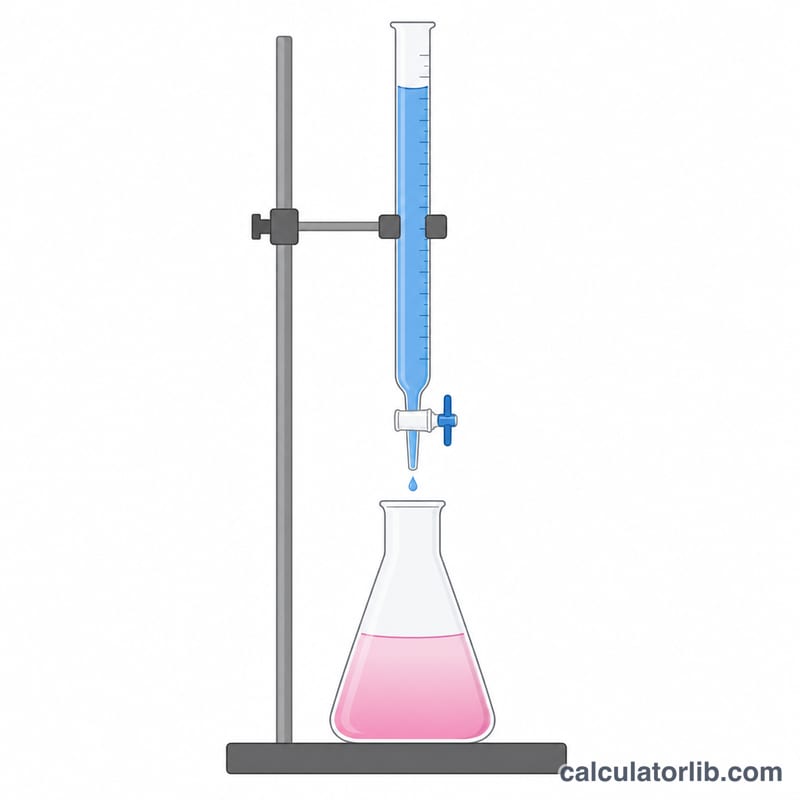
How much 0.10 M NaOH neutralizes 25 mL of 0.10 M HCl? Here n=1 for both.
$$\text{V}_b = \frac{0.10 \times 25 \times 1}{0.10 \times 1} = 25 \text{ mL}$$Now neutralize 25 mL of 0.10 M H₂SO₄ (n=2) with 0.10 M NaOH (n=1):
$$\text{V}_b = \frac{0.10 \times 25 \times 2}{0.10 \times 1} = 50 \text{ mL}$$because the diprotic acid supplies twice the protons.
FAQ
What is n? It is the number of ionizable H⁺ for an acid or OH⁻ for a base per formula unit (also called valence or basicity).
Do I have to use mL? No — any volume unit works as long as both acid and base use the same unit; the answer comes out in that same unit.
Does this give pH? No. This finds the volumes/concentrations for complete neutralization (the equivalence point), not the resulting pH.