
What Is the Saponification Value?
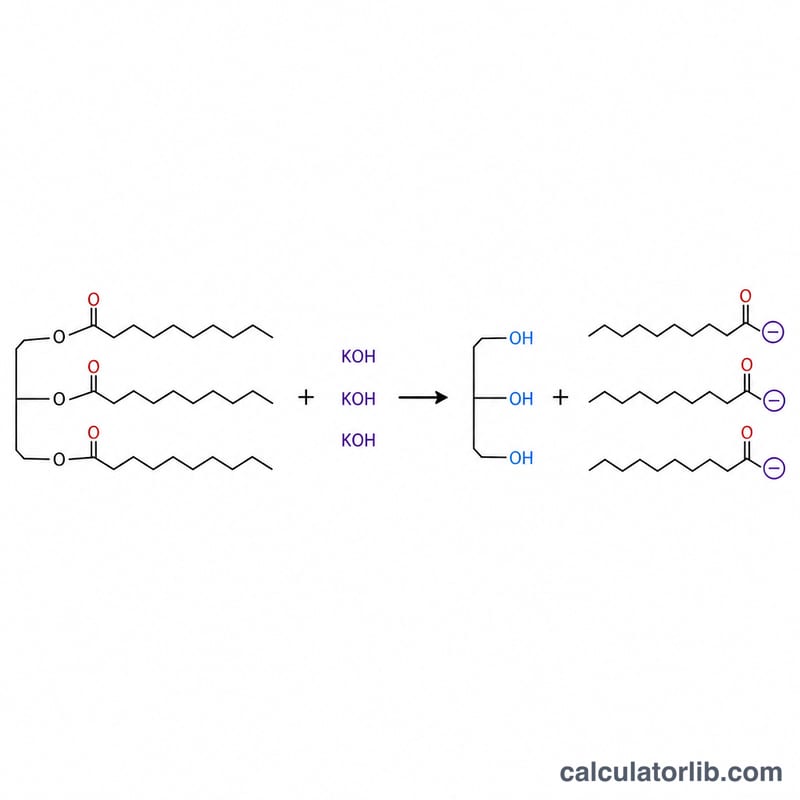
The saponification value (SAP value) is the number of milligrams of potassium hydroxide (KOH) required to saponify one gram of fat or oil. It is an important indicator of the average molecular weight (and therefore the average chain length) of the fatty acids present: a high SAP value means shorter-chain fatty acids, while a low value indicates longer chains. Chemists, soap makers, and food scientists use it to characterize fats and oils.
How to Use This Calculator
Enter the number of moles of KOH that react with (saponify) your sample, and the mass of the fat or oil in grams. The calculator multiplies the moles of KOH by 56,100 mg/mol (the molar mass of KOH expressed in milligrams) and divides by the sample mass to give the SAP value in mg KOH per gram.
The Formula Explained
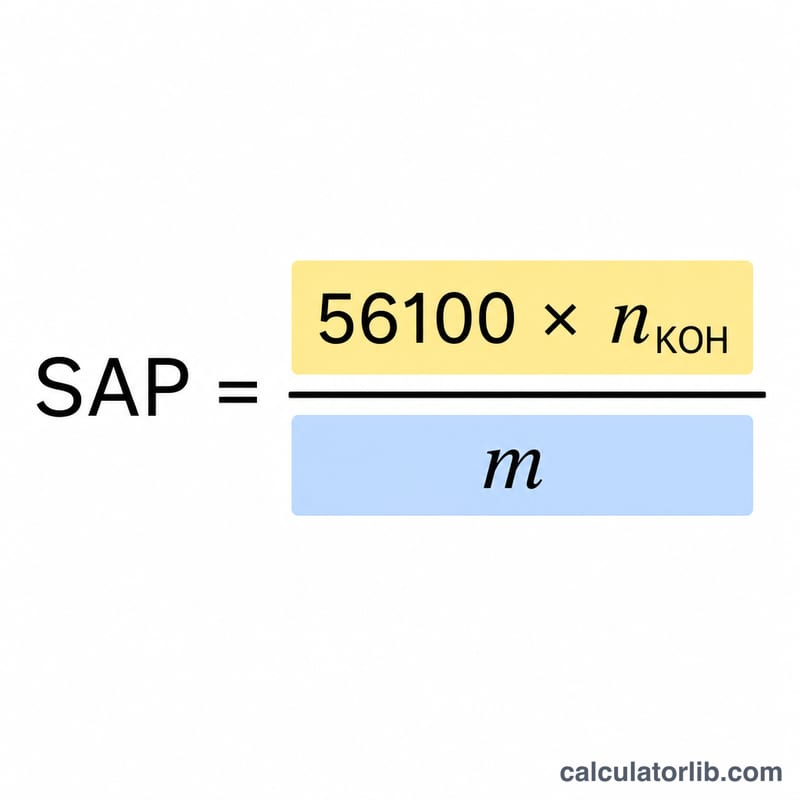
SAP value (mg KOH/g):
$$\text{SAP} = \frac{56100 \times \text{Moles of KOH (mol)}}{\text{Mass of Fat / Oil (g)}}$$The constant 56,100 converts moles of KOH into milligrams (KOH has a molar mass of about 56.1 g/mol = 56,100 mg/mol). Dividing by the sample mass normalizes the result to "per gram" of fat.
Worked Example
Suppose 0.05 mol of KOH is required to saponify 14 g of an oil.
$$\text{SAP} = \frac{56100 \times 0.05}{14} = \frac{2805}{14} \approx 200.36 \text{ mg KOH/g}$$This is a typical value for a triglyceride composed of medium-length fatty acids.
FAQ
Why is KOH's molar mass 56,100? KOH has a molar mass of \(\approx 56.1\) g/mol. Expressed in milligrams per mole that is 56,100 mg/mol, which keeps the SAP value in its standard unit of mg KOH/g.
Can I use NaOH instead? The classic SAP value is defined with KOH. If you measure with NaOH (40 g/mol), multiply your result by \(56.1/40 \approx 1.4025\) to convert to the KOH-based value.
What is a typical SAP value? Most vegetable oils fall between roughly 180 and 200 mg KOH/g; coconut oil is higher (about 250) because of its shorter-chain fatty acids.