
What Is the Solution Dilution Calculator?
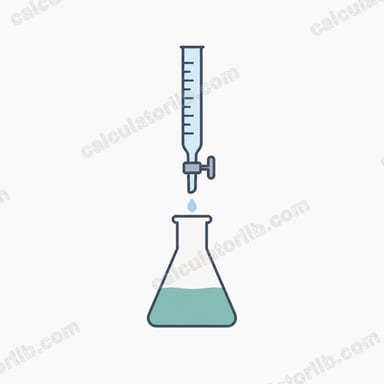
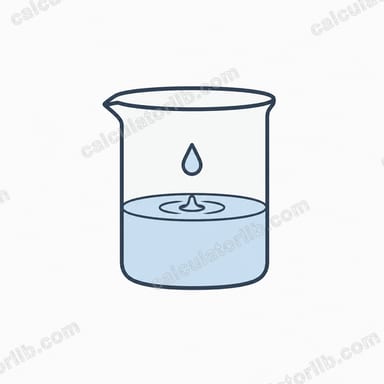
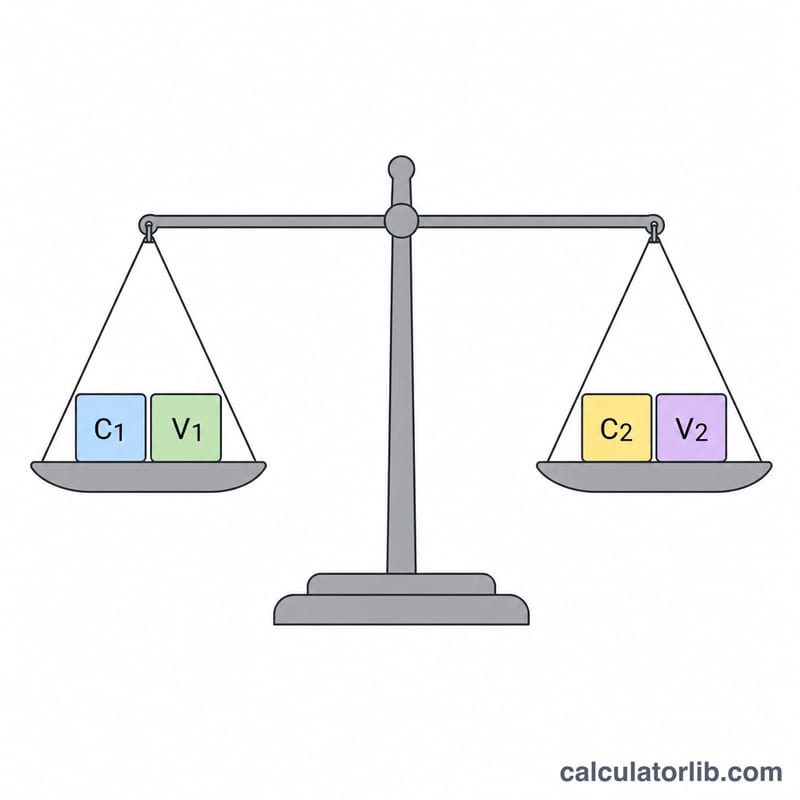
This calculator solves the fundamental dilution equation \(C_1 V_1 = C_2 V_2\), used throughout chemistry, biology, pharmacy, and laboratory work. When you dilute a concentrated stock solution, the total amount of solute stays the same — only the volume increases. The calculator tells you exactly how much stock solution to measure out and how much solvent (such as water or buffer) to add to reach your desired final concentration and volume.
How to Use It
Enter three values: the stock concentration (\(C_1\)), your target final concentration (\(C_2\)), and the final volume you want (\(V_2\)). Make sure \(C_1\) and \(C_2\) use the same units (e.g. molarity, mg/mL, or %), and that \(V_2\) is in your chosen volume unit. The result \(V_1\) — the amount of stock to take — comes out in the same volume unit as \(V_2\). Top the stock up with solvent until you reach \(V_2\).
The Formula Explained
Rearranging \(C_1 V_1 = C_2 V_2\) gives
$$V_1 = \frac{C_2 \times V_2}{C_1}$$The solvent you must add is simply \(V_2 - V_1\). Because concentration is inversely proportional to volume, a higher stock concentration means you need less of it.
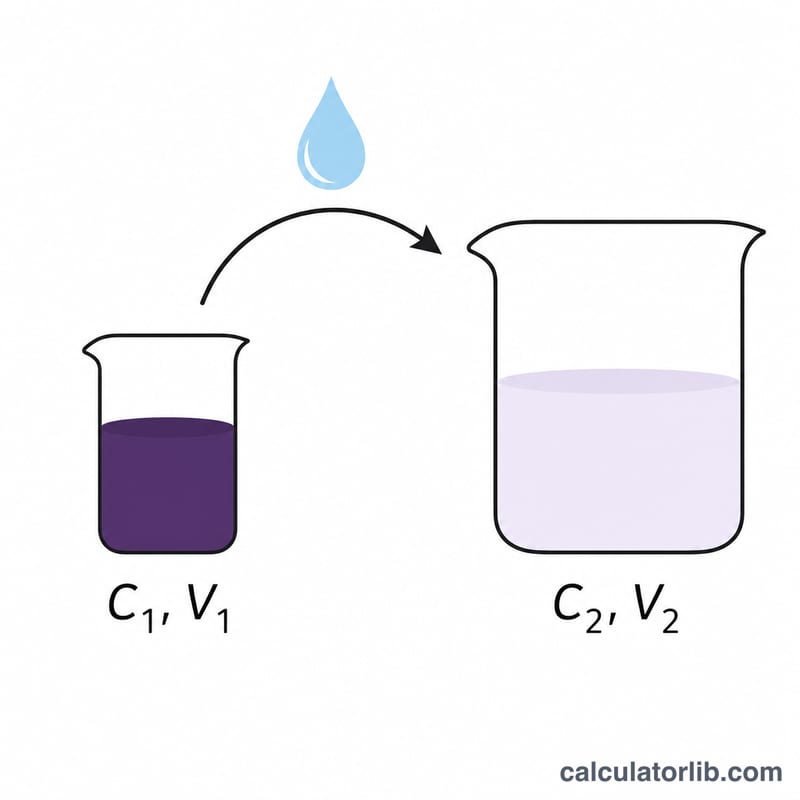
Worked Example
You have a 10 M stock and want 100 mL of a 1 M solution.
$$V_1 = \frac{1 \times 100}{10} = 10 \text{ mL}$$of stock. Add 90 mL of solvent to reach 100 mL total. This is a classic 1:10 dilution.
FAQ
Do the units have to match? \(C_1\) and \(C_2\) must share the same concentration unit; \(V_2\) can be any volume unit and \(V_1\) comes back in that same unit.
What if my result is larger than the final volume? That means your target concentration is higher than the stock can provide — you cannot dilute up. Check your inputs.
Can I use percentages? Yes — percent concentrations (% w/v or v/v) work as long as both \(C_1\) and \(C_2\) use the same percent basis.