
What Is the Equilibrium Constant (Kc)?
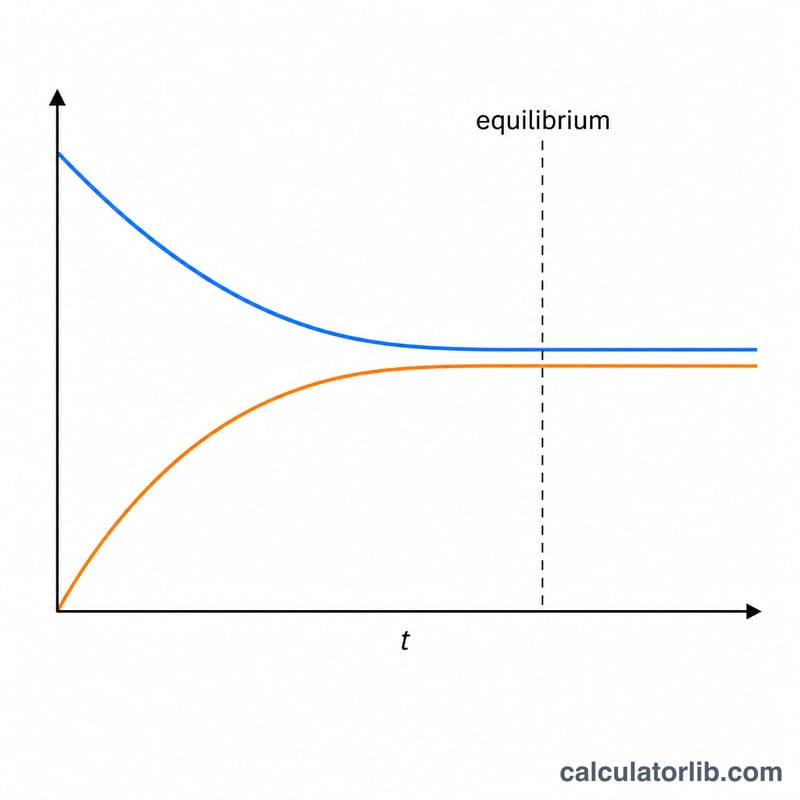
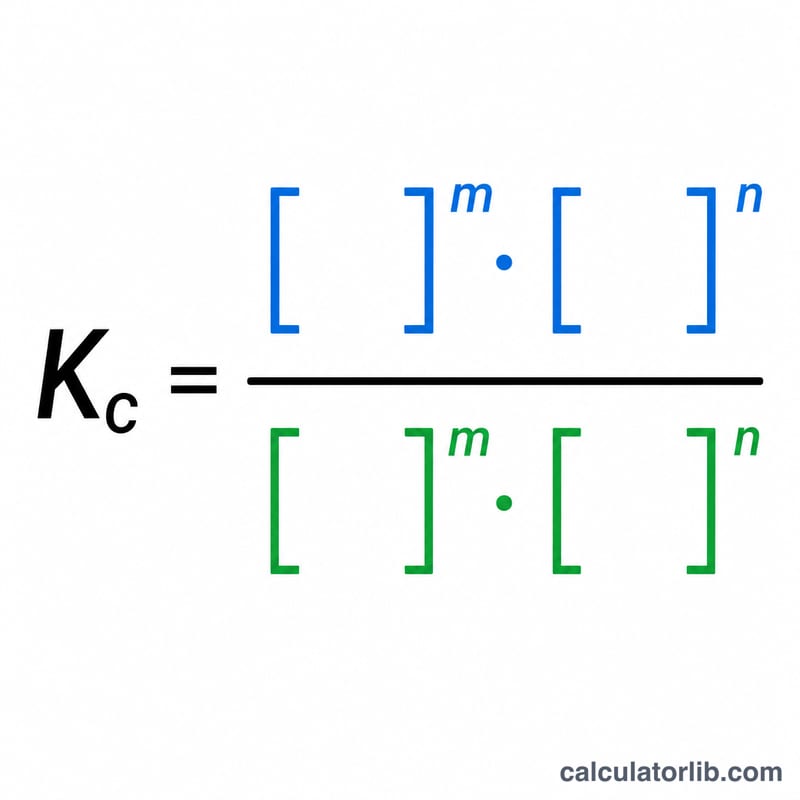
The equilibrium constant Kc describes the ratio of product to reactant concentrations when a reversible chemical reaction reaches equilibrium. For a generic reaction aA → mC, the constant is the molar concentration of products raised to their stoichiometric coefficients, divided by the molar concentration of reactants raised to theirs. A large Kc means the reaction strongly favors products; a small Kc favors reactants.
How to Use This Calculator
Enter the equilibrium concentration of your product (in mol/L) and its balanced-equation coefficient, then do the same for your reactant. The tool raises each concentration to its coefficient, then divides products by reactants to return Kc instantly.
The Formula Explained
The general expression is $$K_c = \frac{\text{[products]}^{\,m}}{\text{[reactants]}^{\,n}}$$ where \(m\) and \(n\) are the coefficients from the balanced equation. Pure solids and liquids are omitted from the expression because their activity is taken as 1. This calculator handles the common single-product, single-reactant case; multiply additional terms manually for more complex equilibria.
Worked Example
Suppose at equilibrium the product concentration is 2 mol/L with a coefficient of 2, and the reactant concentration is 1 mol/L with a coefficient of 1. Then numerator = \(2^2 = 4\), denominator = \(1^1 = 1\), so $$K_c = \frac{4}{1} = 4$$
FAQ
What does a Kc of 1 mean? Products and reactants are present in roughly equal amounts at equilibrium.
Is Kc temperature dependent? Yes. Kc is only constant at a fixed temperature; changing temperature changes the value.
What units does Kc have? Kc is often treated as dimensionless because it uses activities, though raw concentration calculations can imply units depending on the reaction order.