
What is the Kp Calculator?
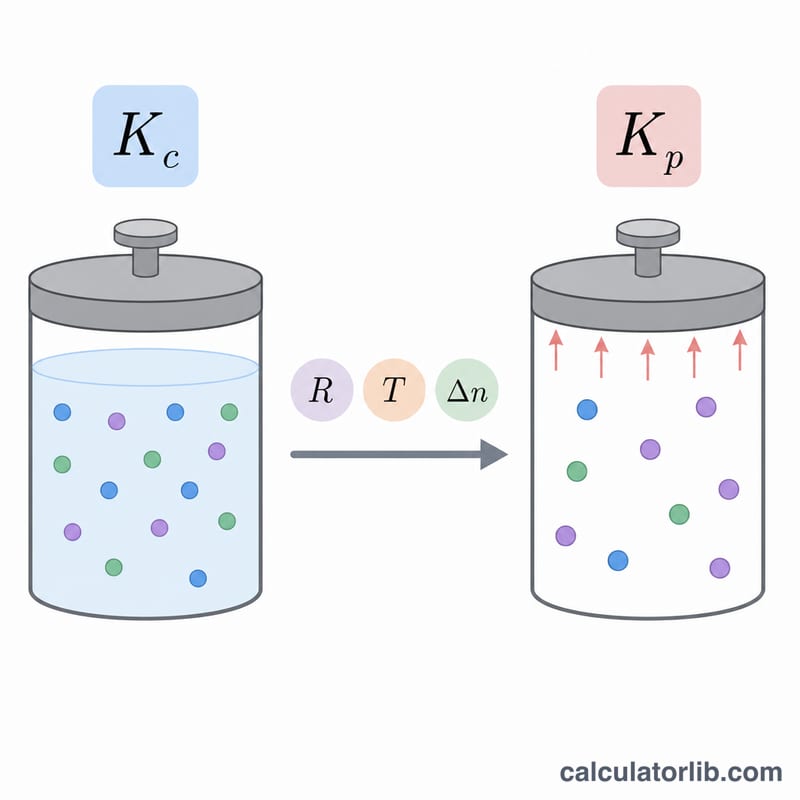
This calculator converts the concentration-based equilibrium constant (Kc) into the pressure-based equilibrium constant (Kp) for a gas-phase reaction. The two constants describe the same chemical equilibrium but use different units — Kc uses molar concentrations while Kp uses partial pressures. They are linked through the ideal gas law.
How to use it
Enter the value of Kc, the absolute temperature in kelvin, and Δn — the change in the number of moles of gas (moles of gaseous products minus moles of gaseous reactants from the balanced equation). The gas constant R defaults to 0.082057 L·atm·mol⁻¹·K⁻¹, which gives Kp in atmospheres. Use R = 8.314 J·mol⁻¹·K⁻¹ if you work in pascals and SI units. The calculator returns Kp along with the intermediate values R·T and (R·T)^Δn.
The formula explained
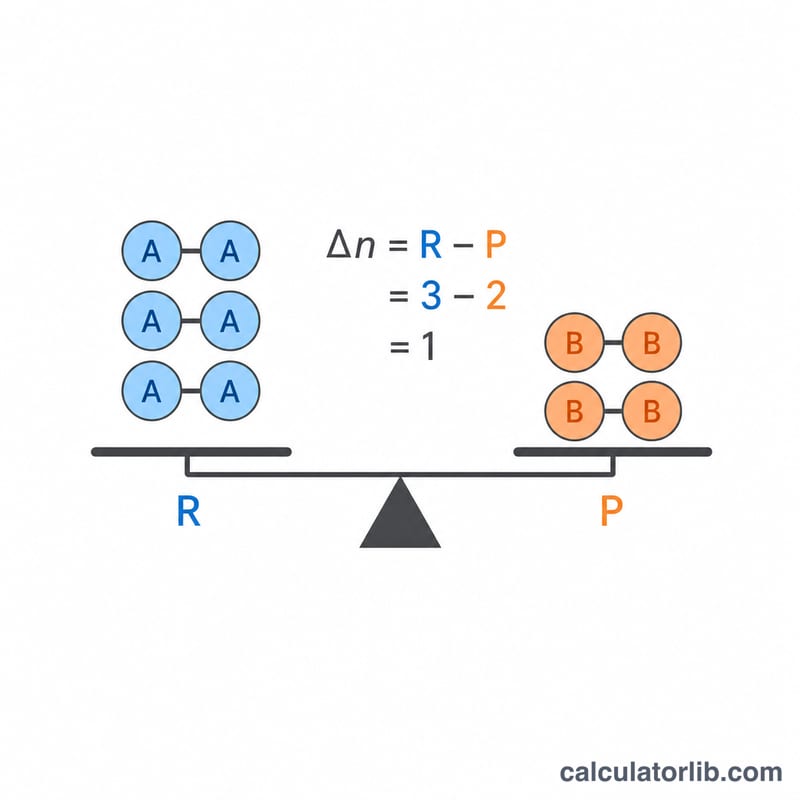
The relationship is $$K_p = \text{K}_c \times \left( \text{R} \cdot \text{T} \right)^{\Delta n}$$ When \(\Delta n = 0\) (equal moles of gas on both sides), \(K_p = K_c\). When more moles of gas appear as products (\(\Delta n > 0\)), Kp is larger than Kc; when fewer, Kp is smaller. The exponent Δn captures how the volume/pressure conversion scales with the net change in gas molecules.
Worked example
For the synthesis of ammonia, N₂(g) + 3H₂(g) ⇌ 2NH₃(g), \(\Delta n = 2 - (1 + 3) = -2\). Suppose \(K_c = 0.5\) at 500 K with \(R = 0.082057\). Then \(R \cdot T = 41.0285\) and \((R \cdot T)^{-2} = 0.000594\). So $$K_p = 0.5 \times 0.000594 \approx 0.000297 \text{ atm}^{-2}$$
FAQ
When does Kp equal Kc? Whenever \(\Delta n = 0\), because \((R \cdot T)^0 = 1\).
Which value of R should I use? Use 0.082057 L·atm·mol⁻¹·K⁻¹ for pressures in atm, or 8.314 J·mol⁻¹·K⁻¹ (pressures in Pa). Be consistent with your pressure units.
Does temperature need to be in kelvin? Yes. Always convert °C to K by adding 273.15.