What Is the Cents to Euros Calculator?
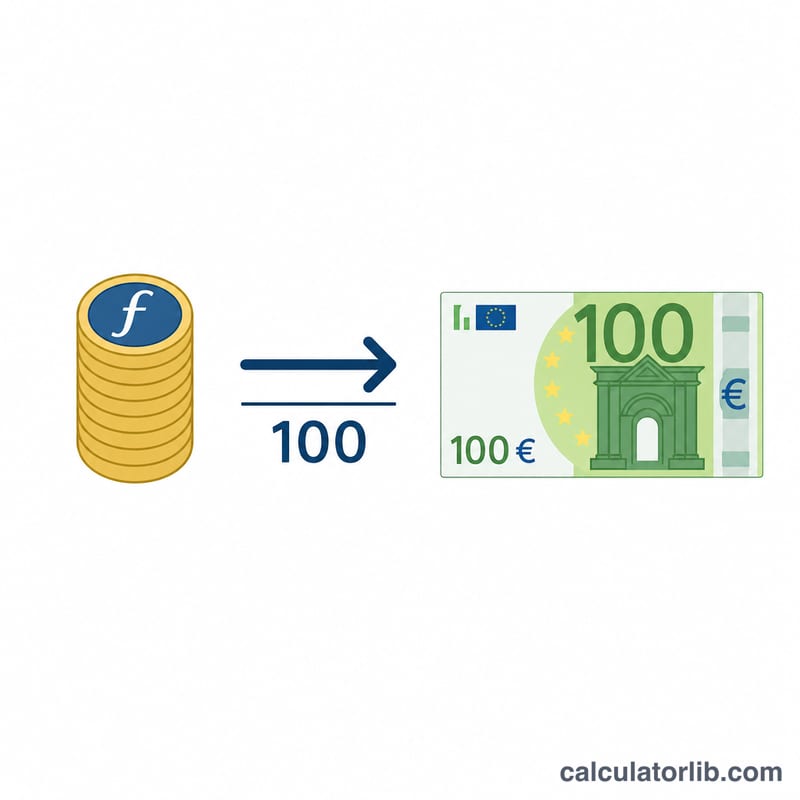
The euro (EUR) is the official currency of the eurozone, and each euro is divided into 100 cents. This calculator converts any amount expressed in cents into its equivalent value in euros. It is handy for counting coins, reading prices listed in cents, reconciling small transactions, or working with financial data stored in cents (a common practice in software to avoid rounding errors).
How to Use It
Type the amount in cents into the input box and the calculator instantly returns the value in euros. Whole numbers work (e.g. 250 cents), and decimal cents are also supported if your data uses fractional cents.
The Formula Explained
The conversion is a simple division because 1 euro equals 100 cents:
$$\text{euros} = \frac{\text{cents}}{100}$$
So every 100 cents make up exactly one euro. Moving the decimal point two places to the left gives the same result.
Worked Example
Suppose you have 250 cents. Divide by 100: \(250 \div 100 = 2.5\). So 250 cents equals €2.50. Likewise, 99 cents equals €0.99, and 10,000 cents equals €100.00.
Euro Coin and Banknote Denominations
The euro (EUR) is divided into exactly 100 cents, so converting cents to euros is a fixed decimal subdivision — not a fluctuating exchange rate. Unlike converting euros to dollars or pounds, the ratio never changes with the markets:
$$\text{Euros} = \frac{\text{Amount in cents}}{100}$$Every euro denomination issued by the European Central Bank and the national central banks of the euro area can therefore be expressed as a whole number of cents. The table below lists the official denominations currently in circulation.
| Denomination | Type | Value in cents | Value in euros |
|---|---|---|---|
| 1 cent | Coin | 1 | €0.01 |
| 2 cent | Coin | 2 | €0.02 |
| 5 cent | Coin | 5 | €0.05 |
| 10 cent | Coin | 10 | €0.10 |
| 20 cent | Coin | 20 | €0.20 |
| 50 cent | Coin | 50 | €0.50 |
| €1 | Coin | 100 | €1.00 |
| €2 | Coin | 200 | €2.00 |
| €5 | Banknote | 500 | €5.00 |
| €10 | Banknote | 1,000 | €10.00 |
| €20 | Banknote | 2,000 | €20.00 |
| €50 | Banknote | 5,000 | €50.00 |
| €100 | Banknote | 10,000 | €100.00 |
| €200 | Banknote | 20,000 | €200.00 |
| €500 | Banknote (no longer issued) | 50,000 | €500.00 |
Notes on the table:
- The €500 note has not been issued by euro-area national central banks since 2019, but notes already in circulation remain legal tender and keep their full value indefinitely.
- The 1-cent and 2-cent coins are legal tender throughout the euro area, but several countries — including Belgium, Finland, Ireland, Italy and the Netherlands — apply national cash-rounding rules that round cash totals to the nearest 5 cents. This is a rounding rule for cash payment, not a change to the 100-cents-per-euro definition.
- Euro coins have a common European side and a national side, but a coin from any euro-area country is worth the same number of cents everywhere.
A worked example: suppose a till drawer holds five €5 notes plus a €2 coin. In cents that is (5 × 500) + 200 = 2,700 cents, which converts to €27. A single €5 note on its own is 500 cents, or €5. Because the divisor is always 100, the conversion is simply a shift of the decimal point two places to the left.
FAQ
How many cents are in a euro? There are exactly 100 cents in one euro.
What is 50 cents in euros? \(50 \div 100 = 0.50\) €.
Can I convert euros back to cents? Yes — multiply the euro amount by 100. For example, \(3.75 \times 100 = 375\) cents.