What Is the Money Change Calculator?
The Money Change Calculator works out exactly how much change you should hand back after a cash transaction. Whether you run a market stall, a lemonade stand, or just want to double-check the cashier, this tool removes the mental math by subtracting what is owed from what was paid.
How to Use It
Enter two numbers: the Amount Paid (the cash the customer handed over) and the Amount Due (the total price of the items). Press calculate and the change to return appears instantly. If the result is negative, the customer still owes that much.
The Formula Explained
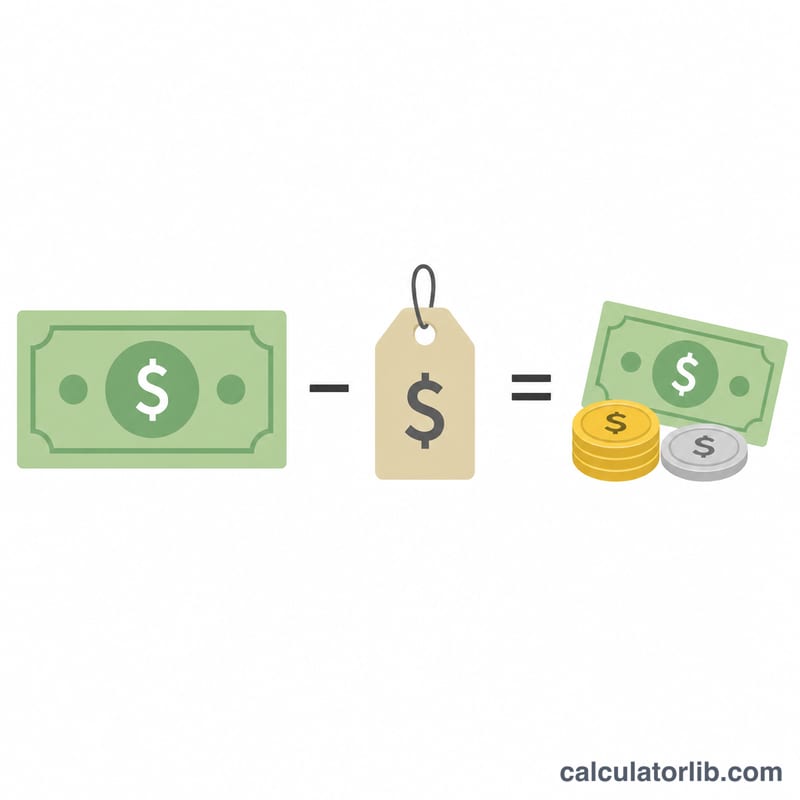
The math is simple subtraction:
$$\text{Change} = \text{Amount Paid} - \text{Amount Due}$$
For example, if a customer buys goods totalling $13.45 and pays with a $20 bill, the change is \(\$20.00 - \$13.45 = \$6.55\).
Worked Example
A coffee costs $4.75. The customer pays with a $10 note. $$\text{Change} = \$10.00 - \$4.75 = \$5.25$$ You would return one $5 bill and one quarter.
Change Owed Across Common Payment Scenarios
Change is a single subtraction: the amount handed over minus the amount owed. In symbols,
$$\text{Change} = \text{Paid} - \text{Due}$$The table below works the subtraction to two decimal places for five situations that come up constantly at a till, a market stall or a cash box. A positive result is money you hand back; zero means the payment was exact; a negative result means the payment fell short and the customer still owes the difference.
| Amount Due | Amount Paid | Change Owed | Notes |
|---|---|---|---|
| $13.45 | $20.00 | $6.55 | Typical single-bill payment; hand back one $5, one $1, two quarters and one nickel. |
| $4.75 | $5.00 | $0.25 | Small purchase settled with one bill — a single quarter clears it. |
| $27.60 | $30.00 | $2.40 | Two bills tendered; change is two $1 coins/notes, one quarter, one dime, one nickel. |
| $50.00 | $50.00 | $0.00 | Exact payment — no change is due in either direction. |
| $18.20 | $15.00 | -$3.20 | Underpayment: the result is negative, so the customer still owes $3.20. |
Two habits prevent most disputes. First, state the amount due and the amount received out loud before opening the drawer. Second, count the change back into the customer's hand rather than placing it down, so both parties follow the same arithmetic.
US Coin and Banknote Denominations
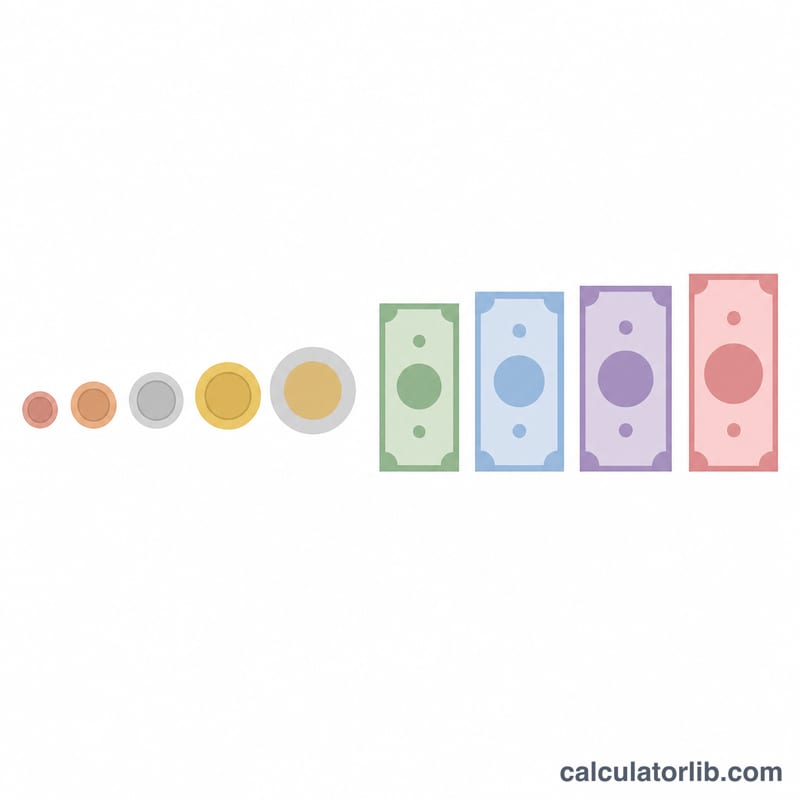
Once you know the change owed, you still have to build it out of physical pieces. The table lists the denominations currently in general circulation in the United States, each with its face value in dollars. (The half dollar and the $1 coin and $2 note are legal tender and produced, but are seen far less often in day-to-day change than the rest.)
| Denomination | Type | Value |
|---|---|---|
| Penny (cent) | Coin | $0.01 |
| Nickel | Coin | $0.05 |
| Dime | Coin | $0.10 |
| Quarter | Coin | $0.25 |
| Half dollar | Coin | $0.50 |
| Dollar coin | Coin | $1.00 |
| One dollar | Note | $1 |
| Two dollars | Note | $2 |
| Five dollars | Note | $5 |
| Ten dollars | Note | $10 |
| Twenty dollars | Note | $20 |
| Fifty dollars | Note | $50 |
| One hundred dollars | Note | $100 |
Why the greedy method works here. To break change into the fewest pieces, take the largest denomination that does not exceed the remaining amount, subtract it, and repeat until nothing is left. For this US set the greedy choice is always optimal — it provably returns the minimum number of coins and notes, so no cleverer combination exists. That is a property of the denominations themselves, not a general rule: in an invented system with, say, 1, 3 and 4 units, greedy would pay 6 as 4 + 1 + 1 (three pieces) when 3 + 3 (two pieces) is better.
Other currencies differ. The euro, for example, adds 1c, 2c and 20c coins and a €2 coin, and its lowest note is €5; the UK uses 1p, 2p, 5p, 10p, 20p, 50p, £1 and £2 coins. The subtraction that gives the change owed is identical everywhere — only the pieces you count out change. Some countries also round cash totals to the nearest 5 cents because the smallest coins have been withdrawn, which shifts the change owed on cash payments slightly.
How to Work Out Change by Hand
Follow the same six steps every time and the arithmetic stays reliable even when a queue is building. The worked figures below use a $13.45 purchase paid with a $20 note (US denominations).
- Total the amount due. Add every item, plus any tax or fee that applies, and fix the figure before touching the cash: $13.45.
- Note the amount paid. Say the tendered amount aloud and leave the note on the drawer edge until the change is counted: $20.00.
- Subtract due from paid. \(\text{Change} = \$20.00 - \$13.45 = \$6.55\). If the answer comes out negative, the customer has underpaid by that amount and owes the difference.
- Convert to cents. Working in whole cents removes decimal-point slips: $6.55 becomes 655 cents.
- Take the largest denomination that fits, repeatedly. 655 → take $5, leaving 155 → take $1, leaving 55 → take a quarter, leaving 30 → take a quarter, leaving 5 → take a nickel, leaving 0.
- State the result. The change is one $5, one $1, two quarters and one nickel — five pieces totalling $6.55. Check by adding back: 500 + 100 + 25 + 25 + 5 = 655 cents.
The counting-up alternative. Many cashiers never subtract at all. Start at the price and add denominations out loud until you reach the amount paid: “13.45 … 13.50 (nickel) … 14.00 (two quarters) … 15.00 (a dollar) … 20.00 (a five).” The pieces you named are exactly the change, and the final number matching the tendered amount is its own proof. This method is fast, self-checking and easy for the customer to follow, and it is what most cash-handling training teaches.
A second example. A $27.60 bill paid with a $20 and a $10: \(\$30.00 - \$27.60 = \$2.40\). In cents, 240 → $1 (140) → $1 (40) → quarter (15) → dime (5) → nickel (0), giving two dollars, a quarter, a dime and a nickel. Counting up reaches the same set: “27.60 … 27.65 … 27.75 … 28.00 … 29.00 … 30.00.”
Two small cautions. Round the amount due to whole cents before subtracting, since a stray third decimal place will not exist in coins. And if the drawer lacks a denomination the greedy method calls for, substitute smaller pieces of the same total value — the amount owed never changes, only the count of pieces.
FAQ
What if the change is negative? A negative result means the amount paid was less than the price, so the customer still owes that amount.
Does it handle cents? Yes — enter dollars and cents (e.g. 13.45) and the result is shown to two decimal places.
Can I use it for any currency? Absolutely. The math is identical for any currency; just read the dollar sign as your local symbol.