
What Is Percentage Change?
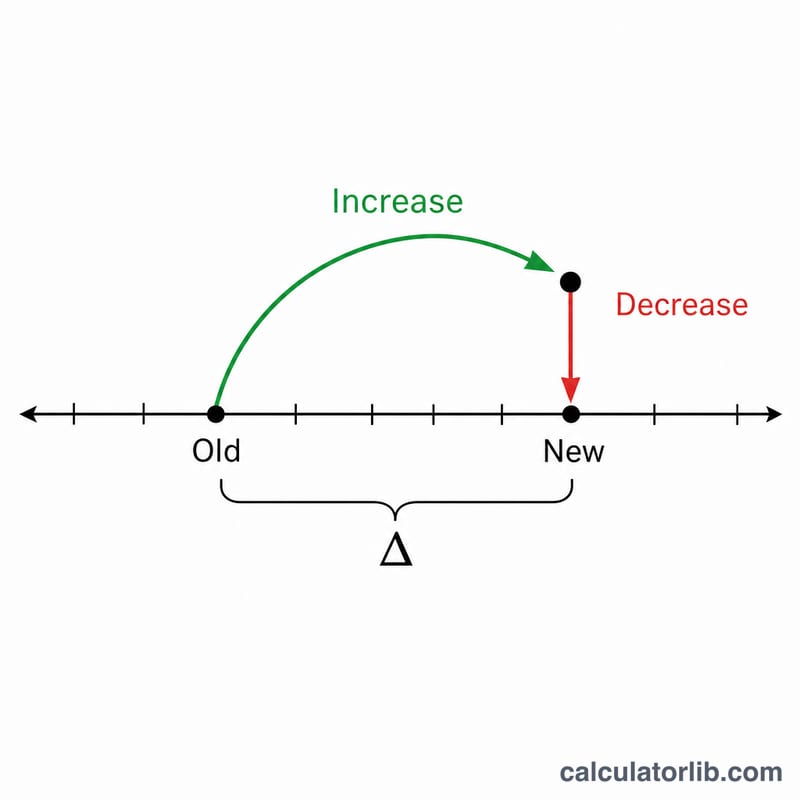
Percentage change measures how much a value has grown or shrunk relative to its original size, expressed as a percentage. It is one of the most widely used metrics in finance, statistics, science, and everyday life — from tracking stock returns and salary raises to comparing prices and population growth. Because it normalizes the raw difference against the starting value, percentage change lets you compare changes across quantities of very different magnitudes.
How to Use This Calculator
Enter the Old Value (the starting or original amount) and the New Value (the final or current amount). The calculator instantly returns the percentage change, the absolute difference between the two numbers, and whether the change represents an increase, a decrease, or no change at all.
The Formula Explained
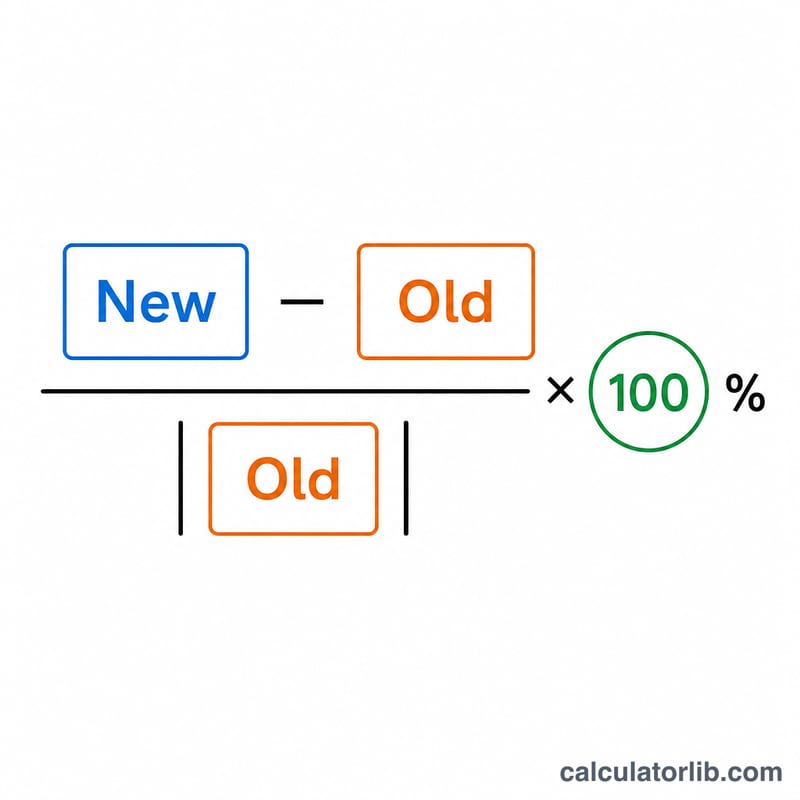
The percentage change is calculated as:
$$\text{Percent Change} = \frac{\text{New Value} - \text{Old Value}}{|\text{Old Value}|} \times 100$$
We subtract the old value from the new value to get the raw difference, divide by the absolute value of the old value to make it relative, and multiply by 100 to convert it to a percentage. Using the absolute value of the old value ensures the sign of the result correctly reflects the direction of change even when the original number is negative.
Worked Example
Suppose a product's price rose from $80 to $100. The difference is \(\$100 - \$80 = \$20\). Dividing by the old value gives \(20 / 80 = 0.25\), and multiplying by 100 yields a 25% increase. If the price had fallen from $100 to $80 instead, the change would be $$(80 - 100) / 100 \times 100 = -20\%,$$ a 20% decrease.
FAQ
What's the difference between percentage change and percentage difference? Percentage change has a clear "before" and "after," so it can be positive or negative. Percentage difference compares two values without a reference order and is always positive.
Why divide by the absolute value of the old value? Using the absolute value keeps the percentage's sign meaningful (positive for increases, negative for decreases) even when the starting value is negative.
What if the old value is zero? Percentage change is undefined when the old value is zero because you cannot divide by zero. This calculator returns 0% in that case to avoid an error.